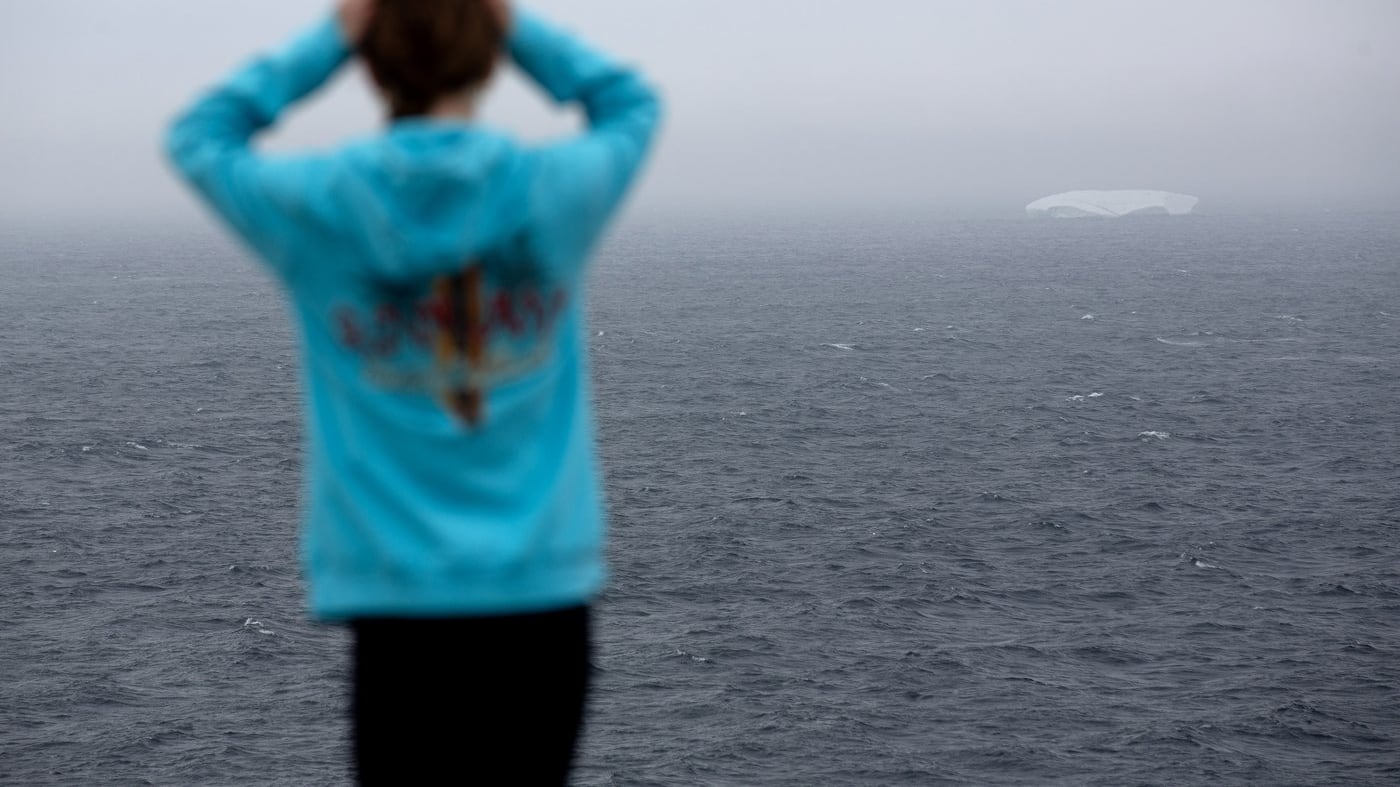
ST. JOHN’S — At the top of Signal Hill in St. John’s, N.L., on Tuesday afternoon, a steady stream of people walked around a rocky cliff and gasped.
Some cheered, some took out their phones to capture the moment — a rush of awe as an iceberg floated in the ocean below, cleaved off from a Greenland glacier and delivered by the Labrador current on a cloudless spring day.
It’s a banner year for icebergs in Newfoundland and Labrador, where tourists and residents alike are gathering on shores across the province to welcome the ancient visitors.
“It’s just joyous. It’s so beautiful. The colours are so intense and wonderful,” said Susan Davis, who was visiting the city from Baltimore.
“I’ve been to Alaska and I’ve seen the glaciers calving, but I’ve never seen this before.”
The spring parade of icebergs is mostly unique to Newfoundland and Labrador, and this year has seen almost twice the average number of bergs. As of Wednesday afternoon, satellite data showed nearly 520 icebergs off the east coast of Newfoundland and southern Labrador, said George Karaganis, a senior meteorologist with the Canadian Ice Service.
At this time last year there were about 426, he said. The average is about 274, according to data from 2002 to 2021.
Conditions for a good iceberg season span years, beginning in Greenland when glaciers more than 10,000 years old start calving. Those pieces can travel for three years before reaching Newfoundland and Labrador, pulled by the Labrador current past Baffin Island and through the Labrador Sea, Karaganis said. If spring winds then blow hard enough from the northeast, they’ll be pushed close to shore in Newfoundland and Labrador where people can see them.
This year, conditions aligned. But experts say the number of icebergs are expected to decline as the climate changes. Sea ice protects icebergs from melting before they reach Newfoundland and Labrador, and sea ice concentrations are expected to decline amid warming waters, said Pradeep Bobby, who leads the Earth observation team at C-CORE, an engineering and research organization in St. John’s.
Pat Bridger woke up Tuesday morning to find an iceberg bobbing in the water outside her sewing room window in Twillingate, N.L. On Wednesday morning, there were two.
Twillingate has a thriving iceberg tourism season, billing itself as the iceberg capital of the world. Bridger is used to seeing them. But they’re still special, and she rushed out to capture photos from all angles, hoping for glints of gold and silver in the sun.
She loves being among the crowds of onlookers, even if they’re right outside her door.
“You’ll see all these people, and they’re so excited, especially the people that haven’t seen one before,” Bridger said in an interview. “They’re so chatty and I just absolutely love it.”
On Wednesday afternoon, St. John’s-based photographer Alick Tsui was beaming as he spoke to The Canadian Press via video from the trails around Signal Hill. He was keeping an eye on an eagle’s nest where an egg was ready to hatch, while watching two icebergs just off the coast.
The day before, he had hopped on a tour boat to see one of the bergs up close.
“You can see the colour, sometimes it’s blue, sometimes it’s green. You cannot see it on land,” he said. “Sometimes you see the sparkles from the sun … you can see a bit of a rainbow colour, when the water hits the ice.”
Even the inside of an iceberg is unique, said Davis. She had also been on a tour boat and her guide handed out iceberg chunks he’d scooped up from the water.
Davis took a bite of hers. It was much harder than she expected, she said. Inside were delicate ice crystals, completely unlike the solid surface of a broken ice cube.
“It was 15,000 years old,” she said. “That’s amazing, it’s incredible. I was eating a piece of ice that was 15,000 years old!”
This report by The Canadian Press was first published May 8, 2026.
Sarah Smellie, The Canadian Press

