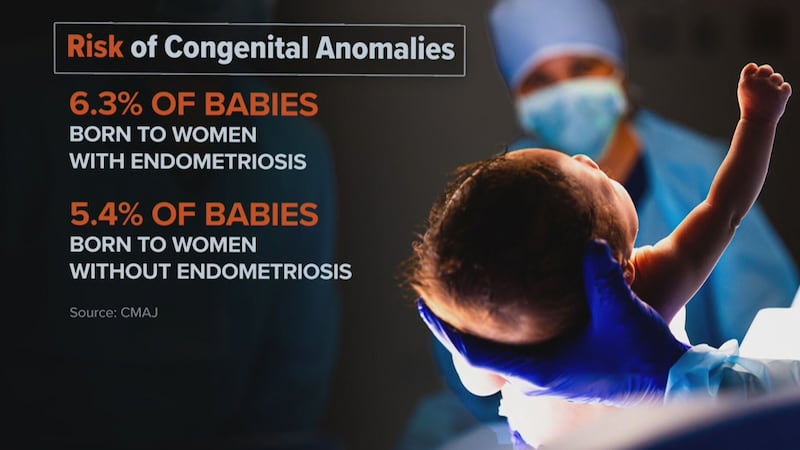
MONTREAL – Endometriosis has impacted several facets of Kristina Kasparian’s life, and she says a new study that found a link between the disease, and a slightly higher risk of birth defects highlights a desperate need for better awareness and treatment.
“I am sure it makes a lot of women feel nervous, because we don’t have that much prenatal follow up,” says Kasparian. “Even in fertility treatments, we feel like a lot of us are not counseled from an endometriosis perspective.”
One in 10 women across Canada lives with endometriosis. But Kasparian, an author and health activist, says the medical system often fails to recognize and treat the disease quickly enough. Improving health outcomes could have an impact on women’s health, but as the latest study underlines, it could also potentially improve outcomes for babies.
Dr. Nicholas Leyland is the president-elect of the Society of Obstetricians and Gynecologists of Canada. He says the study, published Monday in the Canadian Medical Association Journal, has limitations but does point to the need for more funding to study endometriosis, and more generally, women’s health.
- READ MORE: ‘A very unique observation’: Study links endometriosis to slightly higher birth-defect risk
“We need to understand that this isn’t just a bad period,” said Leyland. “This is a significant illness that can impact the quality of a woman’s life, as well as issues around fertility. We need to do better in terms of the medical profession understanding and not normalizing the symptoms and getting the diagnosis much earlier.”
Endometriosis is a chronic inflammation where tissue similar to the endometrium, or the lining of the uterus, grows outside the uterus and implants on other structures. In some cases, it causes debilitating pain during menstruation, intercourse or with bowel movements. It also impacts fertility.
“A large part of my career has been around managing endometriosis and developing strategies to try to get an earlier diagnosis, earlier treatment, and recognition by patients, their families, school nurses, and primary care providers,” said Leyland.
“This is a disease that needs to be picked up early to prevent some of the fertility issues and certainly the chronicity of pain, which can be problematic for many women throughout their life.”
Kasparian, who is now 41, says she began to experience symptoms at an early age.
“Through my teens, I really suffered with missing school, then missing work, and I struggled with a lot of self-esteem issues because I felt like I couldn’t really talk about this,” she said.
After years of medical appointments for a wide range of symptoms, she was diagnosed in 2016.
“A delayed diagnosis wreaked havoc on my nervous system, my immune system, my fertility, my career, on everything,” she said. “After five surgeries, I still have scar tissue.”
Endometriosis has also had a significant impact on her fertility. Over the course of her journey, an IVF treatment ended in a failed pregnancy. She says she was concerned about what the impact could be on a baby and whether birth defects were a possibility.
“I was worried about pain with the pregnancy, I was worried about what estrogen would do in terms of triggering inflammation,” she said. “I was mostly worried that the pregnancy would fail or that the fetus would not develop normally. And I couldn’t get any straight answers because everything was so routine and fast. You saw the doctor for five minutes, in and out like toast, you know?”
Kasparian says she wants care for endometriosis to be a specialty of its own, and for the medical system to set up a multi-disciplinary approach to diagnosis and treatment.
She stressed the need for more in-depth studies into links between endometriosis and congenital anomalies, but also on the need to look at the disease as a women’s health issue.

