Three young great horned owls are now in the care of a Saskatoon wildlife rehabilitation facility after the birds’ parents were found dead nearby.
“They arrived pretty dehydrated, and starting to get thin and pretty hungry. I think it had been a while,” Jan Shadick, executive director of Living Sky Wildlife Rehabilitation, said.
Shadick added that finding this many owlets at once is not very common. She shared that it is a lot of work for owl parents to feed one or two extra mouths, which makes it even more extraordinary that all three of these owls made it.
“These little guys needed a little bit of extra TLC at the beginning. They’re doing really well generally at the moment. They’re taking food from us. They get their full mice so that they get all that calcium and all the nutrients,” Shadick said.
After a resident near the village of Coleville found that the adult owls in the area had died, likely due to hitting a power line, the Wildlife Rescue Society of Saskatchewan was called in to assist in retrieving the owlets and handing them over to the rehabilitation facility.
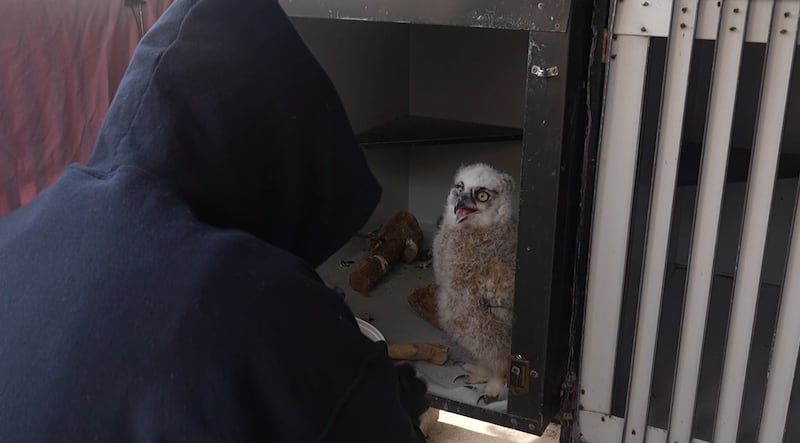
“The rehabilitation process is always to do kind of a full assessment when they come in and see what their needs are, because sometimes they need medication, sometimes they need wound management, and sometimes they just need time and the nurturance to be able to get them back into the wild,” Shadick said.
While the owlets came into Living Sky Wildlife Rehabilitation in concerning condition, they quickly began to spread their wings. One of the main priorities of the rehabilitation facility is ensuring that the birds can one day return to the wild.
“You probably wouldn’t want a great horned owl landing on your shoulder. So it’s really important that they stay wild. It’s also really important, before we release them, that we know that they have the skills they’re going to need to be able to survive in the wild,” Shadick said.
One of the measures taken by Living Sky Wildlife Rehabilitation is to disguise the human features of the person feeding the owls with many layers and an owl mask, to ensure the birds don’t associate humans with food.
“We don’t want them approaching people. We want to make sure that they know that food does not come from people,” Alyssa Daku, a wildlife rehabilitator, said.
In some cases, young birds can be placed in the nest of a different parent, which could then ‘foster’ the young bird as its own.
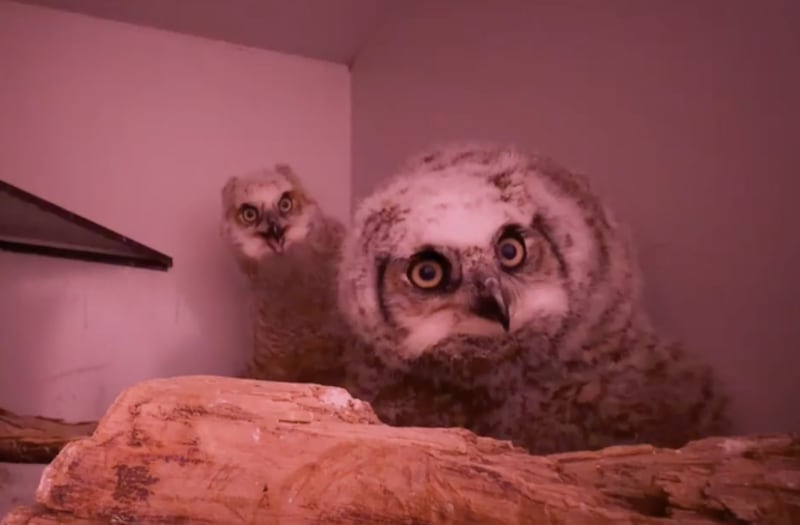
Daku said there’s a long list of requirements for the birds to meet before they are able to be released completely on their own.
“We make sure that they can hunt, they know what food is. And then generally, we do keep them for that first winter. That first winter is really difficult. We don’t generally like sending them out and just kind of hoping for the best. We like to give them the best chance, which means their next spring, they’ll be free to go,” Daku said.
While the process of rehabilitating an animal requires countless hours, the staff at Living Sky Wildlife Rehabilitation expressed that it is well worth it.
“If someone shows compassion for an animal and we can nurture that, then chances are they’ll go on to show that compassion for another human being. So, we are working with that kind of compassion component, having that option to help something is wonderful,” Daku said.
Daku added that oftentimes, those who find the animals who end up at Living Sky will stay in touch with the organization or volunteer their time to watch the progress of the animal.
“It really nurtures that human need to help, and we’re really, really excited and glad that we can offer that opportunity to people,” Daku said.

