


OTTAWA — Prime Minister Mark Carney says Canada is the “best place” for Alberta as a referendum on separatism is now in question.
“As someone who was raised in Alberta, (a) proud Albertan, I view that very much the best place for Alberta is in Canada, and certainly of Canada that works, which is what we’re pursuing,” Carney said while speaking to reporters in Ottawa on Thursday.
“My role and the role of federal government is, and we’re pursuing this, is to practice co-operative federalism, to work with the provinces, work with the territories, work with Indigenous Canadians and get things done on behalf of all Canadians,” Carney added.
The prime minister’s comments come after a judge threw out an Alberta separatist petition Wednesday, ruling the province had a duty to consult with First Nations.
Alberta Premier Danielle Smith says she will appeal the ruling.
“This is a decision by one judge,” Smith said on Wednesday. “We think that this decision is incorrect in law and anti-democratic, and we will be appealing it as a result.”
Lawyers for several First Nations argued last month that Alberta’s referendum process and its use by separatists is unconstitutional, as there’s no requirement for Indigenous consultation. They also said separation would violate treaty rights.
Speaking to reporters, Carney said while he supports the right to hold a referendum on separation as part of a democracy, it must also “be consistent with the Clarity Act.” The act was established in 2000 and outlines the conditions under which the federal government will negotiate the secession of a province.
Alberta is set to have a referendum on Oct. 19 to address questions on immigration and constitutional changes, and a question on separation is now up in the air.
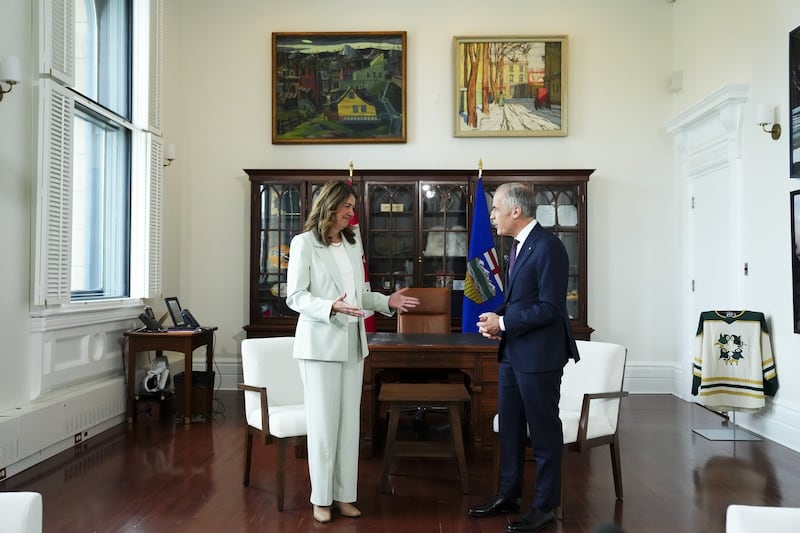
Canada, Alberta ‘will advance’ a potential crude oil pipeline Friday: Carney
Carney also confirmed Thursday that the federal government and Alberta will announce an agreement on industrial carbon pricing on Friday, which is a critical piece of the puzzle in their memorandum of understanding (MOU) to get a pipeline to the West Coast built.
Sources have confirmed to CTV News that both sides are working around the idea of setting the $130/tonne price by 2040, as opposed to 2030.
An agreement on the industrial carbon price is essential before negotiations on a carbon capture project in the oil sands called The Pathways Project can move ahead. As part of the MOU, Pathways must move ahead as a precondition before an oil pipeline can be approved.
Carney emphasized that requirement on Thursday.
“No Pathways, no pipelines. All those elements moving forward, but we’re making progress,” Carney said.
A private sector proponent for a pipeline, which has yet to come forward, is also required.
Smith has continued to say to her government is preparing to submit a proposal for a new pipeline from Alberta to B.C.’s West Coast to the Major Projects Office in June.
Announcements have already been made on some elements of the MOU, including an agreement to streamline environmental impact assessments and a commitment by Alberta to cut methane emissions by 75 per cent from 2014 levels by 2035.
With files from CTV News’ Spencer Van Dyk, CTV News’ Annie Bergeron-Oliver, CTV News’ Rachel Aiello and The Canadian Press

