One month after NASA’s Artemis II crew completed its historic mission around the moon, members of the team are acknowledging a 21st century space race between the United States and China, saying “it does” matter who gets to the moon first.
Back in April, the Artemis II crew successfully completed a 10-day mission to fly around the moon, marking NASA’s first crewed lunar flyby in 50 years. The mission also carried astronauts farther from Earth than any humans before them.
The crew included Canadian astronaut and mission specialist Jeremy Hansen, and American astronauts: commander Reid Wiseman, pilot Victor Glover and mission specialist Christina Koch.
Speaking to CTV Question Period host Vassy Kapelos in an interview airing Sunday, Koch said there is “absolutely” a race between the two countries for benefits.
“I think that the benefits that we get from going to the moon are apparent to many, many countries,” Koch said. “And that’s why the question that I think our countries face isn’t to go or not to go, but should we lead or should we follow?”
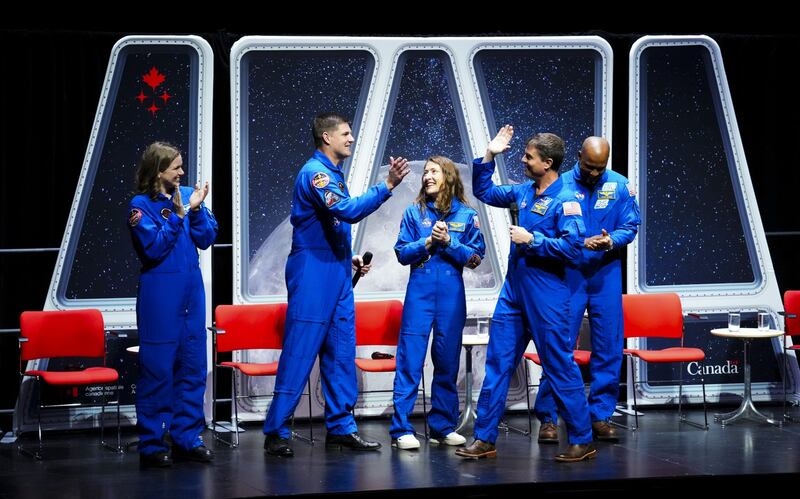
Asked by Kapelos if it matters who gets to the moon first, Koch said, “I would say it does.”
“Oftentimes, the people that pursue something great first, they get to set the standards. They get to pave the way. They get to set the rules,” Koch added.
First established in 2017, NASA’s Artemis program has experienced delays, but plans continue for its first crewed lunar landing by 2028. The program has a broader goal of establishing a long-term presence on the moon, and ultimately, future missions to Mars.
China, meanwhile, is aiming to land its first astronauts on the moon by 2030. China has gone to the moon multiple times, but exclusively with uncrewed spacecraft.
When asked if the U.S. and China are in a space race, Glover said he agreed with Koch’s assessment and pointed to the NASA-led Artemis Accords – a non-binding set of international principles designed to guide civil space exploration. Currently, more than 60 countries have signed the accords, including Canada.
“I say this a lot. If you want to go fast, go alone. If you want to go far, go together,” Glover said. “We’re willing to do this as a coalition and that’s harder because you got to get everybody to agree and to buy in.”
Will Canada and the U.S. continue to collaborate in space?
One of Canada’s most notable contributions to space exploration is the creation of the Canadarm.
The Canadarm is a robotic arm that made its debut in 1981 – first launched aboard Space Shuttle Columbia – and was used to support U.S. space missions for three decades. In total, five Canadarms were built and delivered to NASA with the program ending in 2011.
The Canadian Space Agency, meanwhile, had been recently working to provide hardware – including a $1-billion-plus AI-enabled robotic arm – for NASA’s orbiting space station around the moon, known as Gateway. But in March, NASA announced it’s pivoting away from the plan, leaving Canada’s contribution to the lunar program up in the air.
Asked by Kapelos whether that decision threatens collaboration between the two countries, Hansen said, “it doesn’t” and insisted NASA is looking for “partners who bring real value.”
“This is all opportunity, but it’s not going to fall in our lap. We have to be very intentional,” Hansen said.
“Good news Canada, (we) got a lot of value to give. We just really have to make some decisions,” Hansen added. “There’s some short-term decisions and some long-term strategy that we need to just look at, make some decisions and get after it. I have no fear.”
The moment comes amid strained relations between Canada and the U.S. in large part due to trade tensions.
When asked about having a Canadian represented on the Artemis mission, Wiseman said it was the “utmost importance” to have Hansen as part of the team.
“We could have gone alone as the United States of America, but we made room for others to share their gifts,” Wiseman said.
Wiseman also highlighted how Canada will be needed in the space race.
“We need the brilliance of this nation to come forward and help us build a sustainable presence on the moon. We are in a race, and we aren’t going for a one off. We are going because this is the next step in human civilization, and we are going to do that together,” Wiseman said.
You can watch the Artemis II crew’s full interview on CTV Question Period Sunday at 11 a.m. ET.

