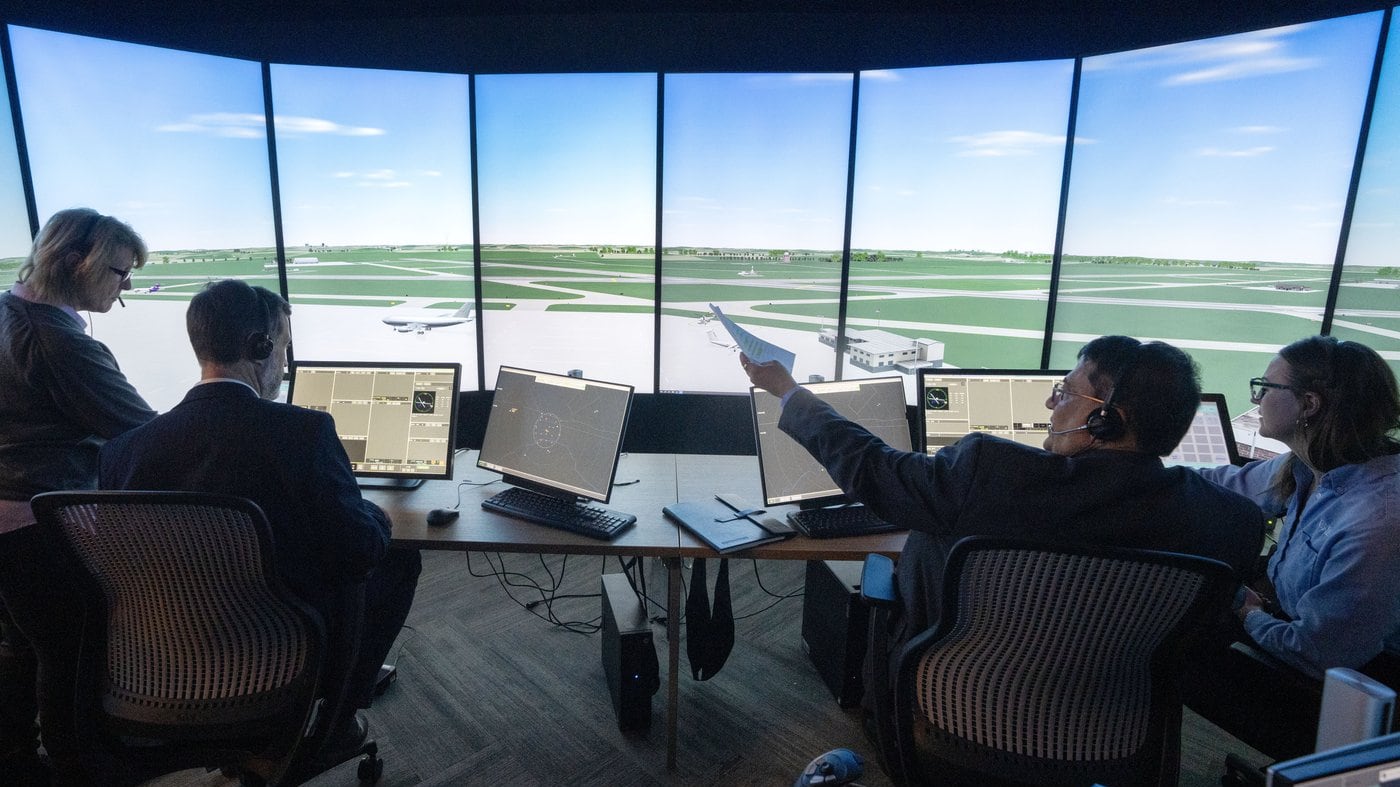
Nav Canada’s head of operations says the country continues to face a dearth of air traffic controllers as the busy summer travel season kicks off, but that the organization has put a raft of measures in place to plug the holes.
With more than 2,100 controllers on staff, the non-profit body that runs Canada’s civil air navigation system remains about 200 short of target levels — a figure unchanged from a couple of months ago — said Marie-Pier Berman.
“The good news is that that gap is closing,” she said in a press briefing Tuesday.
Nav Canada has licensed more than 300 controllers since 2023 and counts more than 500 students in training, she said. Its current head count sits higher than at any point since the COVID-19 pandemic.
Nonetheless, the outfit has had to get resourceful.
Travel volumes are set to rise by several percentage points this summer versus last, Berman said, despite pricier airfares and flight schedule trims among Canadian carriers due to soaring jet fuel prices caused by the Iran war.
With the World Cup and other international events around the corner, Nav Canada has rehired more than 50 retired controllers on contract. It launched an incentive program for workers who take on “high-demand shifts,” Berman said. And it instituted blackout periods on the use of accumulated time off during peak traffic periods.
“Safety will never be compromised,” she said.
“But let me be direct about one thing: no responsible organization can guarantee that there will be zero disruptions over the course of a summer.”
Those holdups derive from myriad factors in the complex chain of global aviation systems, including demand surges, weather issues, airport upgrades and worker strikes.
However, Vancouver is one airport that has seen periodic delays that can be traced directly to staffing shortfalls at Nav Canada.
More than 200 flights were delayed and 23 cancelled at the country’s second-largest airport over the Canada Day long weekend in 2025, “with no end in sight to the staffing problems,” the British Columbia Aviation Council said last July. In late August, another 100 flights were cancelled and 195 delayed due to “staffing constraints” at Nav Canada, the airport said.
“We are definitely making progress,” Berman countered on Tuesday.
Nav Canada developed a new flight simulator specifically for the Vancouver control tower — part of a $40-million simulator modernization program launched this year — and started recruiting experienced controllers from abroad to staff it as well as towers in Kelowna, B.C., Winnipeg, and downtown Toronto.
“But definitely wanted to be candid that Vancouver requires continued attention,” she said.
The broader labour shortage, which has been ongoing for a few years, is not particular to Canada.
The United States and Europe face proportionally larger gaps, according to figures from the U.S. Federal Aviation Administration and Eurocontrol, an agency that manages air traffic across the Continent.
Nav Canada took some steps to fill seats in control towers and its windowless “area control centres” several years ago. In 2024, it inked a partnership with flight simulator maker CAE Inc. to churn out hundreds more controllers through 2028, adding to the alumni coming from the organization’s seven flight schools.
The process to become an air traffic controller is among the longest in aviation, topped only by pilots and a few other specialized jobs. The role demands between 18 and 30 months of training. Parental leave or a move to a new airport often means months of retraining.
At 26 per cent, last year saw the strongest net growth of staff since before the pandemic, according to Nav Canada.
Nonetheless, the number of safety incidents on Canadian runways reached new highs in recent years even as the tally of extremely close calls levelled off, according to the Transportation Safety Board of Canada.
Board data shows that so-called runway incursions — when a plane, vehicle or person winds up on or near a runway when they shouldn’t be — hit a record 639 in 2024, the latest full year for which the watchdog has statistics.
However, the number of incidents categorized as high-risk — when there is “significant potential for collision,” according to Nav Canada — has fallen to an average of about one per year since 2018. The figures ranged higher in the preceding decade.
In April, safety board chairman Yoan Marier told The Canadian Press the upward trajectory of runway incidents overall was still “concerning,” and stemmed partly from a shortage of air traffic controllers, growing plane traffic and increasingly complex ground operations at large airports.
---
Christopher Reynolds, The Canadian Press
This report by The Canadian Press was first published May 19, 2026.

