


The Snowbirds are entering a final chapter.
After more than five decades in the skies, the federal government says the Canadian Forces’ iconic aerobatic team will fly its last season with the aircraft that made it famous.
Defence Minister David McGuinty officially made the announcement Tuesday at Canadian Forces Base Moose Jaw that Canada will retire and replace the Snowbirds’ long-serving CT-114 Tutor jets, marking a turning point for one of the country’s most recognizable symbols.
In a statement, the Department of National Defence (DND) says it plans to replace the Royal Canadian Air Force (RCAF) fleet with a new aircraft, the CT-157 Siskin II, under a modernization effort not expected to be complete until the early 2030s.
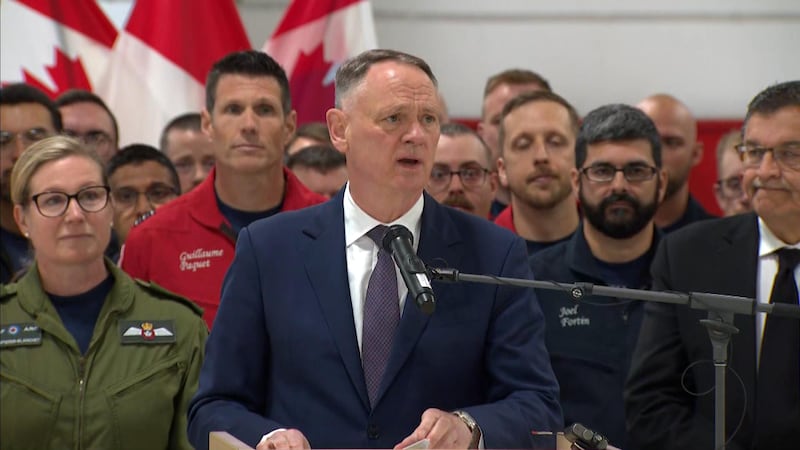
“This will ensure that Canada continues its strong tradition of air demonstration capability with a modern fleet that will ultimately rebuild to the team’s distinctive nine-plane formation,” the statement reads.
As CTV News first reported in early May, the 2026 airshow season will be the last for the Tutors after more than 60 years in service.
Speaking to reporters in Moose Jaw, Sask. on Tuesday, McGuinty would not commit to a specific date for when the Snowbirds will return to the skies.
“We’re moving as quickly as we can. That’s our plan,” McGuinty said, adding that “negotiations are underway with the manufacturer.”
McGuinty also said there will be more details to come on how many new CT-157 Siskin II planes will be purchased for the Snowbirds.
Earlier this month, while speaking in the House of Commons, McGuinty suggested safety concerns are driving the planned changes.
Asked directly if safety is the reason behind the procurement decision, McGuinty would not say but said it came “on the recommendation of the Air Force.” He also said the current fleet “is well positioned to serve for another season.”
In 2021, the government under former prime minister Justin Trudeau committed $30 million to extend their lifespan through upgrades intended to keep them flying until 2030.
Lt. Gen. Jamie Speiser-Blanchet, who is the Commander of Royal Canadian Air Force, told reporters that while 11 of the Tutor jets have received cockpit upgrades, feasibility studies showed “engineering challenges because of the age of the aircraft.”
“This is why (the current Snowbirds fleet) will be retiring in 2027 instead of 2030,” Speiser-Blanchet added.
Prime Minister Mark Carney, meanwhile, said his government inherited the decision.
“I, like many Canadians, have enjoyed the demonstrations of the Snowbirds over the years — absolutely extraordinary, and a source of pride,” Carney said while speaking to reporters in Saint-Michel-des-Saints, Que. “I inherited a situation where the planes literally had come to the end of their lives.”

‘Profoundly disappointing’
In a press conference in Moose Jaw on Tuesday, the Snowbirds Alumni Association called the decision “profoundly disappointing” for “millions of Canadians from coast to coast.”
“While the association acknowledges the government’s commitment to equip the Snowbirds with a new aircraft platform in the future, concerns remain regarding the loss of operational expertise and the prolonged interruption of one of Canada’s most important military outreach programs during the transition period,” Dan Dempsey, a former Canadian Armed Forces pilot and commanding officer of the Snowbirds, said.
Dempsey added that the association would have preferred to see the Tutor jets continue “a little longer” for a “transitional period.”
Moose Jaw Mayor James Murdock said he is also worried about leaving a training gap for pilots.
“These are very qualified, trained professionals that do their job very, very well, so they got to keep being honed in on that,” Murdock said in an interview with CTV News. “They say that there will be opportunities for the squadron to continue on, but I would like to see that there are ways that they can remain as sharp as possible.”
‘We need that national pride’
On Tuesday, McGuinty insisted the plan is to keep the Snowbirds in Moose Jaw.
“The plan is to continue to call the fleet the Snowbirds, and the plan is…to keep the fleet here in Moose Jaw, where we believe the fleet belongs,” the defence minister said.
Before learning about DND’s decision, former Snowbird pilots and aviation supporters in Moose Jaw, were hoping for the best while also preparing for the end of an era.
“We’re not shy on national symbols here in Canada, but we need that national pride,” Roger Blager, president of the Moose Jaw Flying Club, said. “And I think the Snowbirds are probably the symbol of that, and we are proud of them in Moose Jaw.”
For generations of Canadians, the red-and-white jets have been synonymous with summer skies and national pride. Since 1971, the Snowbirds have dazzled crowds with their signature nine-plane formation — a defining image of Canadian aviation.
Now, that era is ending with the focus shifting to a farewell tour — a final chance for Canadians to see the aircraft that have defined the Snowbirds for more than half a century. A final performance with the Tutor jets is scheduled for October in Sacramento, Calif.
At Hopkins Dining Parlour, a popular Snowbirds gathering spot in Moose Jaw, staff were already reflecting on the team’s impact on the community.
“I know a lot of people who live in Moose Jaw and in the surrounding area who will stop what they’re doing to watch a flyby,” Bonnie Johnson, a former staff member at Hopkins, said. “It gives a lot of people goosebumps. I’ve seen people stop on the street and clap.”
In Moose Jaw, there is unapologetic ownership of the Snowbirds who are often referred to as the “Moose Jaw Snowbirds.”
“They’re the heart and soul of Moose Jaw — very important. It’s not just national pride. We are extremely proud of them,” Blager said.
Saskatchewan Conservative MP and former mayor of Moose Jaw Fraser Tolmie warned of the grounding ahead of Tuesday’s announcement and criticized the federal government’s approach, saying there are “alternatives” like flying a modified show.
“This is an iconic team. This is the time that we need to be flying this team now more than ever. It’s part of our national identity, and this is not the time to sacrifice something like that,” Tolmie said.
With files from CTV News’ Stephanie Ha

