Lu Fan is a 2025 Sachedina / CTV News fellow. This is part two of a two-part series on the graphite mine in Saint-Michel-des-Saints, Que. Find part one here.
SAINT-MICHEL-DES-SAINTS, Que. - It’s been more than a decade since geologist Antoine Cloutier made the discovery of his career. It happened in Saint-Michel-des-Saints, Que., and as he tells the story, his eyes still gleam with excitement.
“In 2014, we went to the field. (We) shovelled the ground and checked what the bedrock was. Our metal detectors were beeping through a fairly large area,” said Cloutier, the lead geologist for Nouveau Monde Graphite. “I called my boss and said I think we found something here. I’m going to need a bigger budget.”
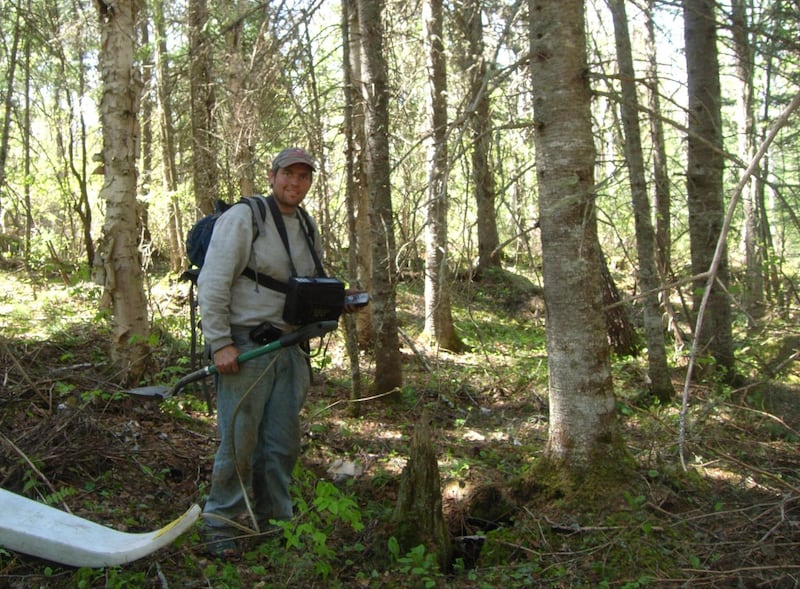
What Cloutier found was a major graphite deposit. “From that point on,” he said with an easy smile, “it became our main focus of continuous exploration work.”
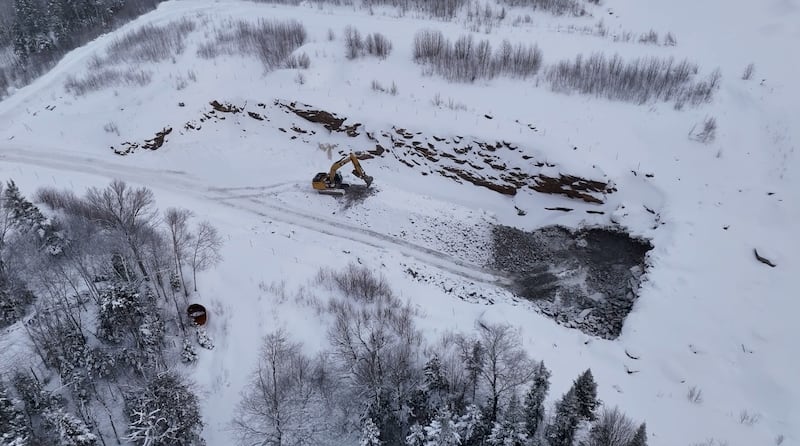
After years of drilling and gathering information, the company proposed an open pit mine — Matawinie Graphite Mine. “The pit measures about three kilometres long by 400 metres wide at a maximum depth of 185 metres,” said Cloutier. It would have a 25-year mine life.
Graphite, a mineral essential for electric vehicle batteries, is one of six critical minerals the federal government considers a priority for investment and development.
In November, Prime Minister Mark Carney announced his second tranche of nation-building plans which included the Matawinie Mine.
Matawinie’s graphite deposits are just a five-minute drive from the village centre. The property covers about 9,200 hectares, about 80 per cent of the size of Vancouver. It lies within the Canadian Shield, one of the oldest geological formations on Earth.
Eric Desaulniers, the company’s founder and CEO, says in 2014, he saw Elon Musk’s early investments in large-scale EV production as a sign that the time was right to get into this business.
“Everybody wanted to sell graphite to the Gigafactory in Nevada. That’s why I started the company,” said Desaulniers. Global electric vehicle sales skyrocketed not long after: statistics from the International Energy Agency show that in the decade that followed sales rose from a few hundred thousand vehicles to around 17 million.
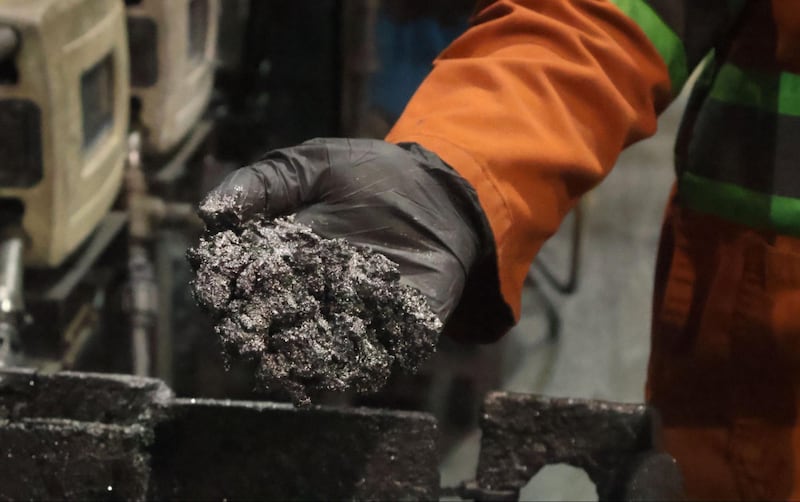
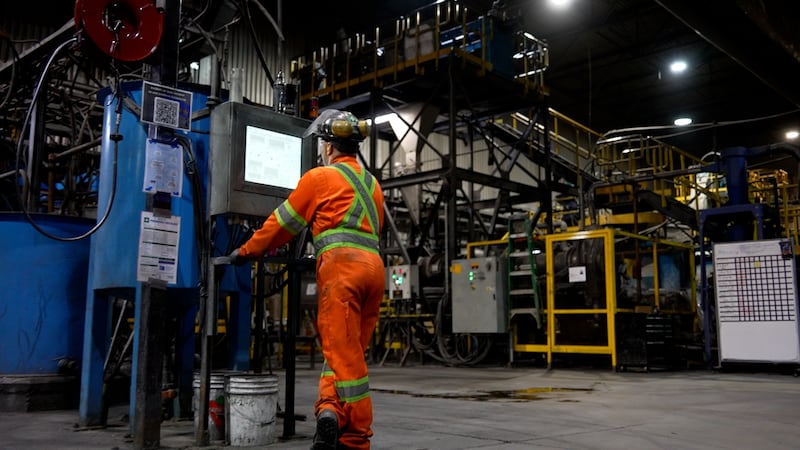
In 2018, Nouveau Monde leased part of a long-shuttered wood panel mill in the village and built a demonstration plant to produce battery material samples.
In this electric vehicle competition, China controls the supply chain. It refines over 90 per cent of the battery-grade graphite in the world. The U.S. has vowed to break China’s grip by digging deeper at home and sourcing minerals from around the world.
In 2020, Desaulniers received a long-awaited email from Panasonic Energy, which produces batteries for Tesla: “We see you as a potential supplier of graphite in North America and we would like to receive a sample.”
He says customers are looking for an alternative.
“(Companies such as Panasonic Energy) are a bit stuck in the geopolitics between the U.S. and China,” Desaulniers said.
Nouveau Monde Graphite has been growing because of the rising electric vehicle market and the trade conflicts between China and the U.S. It is listed on the Toronto and New York stock exchanges and has attracted international investors.
As the project advances, Desaulniers believes the Matawinie Mine could become “the largest graphite mine in the G7.”
Challenges ahead
Disappointing demand for EV sales last year in North America, partially from the end of tax credits and subsidies, prompted some of Nouveau Monde Graphite’s customers to reassess their plans. Panasonic Energy reduced its orders for battery materials from Nouveau Monde by almost one third, while General Motors, which had a deal with the company, is not listed as a buyer anymore.
The federal government has stepped in to help, agreeing to purchase graphite concentrate from the company at a guaranteed minimum price.
Desaulniers believes that will do a lot to ease investors’ worries. “That’s the most important thing to do with western critical minerals projects — to comfort (investors),” he said.
He thinks the military application of critical minerals is also why governments are pushing for resilient critical mineral supply chains. Desaulniers says the company is ready to work with large defence contractors on stealth materials, batteries, and foil for thermal management.
Competition in the industry is fierce and not only from China. Andrew Stewart is the U.S. Geological Survey’s mineral commodity specialist in graphite and nickel. “Though the U.S. is not currently mining graphite,” he said in an email, “there are five graphite mining projects moving forward: two in Alabama, one in Alaska, one in Montana and one in New York.”
Another challenge in the industry comes from synthetic graphite. Graphite can be mined from rocks; it can also be manufactured from oil refinery byproducts.
Synthetic graphite has better purity and batch-to-batch consistency. It has always been more expensive. But in recent years, for some applications, synthetic graphite prices have dipped below natural graphite and some experts see more of the market shifting in that direction.
Debate over public funding for critical minerals
At the Metro Toronto Convention Centre in March, over 30,000 people from the world’s mining industry attended a mining convention. People exchanged business cards and spoke about projects often located in remote corners of the world.
Nouveau Monde Graphite had a booth among the more than 1,300 exhibitors. Visitors stopped by to ask questions. Antoine Cloutier, the company’s geologist, said that construction of the mine could be in the spring.
The company has recently raised over US$600 million through loans and equity investments. Its news release shows US$335 million in loans are provided by two federal Crown corporations (Export Development Canada and Canada Infrastructure Bank). US$309.5 million in equity investments come from the Canada Growth Fund, part of another Crown corporation, Investment Quebec, the Italian energy company Eni and an equity public offering.
Eni is also a potential customer for Nouveau Monde Graphite. It says graphite from Canada could support its energy storage battery manufacturing initiative in southern Italy.
At a panel discussion about mining finance, some raised concerns about governments using public dollars to help fund critical mineral projects in general.
“When I look at governments putting hard dollars into properties, I get a little afraid,” Nawojka Wachowiak, a portfolio manager specializing in the metals and mining sector, told the audience. “I’m wondering whether they are picking the best of the best.” Wachowiak argues that tax incentives from the government would be a better option.
Another panelist, Ilan Bahar, a global metals and mining investment banker at the Bank of Montreal, was more supportive of government involvement. “If you … allow economic balances across the world to determine what projects get invested in, you’ll never invest in North America,” he said. “Projects here won’t get built. They just won’t.”
At the village of Saint-Michel-des-Saints, construction of the Matawinie Graphite Mine has begun. Cloutier, who first discovered the graphite, is excited to get started. “It’s truly a unique opportunity from… a discovery where you’re in a fully wooded area and you find something that might present some potential, right up to having companies from all over the world looking for the product that you’ve found,” he said. “It’s the dream of every exploration geologist, working towards a full-fledged mining operation.”

