Some may say there’s nothing like a dramatic gender reveal - monochromatic fireworks, exploding balloons and demolished cakes.
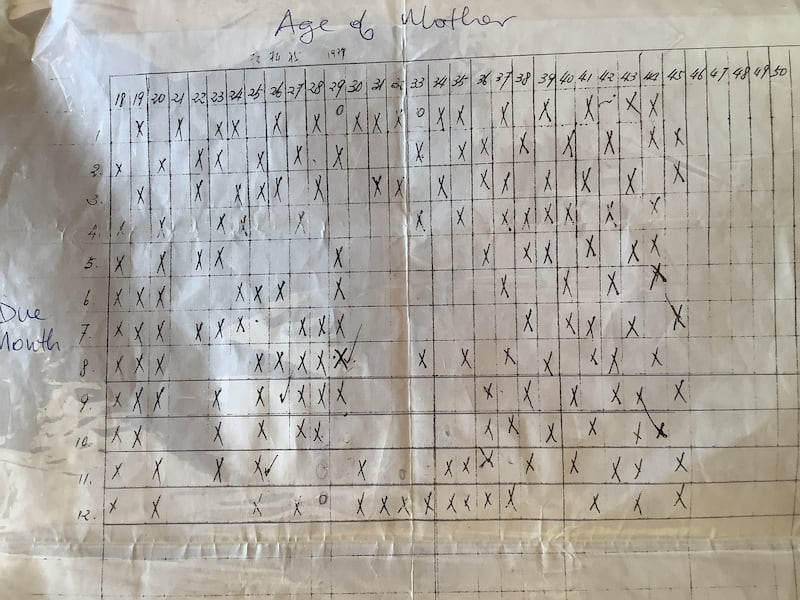
But far from the modern-day blue-and-pink festivities, ancient Chinese astrologers, long revered for their apparent accuracy and knowledge, were predicting a child’s sex before their birth.
How? Simply put, by comparing a mother’s age to a baby’s due date.
More complicatedly, Dr. Sonia Tan, a traditional Chinese medicine (TCM) practitioner and astrologist, explains that ancient Chinese divination dates back to the Neolithic period, long before China’s first dynasty.
It all starts, she says, with the I Ching - one of the oldest classic Chinese texts.
“There’s a circular arrangement to it,” said Tan. “There are two circular arrangements to it. There’s one that’s called Fú Xī Bā Guà (伏羲八卦), pre-heaven arrangement, and then we have Wén Wáng Bā Guà (文王八卦), which is post-heaven.”
She abbreviates the very complicated philosophy to the way seasons flow through the universe.
“It goes through a spring season, which is aligned with wood, and it goes through a fire season, which is summer,” she simplifies. “It’s a way to understand the cycles of how energy changes here on Earth, as well as understanding how that alignment changes, or the cycles of energy changes in the heavens above.”
So, how does this relate to predicting a baby’s sex?
Tan notes that philosophers thousands of years ago connected their observations here on Earth to the movement of the stars and planets as they sought to find patterns and predictability.
“They created this, you could say, language of the cycles of change, and that’s something called the heavenly stems (天干), Tiān Gān, and then we have the earthly branches,” she said. “Based on the pattern of cycles of changes, it actually could create some predictability.”
She continues, “When someone’s born, the Chinese astrologers believed that at that moment in time, you inhale the qi (气) [energy] of the universe, the heavens and the qi of the Earth.”
Dynasties later, all of these beliefs were boiled down to what is known today as the 12 animal zodiacs: rat, ox, tiger, rabbit, dragon, snake, horse, goat, monkey, rooster, dog and pig.
“It’s this beautiful way to help everyone understand what are those energies,” said Tan. “How does it interact, and how do we learn to live in balance with it?”
Relating it to today
Aurore Liang, a Chinese storyteller, explains that historically, the zodiacs played a superstitious role in child-rearing.
“For all these 12 animals, only the dragon is about the power, and only the dragon is not a real animal,” she said. “A lot of people prefer the dragon, prefer the authority to have the children as a leader.”
But, as the years went on and priorities changed, she notes, so have people’s preferences.
“For the snake, sometimes people don’t really like it, but at the same time, what I heard more is, ‘Oh, you are the Year of the Snake, it means that you’re a small dragon, or you’re so beautiful,” said Liang. “Because we say the girls who are born in Snake, here is the beautiful girl.”
For those curious to test the ancient chart’s accuracy, Tan warns against going to the internet, as those are often incorrectly translated from the lunar calendar to the Gregorian.
“The ancients somehow knew, based on the age of the woman and the year, what polarities come up, what’s the potential to have what sex at birth,” she said. “If you’re reading the lunar calendar correctly, which is the trick, you could get pretty accurate on that.”
Liang adds that nowadays, for many people, emphasis on the zodiacs is more about sharing Chinese traditions and history than making life-changing decisions based on a text that is thousands of years old.
“When we have a new family member, it’s a very important thing,” Liang said. “We say that during our life travel, there are three times [that] are very important: the birth, the wedding and the death, so this is one of the most important events in our life journey.”

