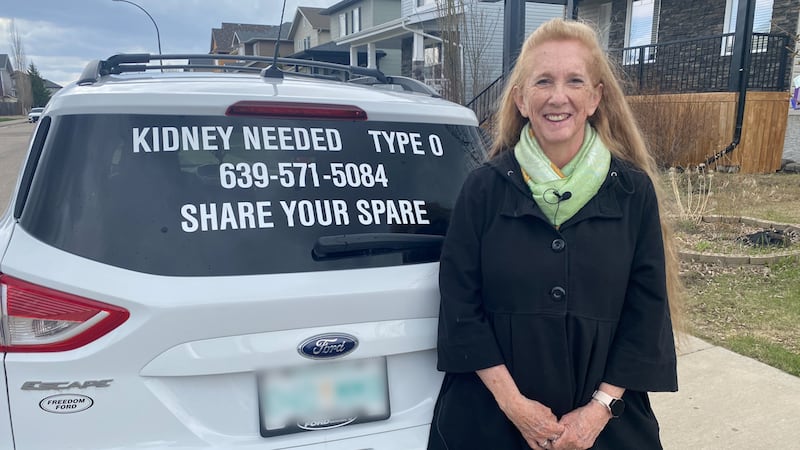
A Saskatoon woman in need of a kidney transplant has turned her vehicle into a driving advertisement with the hope someone on the road might be able to share their organ.
Peggy Macala, 64, says she has been waiting for a kidney on Saskatchewan’s organ transplant list for over three years.
Last year, she said she reached a point where she felt lost and wanted to do something to help herself. That’s when she decided to plaster her plea on the back windshield of her SUV.
The decaled letters simply read: “Kidney Needed Type O” along with her phone number and the ask to “Share your spare.”
“We just thought we’d give it a shot,” Macala told CTV News. “If nothing comes of it, fine. If something does, good.”
She says she took the idea from another woman in Saskatchewan who did the same thing to her vehicle a few years ago. That woman found a successful kidney donor in the process.
Macala says none of her family members or friends are donor matches, which is why she’s expanding her search.
“What could it hurt?” she said. “Even if one person says, ‘maybe,’ it’s worth getting the information out there.”
Macala says she received a few inquiries when she first put the message on her vehicle and has seen a recent spike in interest after a photo of her vehicle was posted in a local Facebook group. But no offers of organs have come from it, yet.
Most organ donations in this country, about 82 per cent, come from deceased donors, according to 2024 data from the Canadian Institute for Health Information (CIHI).
Katrina Sullivan, the program lead of the Canadian Organ Replacement Register at CIHI, says it’s typically up to the patient to identify a living donor or a candidate interested in living donation.
“It’s always been the way to receive a living donation. You have to talk to family and friends, and with the invention of social media it has expanded into that sphere as well,” she said.
Nationally, there’s a push to increase the number of donors, both deceased and living, she said. Organizations are looking at strategies in other countries that could be used here to encourage more organ donation.
“If you want to be an organ donor, talk to your family about it. You can register to be an organ donor, but if your family is asked and they say ‘no,’ then they will not use your organs,” she said.
Years-long waitlist
Macala is one of 82 people waiting for a kidney transplant in Saskatchewan, according to the government’s most recent data from January.
In 2025, the average wait time for a kidney transplant from a deceased donor in the province was about 2.25 years.
Based on when patients started dialysis, CIHI data shows the national wait time for deceased donor kidney transplants was 3.7 years in 2024, more than double the national wait time for living donor kidney transplants at 1.5 years.
“The waitlist is higher than we want it to be always,” said Jamie Robin Partyka, manager of the Saskatchewan Transplant Program. “Somebody is always suffering and you always want to try to see what you could do to make it better.”
Promoting living kidney donation is part of a broader effort by the Saskatchewan government to increase organ and tissue donation and reduce wait times.
Saskatchewan takes part in the kidney paired donation program run by Canadian Blood Services. If a living donor wants to donate to someone they know, but they are not a match, the program will match them with another donor-recipient pair to ensure both patients get a compatible kidney.
Partyka says the province has a goal of performing one to two living kidney transplants every month.
“Living donation is a big ask. Deceased donation is a really big ask as well,” Robin Partyka said. “We have to support and definitely respect decisions. It’s very much about autonomy.”
Repeat recipient
Macala is no stranger to organ transplants. She received a new heart more than 30 years ago and has been on immunosuppressants ever since, which she says have slowly deteriorated her kidney function.
“I waited six months for my heart, so (three years) seems like an extremely long time. But I was much, much sicker with my heart,” she said.
“I have limitations, but I’ve been functioning fairly well.”
Prior to being placed on the transplant list, Macala says her kidney function was around 13 per cent. It now hovers around 10 per cent.
If her kidney function drops any more, Macala says she will have to go on dialysis.
“Dialysis is going to be hard on my transplanted heart and it’s going to be hard on me,” she said. “I want to be able to get my kidney before I’m forced to take dialysis.”
Macala says she wants another chance to live her life to the fullest. Right now, she’s restricted on what she can do, eat and drink.
She hopes a new kidney will allow her to enjoy retirement and more time with her kids and grandchildren.
And if her advertisement doesn’t get her a new kidney, she hopes it at least encourages someone to register as a donor.
“People are waiting for a second chance. And that’s what it is, it’s a second chance,” she said.

