Warning: Graphic content.
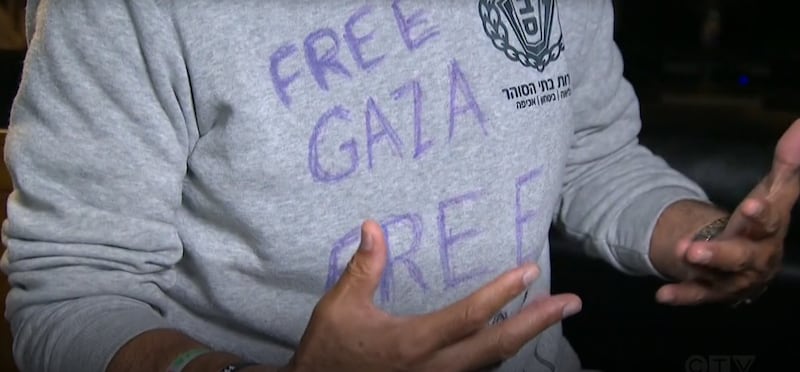
A day after returning home from what Shahid Mahmood describes as the most terrifying experience of his life, the software engineer from Belleville, Ont. continues to wear his Israeli prison uniform, in an attempt to make it his own. The grey sweater and sweatpants set now has the words “FREE GAZA” emblazoned across the front next to the Hebrew text.
Mahmood rolls up the sleeves to show he still has scars on his wrists from the zip ties he says Israeli soldiers put on him and hundreds of others when their flotilla attempting to bring aid into Gaza was intercepted by Israeli navy forces, around a week ago.
“I still have the bruises and cuts here on my wrist. The hands are tied tightly with those zip ties, and they do it on purpose,” he told CTV News Sunday at his Belleville home, showing both wrists – then pulling down his collar to show the scar on his neck from when, he says, Israeli soldiers, “ripped” his life vest from him.
Mahmood claims he was punched twice in the torso while being patted down by soldiers and strip-searched, en route to being transferred to Israeli vessels and then taken to an Israeli prison. But he says other members received much worse treatment.
“I hear crying, their screams, and I hear punching and pounding,” said Mahmood, while he was waiting for other members from their flotilla to be brought into a shipping container that served as a make-shift prison.
“I hear them bouncing people on the floor, on the container walls, bumping them around and their painful screams.”
“That is the most painful moment of my life (that) I (have) ever witnessed – and one by one we hear those screams and we just stand in horror, waiting for the next person to come and see how painful it might look," he added. “The person they throw in is either limping... or bruised on the face or has something else broken.”
Mahmood says when they were first met with Israeli forces on international waters, soldiers shot at their boat to make them stop.
He said that once the soldiers boarded and put zip ties on all members of the flotilla, they were transported to what he describes as shipping containers turned into prisons. They were given minimal food and water, and several people were beaten repeatedly in these containers.
“The welcoming is a beating,” Mahmood said. “They beat you with kicking and butts of their guns and pounding and throwing you on the floor and against the walls of the container… And then they throw you in the middle of the shipping container’s open area.”
“It was full of about a hundred people, (but) it’s like the container that you see on the trucks. It’s not huge and it cannot fit a hundred people unless they’re all standing up,” he added.
“There’s no room to sit down and there were people who were injured, there were people who couldn’t stand...They were just leaning against other people, and there was no water – that was the biggest concern.”
Allegations of abuse
The Global Sumud Flotilla claims widespread abuse of the more than 400 members from over 40 countries who took dozens of vessels across the Mediterranean Sea to try to bring aid to Gaza, including food supplies, baby formula and medical kits.
The coalition of international activists allege that while they were transported, detained in shipping containers and then to an on-land prison, there was widespread “assault and torture,” including the use of rubber bullets, tasers, and stun grenades.
The flotilla group also claims Israeli soldiers took part in various forms of sexual violence, including “multiple accounts of rape.”
Prime Minister Mark Carney called the “abominable treatment” of flotilla members “unacceptable” on Wednesday, after video showing activists kneeling with their hands bound behind their backs, being taunted by Israeli National Security Minister Itamar Ben-Gvir emerged.
Foreign Affairs Minister Anita Anand also on Wednesday told reporters she had asked Global Affairs Canada to summon Israel’s ambassador about the treatment of Canadians on the flotilla.
In a social media statement Friday, Anand said Canada “unequivocally condemns” the mistreatment inflicted on its citizens in Israel, adding that those responsible for the abuse “must be held accountable.”
Israel’s prison service has denied these claims, saying they are false and that all detainees were “held in accordance with the law,” calling the allegations “false and entirely without factual basis,” in a statement to Reuters.
Montreal’s Ehab Lotayef also returned home Saturday to cheers and support from a pro-Palestinian rally taking place at Trudeau International Airports’ arrivals area.
Lotayef hugged the dozens of attendees, his visible smile and relief accompanied by a bandaged hand, which he said was the result of an Israeli soldier coming at him with a knife while he was in captivity.
“When I found an elderly person or somebody who’s weaker or needs medicine, I would give them some water... one of the soldiers didn’t like that at all, I guess,” he told CTV News on Saturday, after his arrival.
“He targeted me personally with the knife he had in his hand, and he stabbed me between the(se) two fingers,” said Lotayef, pointing to the stitches on his hand.
He said he was also beaten for multiple days, along other flotilla members and abused.
“They have a container that acts like the beating room, and when you pass through it, you just get beaten,” he said. “Some people got their ribs broken; I suspected a collapsed lung.”
“Then they throw us out in the prison area, which is surrounded by four containers,” Lotayef continued. “We had only been given bottles of water and bread.”
“We (would) get attacked twice a day by a commando team that comes into the prison area, throws some (stun) grenades and asks us to do whatever they want to do – go behind the black line, stand in a specific order, clean the containers.”
For Mahmood, he says the price he paid was worth putting a spotlight back on the people of Gaza, adding he would board another flotilla without hesitation, if it meant getting aid to Palestinians suffering from food insecurity.
“I would go back again if needed,” he said. “I feel relieved to be back with my family, and privileged that I didn’t get to go through so much pain and horror that Palestinians had to go through every day of their lives.”
“I feel privileged that I get to see my family and my family gets to see me alive, which most Palestinian children do not get to see.”

