Montreal’s population is on the decline due to lower immigration and the ever-aging population, according to a recent report by the Observatoire Grand Montréal.
Its projections indicate the trend could prevent the city from “experiencing population growth in the coming years.”
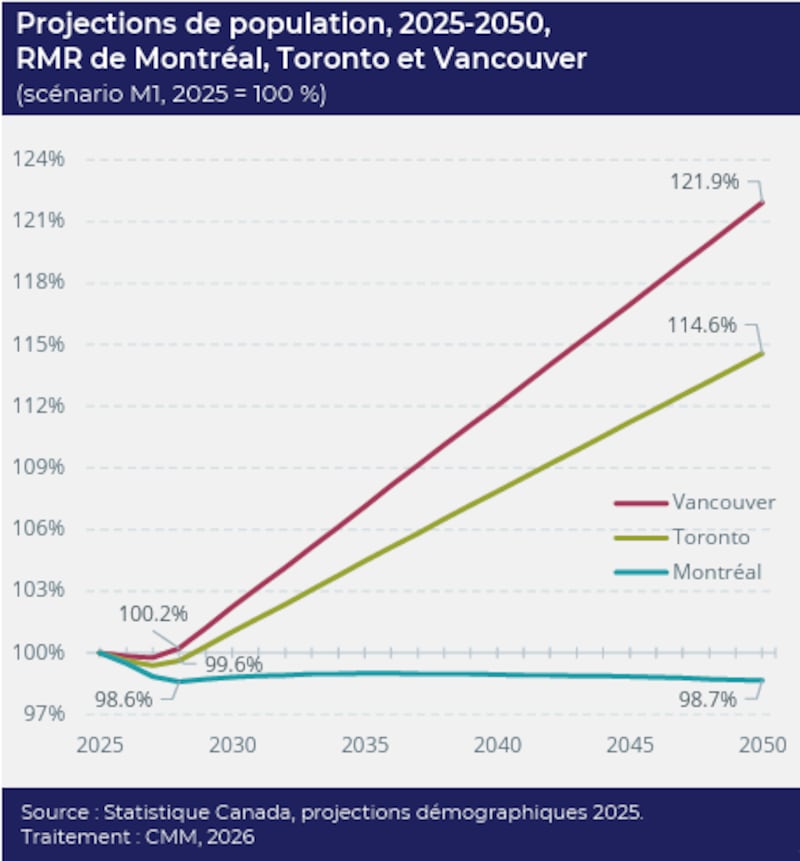
This contradicts patterns in other large cities, like Toronto and Vancouver, which are expected to see their populations increase by 2050.
In 2025, Montreal counted 4.3 million inhabitants; by 2050, population numbers could see a 1.3 per cent decline.
“In contrast, higher immigration and a slightly younger age structure should allow the Toronto and Vancouver regions to offset the effects of aging and maintain their demographic growth trajectory,” said the Communauté métropolitaine de Montréal (CMM). “By 2050, Toronto’s population is projected to grow by 14.6 per cent, while Vancouver’s is expected to surge by 21.9 per cent.”
The CMM adds that for the first time since the pandemic, Montreal’s youngest age groups, 19 and under and 20 to 29, diminished.
Contrarily, the population aged 65 and over has increased by 2.9 per cent - up 23,000 in 2024 and 22,000 in 2025.
“Far from being a new phenomenon, this trend has been developing for more than 25 years,” the report said. “As early as 2001, the population aged 19 and under had stagnated, while in 2006, the growth of the population aged 65 and over exceeded that of the 40 to 64 age group for the first time.”
Impacting the dependency ratio
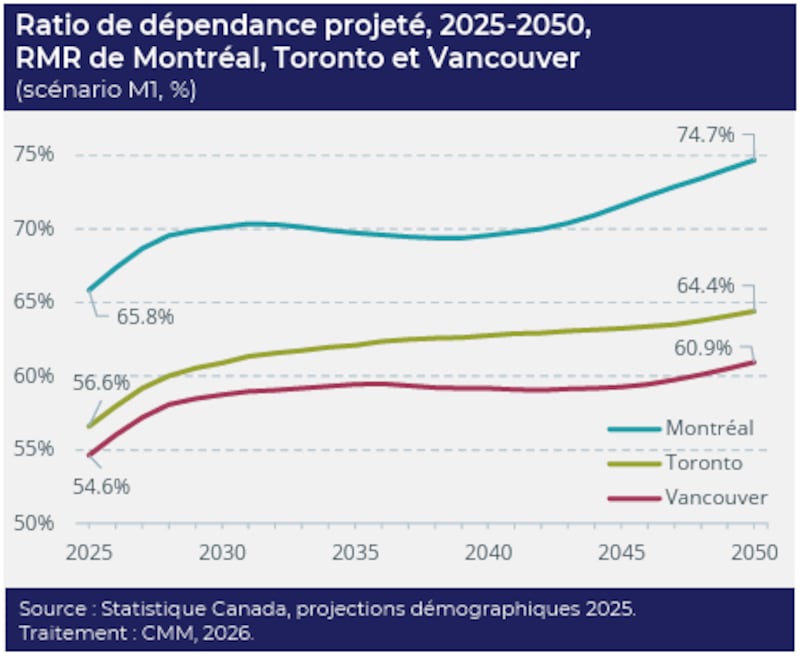
In Greater Montreal, the CMM explains that the dependent population grew twice as fast as the working-age population between 2006 and 2025 - an annual rate of 1.4 per cent versus 0.7 per cent, respectively.
That means Montreal could face a dependency ratio of 74.7 per cent by 2050, significantly higher than Toronto (64 per cent) and Vancouver (61 per cent).
“[This could] place greater pressure on the workforce and public finances,” the CMM states. “Living environments will also need to adapt as the aging population will accelerate demand for smaller housing units located near services.”
It observes that the dependency ratio did dip slightly in 2023 and 2024 due to an influx of newcomers temporarily bolstering the city’s working-age population.
“This one-time improvement shows that immigration can support the working-age population, without, however, reversing the aging trend,” the CMM said. “In Greater Montreal, where natural growth is no longer sufficient to support population growth, economic growth and labour needs, immigration remains the primary short-term lever for reducing pressure on the working-age population.”
The report finds that as of 2025, declines in immigration alone could push the dependency ratio to 65.1 per cent, a historic high that may eventually lead to increased pressure on taxpayers.

