A question about Alberta’s future in Canada remains top of mind for many – including Saskatchewan Premier Scott Moe.
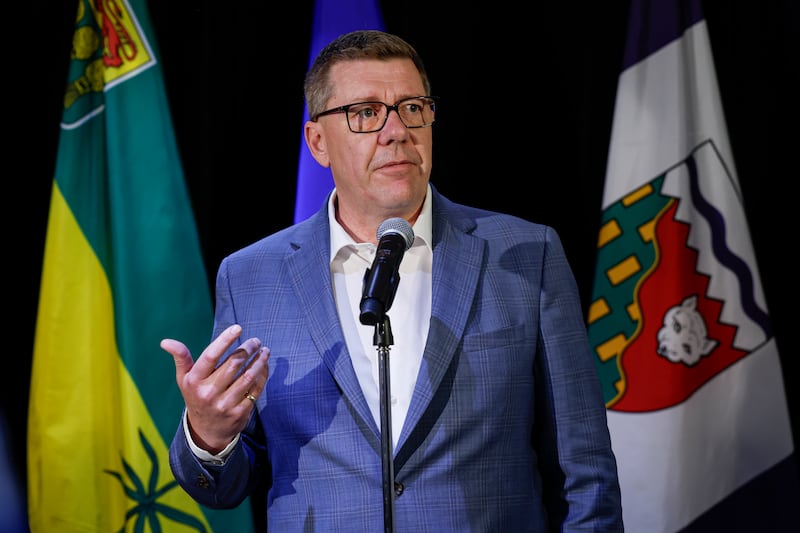
Speaking to reporters Monday in Kananaskis, Alta. where he is attending an annual meeting of Western premiers, Moe defended Premier Danielle Smith’s announcement to include a question on whether Alberta should pursue a vote on separating from Canada in this fall’s referendum.
“My perspective of what I see Premier Smith doing here – she’s following the law,” he said, pointing to the fact other provinces have similar legislation to Alberta’s on the topic of plebiscites.
“We have plebiscite legislation in Saskatchewan, B.C., I believe has a plebiscite legislation as well. Those are the three provinces that have citizen initiatives, initiative questions that can be put forward and so if that was met in Saskatchewan, we’re a government that would follow the law in that space.”
Last week, Smith announced a question about a separation vote would be included in the referendum scheduled for Oct. 19.
The referendum will feature 10 questions asking for a mandate on a number of immigration and constitution-related questions - the first nine of which are ‘yes’ or ‘no’ answers.
However, the tenth is a dual question.
“Should Alberta remain a province of Canada, or should the Government of Alberta commence the legal process required under the Canadian Constitution to hold a binding provincial referendum on whether or not Alberta should separate from Canada?”
The announcement came as two competing petitions, named Forever Canadian and Stay Free Alberta, garnered around 400,000 and 300,000 signatures respectively.
“We’ve had 700,000 people who’ve asked to have the question of whether to remain in Canada or leave Canada. So, I’m following our law,” Smith told reporters Monday.
When asked if the question about a separation vote worries him, Moe answered in part, pointing to lingering policy disagreements between the federal government and Alberta as the reason the province is having the separation conversation in the first place.
“I wouldn’t say I don’t have concerns about that, but I would say I understand why it’s here. We’ve had 10 years of unconsulted, harmful policy by the previous prime minister,” Moe said, before praising Prime Minister Mark Carney for his efforts in collaborating with provincial leaders.
“I think I have great hope for our nation as we look ahead.”
Moe did go on to say he believes “it’s beneficial for Alberta to remain in Canada.” However he noted, the decision is not his.
“What I would say, and it isn’t for me to tell Albertans how to vote in this, these questions or any others that are coming to them,” he said.
Saskatchewan’s Official Opposition said Moe’s response was simply not enough.
“He’s not doing enough to talk about the ramifications that even the discourse of separatism is having. We’ve seen with the Alberta Chamber of Commerce report, that even the discourse around this issue is causing uncertainty and it’s causing economic repercussions,” NDP MLA Kim Breckner told reporters at an event in Saskatoon on Monday.
Going further, Breckner told reporters her party acknowledges the concerns around “Western alienation” and its effects. However, she doubled down on the need for unity and to speak up against separatism, claiming the recent developments in Alberta have given momentum to Saskatchewan-based separatism initiatives.
“The route forward is to work together to build a stronger Canada, and within that, a stronger Saskatchewan,” she added.
“I hope that the premier can tell us that out of these western premiers meetings that they’ve been talking about nation building infrastructure, how we can get our products to port, how we can be stronger together in this nation of Canada, and a clear message to separatists to stop that discourse, because it’s harmful.”
A new pipeline being proposed from Alberta to British Columbia is also up for discussion at the conference.
The meeting is set to conclude Tuesday afternoon.
With files from Hannah Kavanagh
RELATED STORIES:

