The leaders of the Alberta independence movement say Premier Danielle Smith is inflating the cost of separation if Albertans vote in favour of wanting to leave Canada.
“Keep in mind, this is going to be a negotiated divorce,” said Jeffrey Rath, general counsel for the Alberta Prosperity Project (APP).
“I don’t know why Danielle thinks that she’s going to threaten us with a $400-billion cost. It’s obviously a lot less than that, but who cares? Let’s just get out. We’ll be so much better off.”
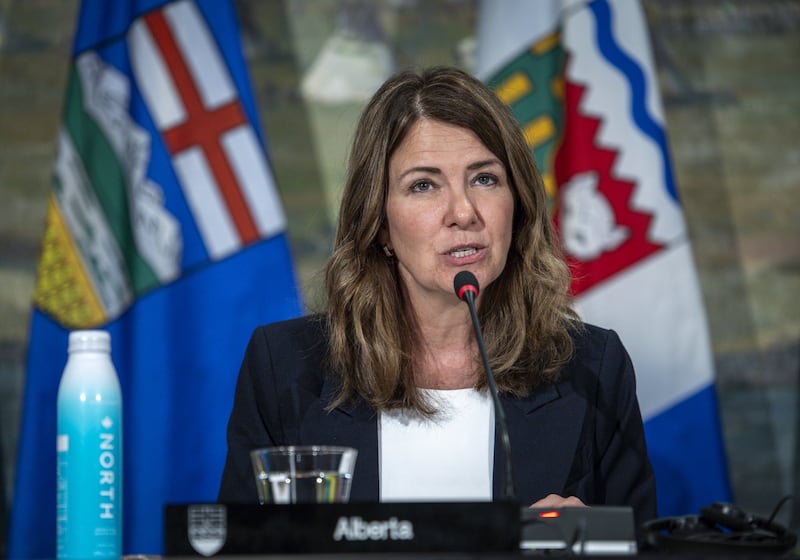
On Monday, Smith said the cost to separate would be in the hundreds of billions to create a new national government.
“I came up with almost $400 billion worth of transitional costs that we’d have to assume in addition to somewhere between $25 (billion and) $50 billion worth of annual costs,” said Smith.
“So, I think people just need to look at this, at the facts, and see whether or not what is being proposed is realistic.”
Smith pointed to things such as regulating banks, post offices, railways, assuming control of Alberta’s portion of the Canada Pension Plan, employment insurance, border control, old-age security and child tax benefits, paying the province’s share of the national debt, NATO commitments and telecoms.
Smith said Alberta would also have to renegotiate trade deals and possibly deal with tariffs.
“If you reject your allies, then they reject you,” she said.
“I think that we have to be very realistic about what it is that we’d be looking at for dollars and cents.”
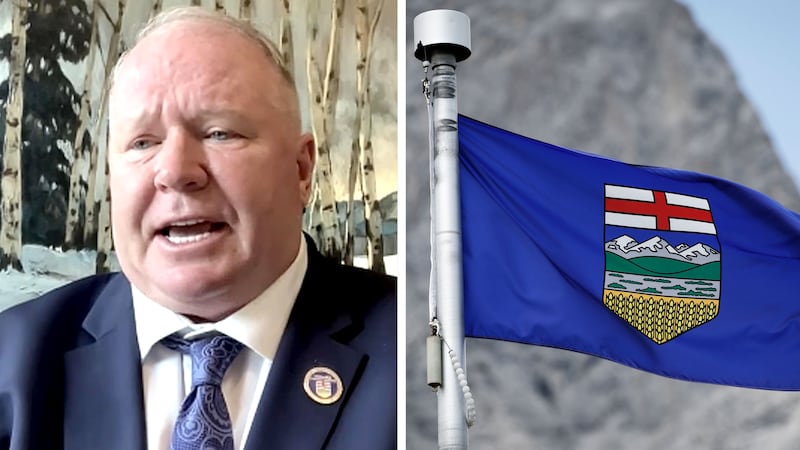
Rath refutes those claims, saying many systems are already in place and would be taken over by an Alberta government.
“We know what we’ve been talking about from Day 1. We’ve been doing our due diligence. It’s the same thing, like, ‘Oh, you’re not going to have any trade agreements.’ Why do you think we’ve been travelling to the United States of America?” said Rath.
“We’re going to have a better trade agreement in a free and independent Alberta than Canada has, because we haven’t been constantly sticking our finger in the eye of the president and administration of the United States.”
Rath points to the Alberta Prosperity Project’s website, where the separatist group has a costing plan that was created last year.
The group says it pulled data from Statistics Canada, Alberta’s budgets, and public documents from accounting firms.
The document is titled The value of freedom: A draft fully costed fiscal plan for an independent Alberta.
“It presents a financial analysis for an independent Alberta, focusing on the province’s potential to retain $68–75 billion in annual federal tax contributions, establish an Alberta Pension Plan, replace federal services, and implement a robust environmental strategy,” the document reads.
The group’s plan talks about eliminating federal income tax, scrapping the GST, and keeping more money in Alberta.
“Combined with provincial revenues of $74.1 billion (2025–26) and an Alberta Pension Plan (APP) generating $23.34 billion annually from a $183.7-billion asset base, total revenues reach $$142.1-149.1 billion,” it reads.
“Expenditures, including $75.3 billion for provincial services and $22.7–31.6 billion to replace federal services (e.g., defense, policing, Indigenous services), total $98–106.9 billion, with one-time setup costs of $2.8–5.7 billion. This results in a fiscal surplus of $29.4-48.3 billion (excluding setup) or $23.6-45.5 billion (including setup).”
“All of Danielle’s numbers and projections are completely false,” said Rath.
“I mean, it’s not a surprise. We sent this document to Danielle, by the way. All the numbers are based on Statistics Canada figures and Fraser Institute figures.”
The APP believes Canada owes Alberta around $334 billion in Canada Pension Plan costs but expects a transfer would be about $167 billion from CPP assets.
Smith says the province will have its own costing document provided to Albertans before August.
Trevor Tombe, a University of Calgary economist, penned a report last summer that said a separate Alberta would be a poorer Alberta, calling the Alberta Prosperity Project’s costing plan a “fiscal fantasy.”
“Scrapping income and sales taxes would cut nearly $80 billion from government revenues—that’s the combined current federal and provincial take from these sources,” wrote Tombe.
“This amount represents over half of what the Prosperity Project assumes the new country would collect in total revenues. You can’t eliminate more than half your income and still balance the books. Indeed, the lost revenue from eliminating these taxes is worth roughly twice as much as the Prosperity Project assumes Alberta’s surplus would be.”
Trevor Harrison, a retired University of Lethbridge professor in sociology, says Smith was quite defiant with her answer on Monday about the costs of separation.
He adds that her numbers are “probably realistic.”
“The more striking thing is how stridently she decided to say them. And I think that says a lot about the premier finally having to get off the fence, which she has straddled fairly successfully for a year, a year and a half, and finally having to decide that, hey, it’s pretty dangerous to continue in this way politically,” said Harrison.
“And so, while there’s potential costs here in terms of some of her supporters, she’s decided that she will, finally, say that she’s really onside with Canada, which is not something that has come easily to her lips since she’s been premier.”
READ MORE:
- UCP ‘not an independence party’; also not lacking members who would support one
- UCP president, several constituency associations say support for Smith remains
- Danielle Smith pushes back against Manitoba premier’s comments as controversy grows over prospective referendum question
- Alberta referendum could cause ‘real damage’ to province’s reputation, new group claims
- ‘Angered people on both sides’: Many Albertans unhappy with separation referendum plan

