The Canadian government is considering a mixed fleet of fighter jets that could total more than its initial target of 88 aircraft, according to industry sources.
A larger fleet would include both the American-made F-35 from Lockheed Martin as well as the Gripen from Swedish aerospace and defence manufacturer Saab.
Multiple industry sources with knowledge of the discussions confirmed the details with CTV News on the condition of anonymity.
CBC News first reported that a mixed fleet of jets could include more than 100 aircraft.
Ottawa has been quiet for months now about its highly anticipated decision on procuring a full fleet of next-generation fighter jets.
In 2023, the federal government committed to acquire 88 F-35s to replace its aging fleet of CF-18 Hornets. But in 2025, amid trade tension with the U.S., the Carney government launched a review of the purchase.
Canada is already under contract for 16 F-35s but speculation has swirled about whether the government would change course to complete its fleet.
Last week, Prime Minister Mark Carney announced Canada had entered into negotiations to procure GlobalEye, an advanced aerial surveillance system developed by Saab that uses Canadian-made jets.
In an interview with CTV News at the end of March, the CEO of Saab said there were still “intensive” talks underway with the Canadian government around the potential purchase of Gripen fighter jets, but that he had no timeline for when Canada will finish its review of the American-made F-35s.
3 aircraft?
News that Canada is considering procuring a mixed fleet of aircraft left at least one analyst scratching his head.
“It complicates things for a reason the government has not yet articulated,” said David Perry, president of the Canadian Global Affairs Institute, which lists Lockheed Martin as a strategic sponsor, and Saab as an event supporter, in its 2025 annual report.
“The planes are completely different in terms of how they would work. You wouldn’t have a situation where you could have a pilot hop into one cockpit one day and the other one the other day,” he explained, adding that Canada is likely to continue using its existing fleet of CF-188 Hornets, commonly called the CF-18, for close to a decade.
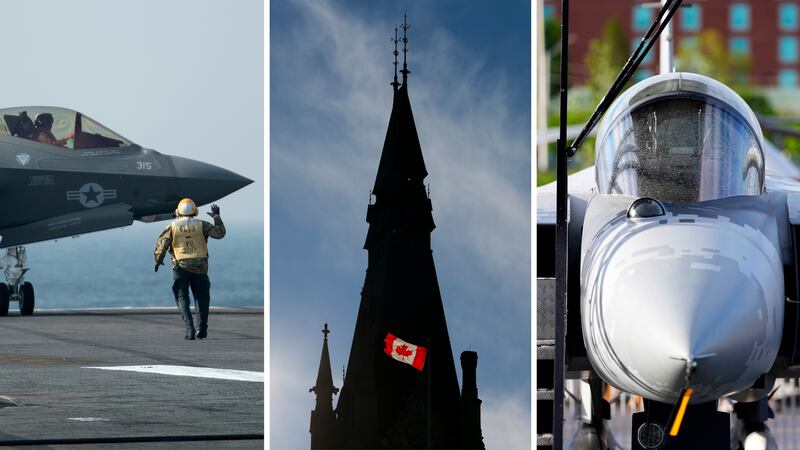
If Canada moves to procure two new models, the Canadian Air Force would have to maintain and service three different kinds of planes at once.
He accused the Carney government of reopening the procurement plan for political reasons, namely tensions with the United States. It took years of consultations and studies to finalize an agreement with the U.S. and Lockheed Martin.
“If the government really wants to increase the size of our overall fighter fleet, the smartest way to do that would simply be to add on to the order of F-35s, the more capable aircraft and the one that was competitively selected in a competition by a highly skeptical prime minister, Justin Trudeau,” said Perry.
Two ‘very capable’ platforms
While operating two separate aircraft models would pose additional personnel challenges, navigating multiple platforms within one fleet is not unprecedented, remarked Ret’d Maj.-Gen. David Fraser, CTV News’ military analyst.
He pointed to the United States’ military, which operates multiple generations of aircraft within its air defence arsenal.
Fraser called the F-35 “the best jet in the world today,” but added it’s also more expensive to run than the Gripen, and the latter could satisfy other operational needs.
“The F-35 is interoperable with Norad (Canada’s bilateral defence pact with the U.S.), and it is the jet that’s going to be able to defend North America,” Fraser said. “The Saab jet is going to be great for NATO. So, you can actually run two operations simultaneously, one in Canada and one overseas.”
In 2023, when Canada first announced it was moving forward to procure 88 F-35 jets, the government called it the most significant investment in the Royal Canadian Armed Forces in more than three decades. An expanded fleet, even one that includes more than one aircraft, is a welcome addition to that plan, said Fraser.
“We’re talking about getting more airplanes than we’ve ever had before, and two very capable platforms.”
With files from CTV’s Spencer Van Dyk

