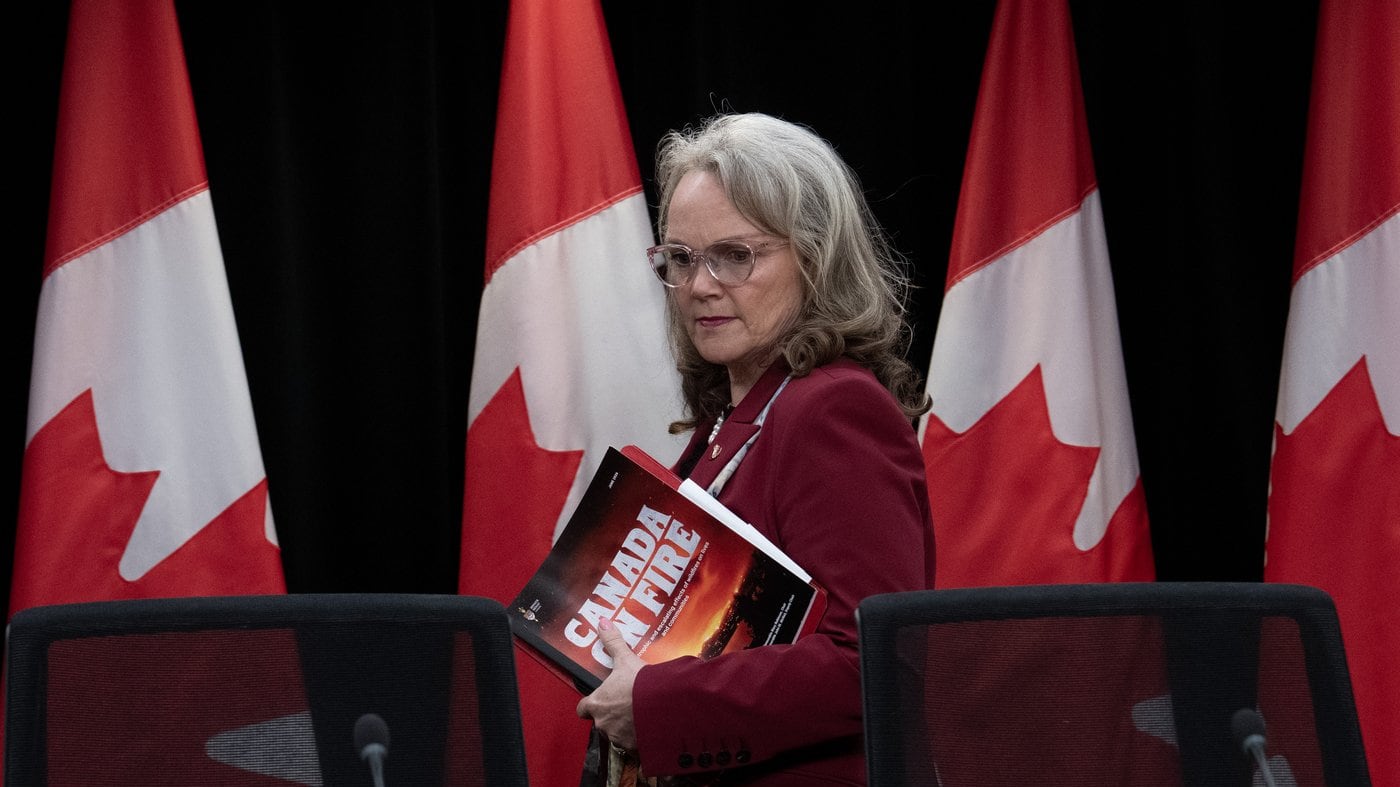
OTTAWA — Canada needs to create an office to co-ordinate responses to wildfire emergencies and fund a new national fleet of modern firefighting aircraft, says a new Senate report released Wednesday.
Those recommendations were among 15 in a report from the Senate committee on agriculture and forestry.
At a news conference in Ottawa, senators on the committee said one of the key requests they heard while assembling the report was for a single national point of contact to co-ordinate wildfire response.
“We heard that Canada is the only country in the G7 that does not have a seat at the federal table, more or less, to manage and talk about and co-ordinate fire response,” Sen. Mary Robinson, the committee chair, told The Canadian Press.
“I think the efforts to date are appreciated but the crisis is growing and escalating, and we need government to do more for sure.”
About six months ago, the federal government launched a new national centre to allow for better co-ordination of disaster response.
Federal Emergency Management Minister Eleanor Olszewski said at the time the centre would help co-ordinate resources in situations where provinces and communities can’t manage on their own.
But the Senate report calls on Ottawa to take on more of a leadership role.
“There is nothing that allows co-ordination at the federal level for municipal assets across the country,” said Ken McMullen, president of the Canadian Association of Fire Chiefs.
“That’s where this office would make an absolute dramatic difference across the country.”
The committee heard that under the current system, wildfires are handled first at the municipal level, then escalated to the provinces and territories before a request for assistance is made to the federal government.
Committee deputy chair Sen. John McNair said that process wastes valuable time.
“Each escalation and application for assistance also takes precious time at a critical moment when the rapid response is most required and those co-ordination challenges directly contribute to inconsistent planning, delayed response times and sporadic access to equipment and personnel,” McNair said.
“We heard consistently that there is a need for a single point of contact to improve collaboration and break down silos.”
Olszewski told The Canadian Press she hadn’t seen the Senate report yet because she spent the morning in the weekly Liberal caucus meeting. She said she’d have more to say Thursday after reading the report.
The Senate committee also called on Ottawa to “create and fund a national fleet of modern firefighting aircraft.”
Ottawa announced last month it would lease 10 aircraft -- four air tankers, one spotter plane and five heavy lift helicopters -- for 150 days starting this month.
But Robinson said leasing aircraft isn’t good enough.
“I think it definitely is going to bolster the firefighting capacity in the short term, but this committee is calling for a long-term national solution for wildfire aviation,” Robinson told The Canadian Press.
“We were thinking this would, ideally, involve renewing the current fleet and purchasing new planes, so Canada can be more self-sufficient in battling more frequent and destructive wildfires across the country.
“So the 10 that are being leased, these new firefighting aircraft with two support assets, it’s great. They’re definitely going to bolster the effort. But no, it’s not enough.”
The Senate committee report also calls on Ottawa to create a national reforestation policy to plant more trees after wildfires.
In its last budget, Ottawa scrapped planned spending on tree planting as a cost-cutting measure.
This report from The Canadian Press was first published June 10, 2026.
Nick Murray, The Canadian Press

