OTTAWA – Despite agreeing to a “common set of principles” for a safer and more secure digital space for minors, leaders of G7 countries are unlikely to come to a consensus on government regulations against online harms, according to senior government officials.
The background briefing was given to reporters ahead of Prime Minister Mark Carney’s trip to Ireland and France later this week, which includes the meeting of seven of the world’s advanced democratic economies.
A week ago, G7 digital and technology ministers did agree to the first-ever joint approach to protecting children online. However, Canadian government officials said “there are a difference of perspectives among certain members of the G7 on the proper role of government regulation.”
Achieving that consensus around the table in France next week on a number of pressing issues could be just as elusive as the last time the meeting was held in that country.
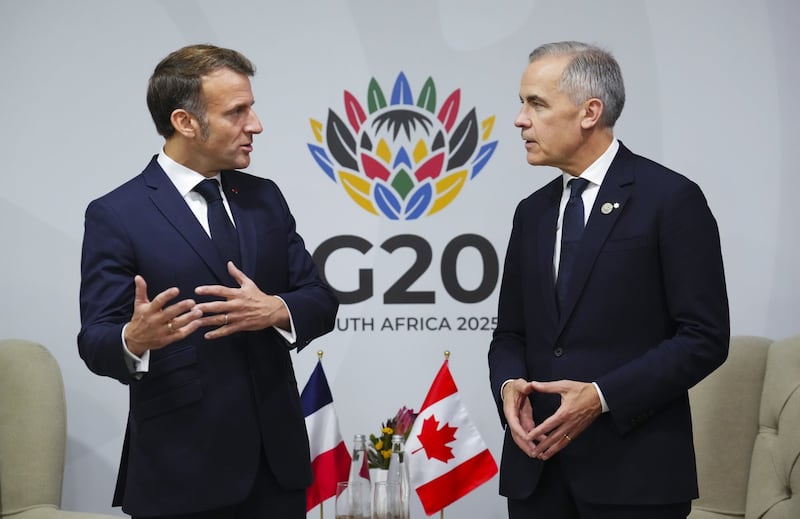
Including online harms, the group of seven, plus a representative from the European Union, will work towards agreements on: strengthening critical minerals value chains, reducing macroeconomic imbalances and the future of international aide.
Senior government officials cautioned not to expect a final joint communique from the leaders of Canada, Italy, Japan, France, the United States, Germany and the United Kingdom.
One government official pointed to the 2019 summit in Biarritz, France, where “there were virtually no pieces of paper that came out of that summit,” referring to documents which all leaders agreed to sign.
G7 hosts countries moved instead to standalone statements that are issue specific and endorsed by certain leaders.
The government officials didn’t name U.S. President Donald Trump as the reason for breaking with tradition, but did add, “I’ll let you do the math as to who the leaders were back then.”
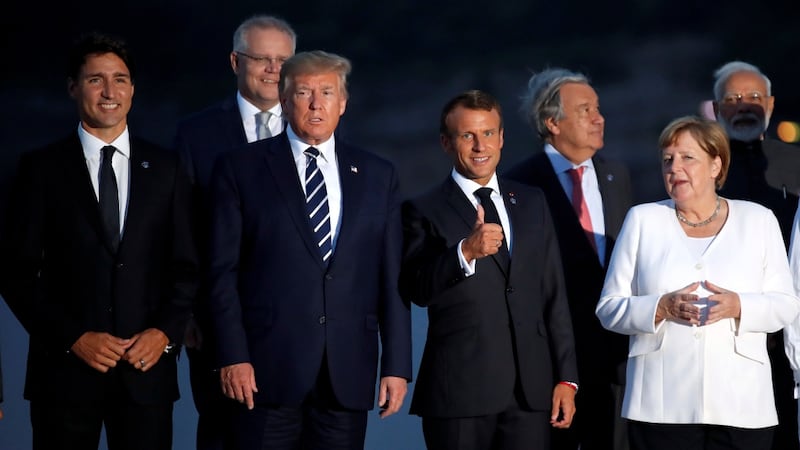
The leaders in 2019 were then-Prime Minister Justin Trudeau, French President Emmanuel Macron, then-German Chancellor Angela Merkel, then-Italian Prime Minister Giuseppe Conte, then-Japanese Prime Minister Shinzo Abe, then-U.K. Prime Minister Boris Johnson and Trump, who was in office during his first term.
“The G7 simply expresses the will of its member states, so sometimes it’s easier, frankly, to gain consensus than at other times,” said the government official. “There is no one size fits all”.
Among the priorities, Canada is hoping to make progress on critical mineral supply chains, as it was part of the discussions when Carney hosted G7 leader in Kananaskis, Alta., last June.
“(It’s about) securing supply chains for Canada and the wider group of G7 countries, so that they have access to what is needed for defence purposes, for green-transition purposes, for overall industrial purposes,” said the government official on background.
Ahead of the G7 Summit in the eastern French community of Évian-les-Bains, Carney will hold bilateral meetings with Macron in Paris, where the two leaders are expected to talk about the summit and subjects like artificial intelligence.
While Canada launched its AI strategy last week, France is touting pledges of $140 billion in investments for AI and data projects.
In Ireland, Carney is expected to meet with the country’s taoiseach (Irish for prime minister), Michal Martin, as well as President Catherine Connolly. Canadian officials say Carney wanted to expand co-operation between the countries in areas like agri-food, digital innovation, artificial intelligence, pharmaceuticals and climate.
“Since 2016, our bilateral trade with Canada has increased by 130 per cent,” said Neale Richmond, Ireland’s minister of state for international development and diaspora, in an interview with CTV News. “We can see that grow by another third over the next couple years.”
Richmond says Ireland is looking for “reliable, trusted partners,” adding Canada is at that top of that list.
According to Global Affairs Canada, bilateral merchandise trade between Canada and Ireland was valued at $6 billion in 2025. Canada exported $1.1 billion worth of merchandise, with the bulk of it being cereals, while Canada imported $4.9 billion worth of merchandise from Ireland, with pharmaceutical products accounting for 42.5 per cent of it.
“We have a great relationship,” said Richmond. “Ireland is the 10th-largest investor into Canada, but we know we can do so much more.”
While Canada is hoping to have a strong trade and investment component to the Ireland leg of the trip, officials say there is not an accompanying business delegation.

