A high school student from Ontario is breaking medial barriers.
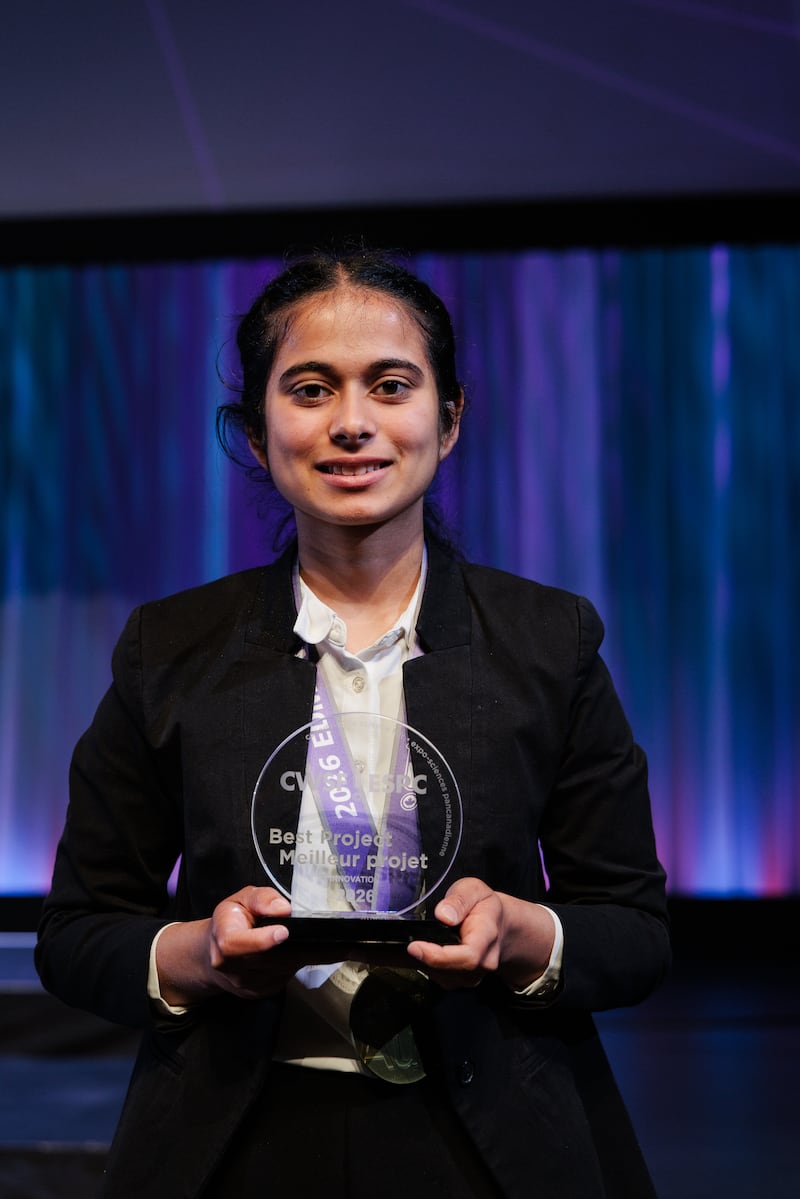
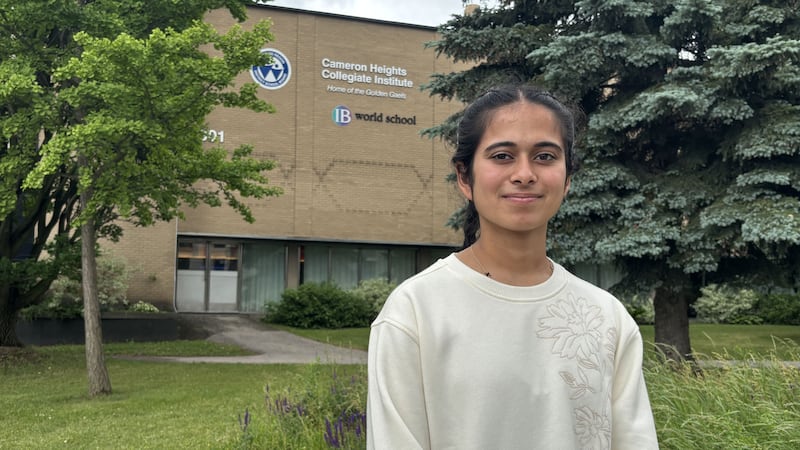
Gurnoor Kaur is a Grade 11 student at Cameron Heights Collegiate Institute in Kitchener, Ont. She recently received a top prize at the Canada-Wide Science Fair for her project titled Eliminating Demographic Bias in Pulse Oximetry and Remote PPG from First Principles.
Her research delved into how blood oxygen sensors respond to patients with darker skin tones. She was inspired by her father’s hospitalization. She said she watched as staff struggled to regularly check his vital signs due, in part, to overwhelming workloads.
“On the same ward he was in, a patient fell into hospital-induced delirium,” Kaur explained. That experience led her to develop a prototype to detect early signs of the neuropsychiatric syndrome.
“Within that prototype was non-contact based monitoring of heart rate. Basically, you can use a regular camera to actually detect heart rate without needing to put sensors on patients,” she said.
But, when she tested her prototype on darker skin tones, it failed.
It piqued her curiosity about how other established health techniques and technologies reacted to melanin. She developed a new concept for pulse oximeters, devices that monitor blood-oxygen levels.
Her work led her to the work of Dr. Martin Tobin, who began studying the phenomenon in the 1990s.
“What essentially was shown was that in darker skin, the oxygen saturation level is overestimated,” Kaur said.
“This is a very large problem because you can’t get patients the treatment they need because you actually think [the patients] are doing better than they are.”
For years, experts thought the bias came from a small sample size, but Kaur realized that wasn’t the case.
“It’s the actual foundational math and physics that build up the models we’ve been using,” she said.
So, she developed a new algorithm, which is being nationally recognized.
Canada-Wide Science Fair
Kaur’s work with both hands-free heart rate detection and pulse oximetry won her the top prize at the 2026 Canada-Wide Science Fair, hosted by Youth Science Canada.
“Other people had looked at [the bias]. These are professionals who had looked at it for almost 30 years trying to figure it out and couldn’t,” said Reni Barlow, the executive director of Youth Science Canada.
“She got to the root cause of it and identified a solution using algorithms that ultimately will be able to correct the devices that hospitals and people use around the world.”
Kaur beat out roughly 400 other students for the top innovation prize and industry professionals are already taking note of her research.
“A large pulse oximetry company actually saw my project board and they got in contact with me. So, I’m working with them to continue to get more data and test my algorithms out on their larger datasets,” she said.
Her heart rate detection technology was also noticed by Kinetic Labs, which specializes in creating sports technology.
“I’m trying to do both the detection of oxygen saturation and heart rate all through non-contact methods and that technology is being licensed by Kinetic Labs,” Kaur explained.
After winning the national science fair, she qualified for the European Union Contest for Young Scientists and will be heading to Germany in September to share her work.

