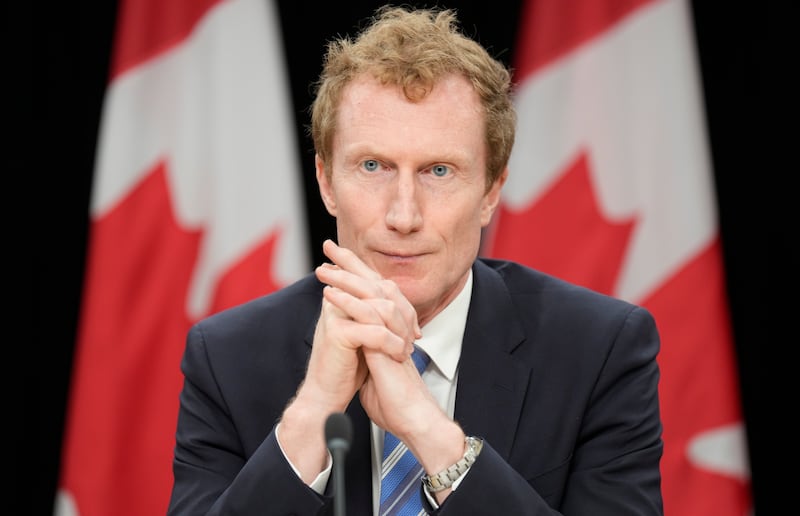
Minutes after he tabled the Safe Social Media Act, Marc Miller, the Canadian Identity and Culture minister, faced a packed room of reporters to defend the Liberal government’s latest attempt to protect children from the dangers of the Internet.
The latest iteration, Bill C-34 includes a plan to block users under 16 years old from having social media accounts. It places a duty to protect on the Internet platforms and puts the onus on companies to make their sites “safe by design.”
“We are failing our children. Enough is enough. Our parents cannot face these challenges alone and the safety of children cannot be an afterthought,” Miller said, while referring to government sourced data that showed 52 per cent of young people have received unsolicited sexual images online.
The Canadian Centre for Child Protection receives more than 100,000 reports each month of child sexploitation on its cybertip.ca tipline.
“We need basic protection in place so every child in this country can be safe on platforms they use every day,” the culture minister emphasized.
The legislation has wide support from child advocates, parents and doctors.
The Liberals have been trying to pass an online harms bill since 2019. Two previous attempts have failed, stymied by a minority government and what Miller admitted was legislation that overreached and “tried to do too much.”
Under Prime Minister Mark Carney, the Liberals now have a majority which makes passing the bill easier, but some legal experts say C-34 could raise the ire of U.S. President Donald Trump and become collateral damage in the ongoing trade war.
Compliance without enforcement
“There are elements that may face some real trade pressure,” says Michael Geist, Canada Research Chair in Internet and E-Commerce Law at the University of Ottawa.
Geist says mandated age verification could violate privacy rights. He says the culture minister’s expressed intent to put a ban in place before a new digital safety commission is set up is also problematic.
During Wednesday’s news conference, Miller said that “it’s clear” that social media companies would have to “take the appropriate measures to limit kinds under 16 from opening social media accounts as soon as the law comes into force.”
However, he also acknowledged that it could take 18 months for the regulatory body to start operating.
Under the legislation, social media companies could get an exemption from age restriction if they put in sufficient safeguards such as limiting children’s exposure to high-risk interactions and pornographic content.
The commission would be responsible for setting the standards for age verification and deciding if a company is exempt from the ban. Without a regulatory body in place, there would be no enforcement or verification of compliance
“(The government) is effectively saying you’re not going to be exempt, at least not initially, even if you meet some appropriate standards.” Geist says that could bring on potential charter challenges in Canada and put it on a collision course with the United States.
American opposition
The Trump administration has recently signalled a willingness to fight social media bans in a submission to the United Kingdom during British consultations on a digital age of consent.
In their June 5 submission, U.S. officials expressed concerns about mandating specific product design restrictions and regulations that “impose disproportionate compliance burdens on American companies or that apply to one platform but not similar services.”
The response stated that the “United States favors parental empowerment over government mandates” and insists that platforms should be incentivized to offer age-appropriate alternatives instead of “outright bans.”
Geist says if the federal government moves ahead with the proposed ban and starts targeting American companies, “it’s certainly possible the U.S. may object and Canada will face some real pressure at the trade table.”
Background information provided to reporters during a technical briefing on the Safe Social Media Act referenced X and Meta, which owns Facebook and Instagram, as examples of companies that would be impacted by the new legislation.
Other platforms which could also be impacted include Snapchat, Reddit and TikTok.
Big tech responds
In a statement to CTV News, Meta, the world’s biggest social media platform said that “like lawmakers it wants safe positive online experiences for young people” and that it was assessing the new act.
A Meta spokesperson noted that “social media bans are counter productive,” but the company was encouraged by the government’s recognition of services that provide tees with sufficient safeguards.
As for TikTok, a spokesperson said the platform’s teen accounts already have “more than 50 preset safety and privacy settings.”
TikTok, one of the youngest-skewing social media platforms, said in its statement that it is looking forward to “collaborating constructively” with the government on the issue.
The Liberals under Mark Carney have previously backed off fights with American tech giants. The digital services tax which forced companies such as Meta and Google to pay three per cent of revenues earned from Canadian customers was repealed in June 2024.
More recently Miller announced that the government was delaying the implementation of the Online Streaming Act, which would require streamers to reinvest 15 per cent of its Canadian revenue into domestic and Indigenous programming.
Given the Carney government’s track record, Miller was asked by reporters how Canadians can be confident that the Liberals will not fold on the social media ban under potential U.S. pressure.
“The priority is to protect kids in Canada. That’s not something you trade for,” Miller said.

