Warning: This story mentions suicide.
An Alberta man who had been outspoken about changes to the province’s disability support system appears to have died by suicide after sending a lengthy message to government officials, media and advocates criticizing the transition from AISH to a new disability program.
Bruce Johnson, 57, said in his final written message that Alberta’s planned move from the Assured Income for the Severely Handicapped (AISH) program to the Alberta Disability Assistance Program (ADAP) had intensified his anxiety, stress and depression in the weeks leading up to his death.
In his message, Johnson referenced living a lifetime on disability supports and said he had struggled with mental health issues since the age of 10.

“The Alberta Government kicked me in the teeth with the introduction of ADAP,” Johnson wrote.
In another passage, he says ADAP was “just something that has finally pushed me to end everything.”
RCMP confirmed officers and firefighters responded to a fatal residential structure fire in the Village of Empress on June 8.
Police said the cause of the fire remained under investigation, but it is not considered suspicious.
They are not identifying the deceased. But CTV has confirmed it was Johnson’s home.
The death has now intensified criticism of the province’s disability support reforms, which are scheduled to take effect next month and will transition tens of thousands of Albertans from AISH to ADAP.
Concerns over disability benefit changes
Beginning July 1, most Albertans receiving AISH will be moved to ADAP unless they fall into exempt categories, including those aged 60 and older, individuals with severe and profound developmental disabilities, people living in continuing care homes and those receiving palliative or terminal care.
Under AISH, individuals receive up to $1,940 a month, but those who will now transition to ADAP will take home $200 less a month — $1,740.
The Alberta government has said the changes are intended to create a more tailored system that distinguishes between people who cannot work and those who may be able to participate in the workforce with supports.
Johnson, wrote he had received AISH and CPP disability benefits for nearly three decades and once receiving notice he would be moved to ADAP, triggered intense anxiety.
“My anxiety and stress levels sky-rocketed,” he wrote.
He said he worried he would be required to participate in employment programs and job searches despite believing he was incapable of maintaining stable employment because of longstanding mental health challenges.
“From everything I’ve read about ADAP, I’m going to be required to participate in ‘employment supports’ and look for work, or face losing ADAP financial support,” Johnson wrote.
“I’ve already tried all that. There is no point in trying anymore.”
Advocates say fears are widespread
Disability advocate Zachary Weeks said news of Johnson’s death has shaken Alberta’s disability community.
In a blog post published after the death, Weeks said advocates became aware of an individual who felt overwhelmed by the transition from AISH to ADAP and attempted to connect him with supports.
“Today, we learned that he has passed away,” Weeks wrote.
“I am heartbroken. I am angry. I am grieving. And I know I am not alone.”
Weeks said the death serves as a reminder that policy decisions have real-world consequences.
“This loss is devastating. It is a reminder that behind every policy discussion, every government announcement, and every budget decision are real people trying to survive, maintain their independence, and live with dignity.”
Weeks noted in his post, he would continue advocating for changes to disability policy and urged people struggling with the transition to seek support.
“If there is one thing I hope comes from this tragedy, it is that we listen more carefully to the people living these realities,” he wrote.
“Their voices matter. Their experiences matter. Their lives matter.”
Albertans facing transition describe uncertainty
Some Albertans who are set to transition from AISH to ADAP say Johnson’s concerns mirror fears they have expressed for months.
Elaine Lee, a Calgary woman who recently learned she would be moved to the new program, said receiving notice from the government caused significant distress.
“Sadly, I feel so much disappointment and in a lot of ways it’s disheartening and it’s unacceptable,” she said.
Lee told CTV News she also now worries many other recipients face uncertainty about future benefits and employment expectations.

“The uncertainty and requirement to go get a job under the ADAP program is not possible for so many people,” she said.
When asked about Johnson’s death, Lee said she also believes some recipients feel overwhelmed by the changes.
“This person who took his own life just felt like he was at a dead end,” she said.
“And that’s actually how I feel.”
Larysa Armstrong, another Calgary resident preparing to transition to ADAP, said her household expects to lose hundreds of dollars per month under the new system.
“Approximately $460 per month [we] will be losing as of August,” Armstrong said.
She said many recipients are worried about housing costs, food insecurity and finding work in a difficult labour market.
“There are a lot of people who are afraid,” Armstrong said.
“This person who passed isn’t alone. There are other people who are in despair just like him.”
Armstrong called on the government to halt or delay the transition.
“The province says they spoke to the disabled community and this is what people wanted, but they won’t show us who they spoke to,” said Armstrong.
“Was there a focus group? Nobody asked us. Nobody asked for the change. I mean, what about my quality of life? There’s not going to be any.”
Government defends changes
CTV News reached out to Premier Smith’s office about this issue and was referred to the Ministry of Assisted Living and Social Services.
Previously, Smith has defended the reforms, saying Alberta’s disability support system should distinguish between people who are unable to work and those who can participate in the workforce with accommodations and supports.
“We want to make sure that those who are severely handicapped have the highest level of support,” Smith said during a May 30 radio appearance.

“People who have a partial disability or a minor disability and are still able to work, we want to give them an avenue to be able to work.”
Smith said the province is creating separate streams of support for people with different levels of disability and employment capacity.
“We’re creating three different programs,” she said.
“We shouldn’t treat everybody the same.”
Alberta’s Minister of Assisted Living and Social Services, Nathan Neudorf, also issued a statement following Johnson’s death.
“Every life lost to suicide is a tragedy,” the statement said.
“Our thoughts are with the friends, family and community who are grieving this loss. We recognize that those struggling with thoughts of suicide are facing profound mental health challenges and need compassion and support.”
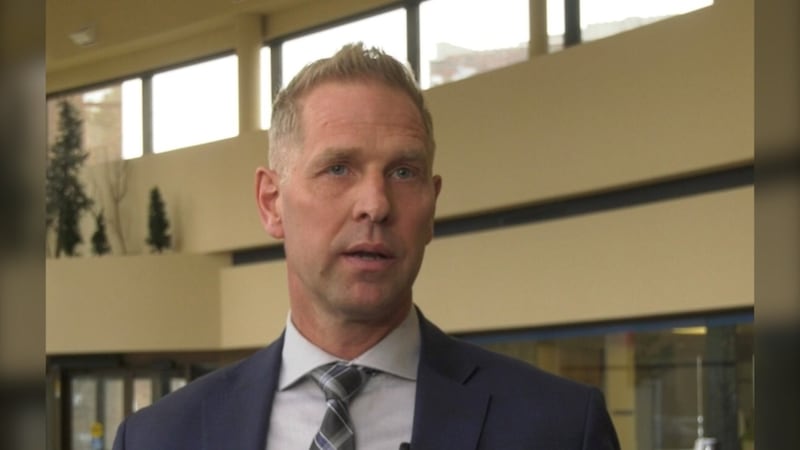
But the minister did not agree to an on-camera interview and did not address the connection to changes in disability payments.
Opposition calls transition a ‘disaster’
Alberta NDP Leader Naheed Nenshi said reports surrounding Johnson’s death should prompt the government to reconsider the transition.
“Our thoughts are with family and friends and loved ones, but with all Albertans living with disability,” Nenshi said.
“I want to reach out to Albertans living with disability, saying you matter.”
Nenshi accused the government of treating people with disabilities as “expendable” and said the transition has created significant anxiety for recipients.

“This whole thing is a disaster,” he said.
“You can’t play with people’s lives like this.”
Nenshi argued many Albertans living with disabilities are already struggling with rising costs and uncertainty.
“How are you supposed to live?” he said.
“It’s time to stop this transition.”
If you or someone you know is in crisis or struggling with mental illness, here are some resources that are available.
Canada Suicide Crisis Helpline (Call or text 988 or visit 988.ca)
Centre for Addiction and Mental Health (1-800-463-2338)
Kids Help Phone (1-800-668-6868)
If you need immediate assistance call 911 or go to the nearest hospital.

