Capital Dispatch is a weekly newsletter, sent when Parliament is in session every Friday. To stay on top of what’s happening on the Hill, you can sign up to receive the latest political news and insights directly in your inbox, here.
Can social media be made safe? Plus, big bridge drama … and no recession?
The biggest source of political intrigue in Ottawa this week was of course the breakaway and ultimately blocked ribbon cutting at the Gordie Howe International Bridge. The Bank of Canada says no recession, and the prime minister heads abroad.
Plus, the federal government thinks they can make social media safe … but when?
Here’s what you need to know.
The week that was
You’d think the Gordie Howe International Bridge that connects Windsor, Ont., and Detroit was actually a roller coaster and not an international crossing, the way this week went down.
The tumult can probably be best articulated by three quotes from Prime Minister Mark Carney, each said just one day apart.
On Tuesday, Carney said the bridge would be opening later this week, after what was a protracted standoff led by U.S. President Donald Trump over tolls, calling it “positive news.”
On Wednesday, as it seemed word of the ribbon cutting had got to the White House, the prime minister cooled his jets, telling reporters that if it takes a little longer to open, “it will take a little longer.”
Then, on Thursday as news was breaking that the two sides had agreed to delay the opening after all to “resolve outstanding issues,” raised by the Trump administration Carney asserted there was “not great drama here.”
After a week of speculation on what was going on behind the scenes, it was finally confirmed that Canada obliged an American request to delay the opening. Now, the opening date remains – much like the overall state of trade relations with the U.S. – a big TBD.
Colleague Jeremie Charron is in Windsor, covering the fallout.
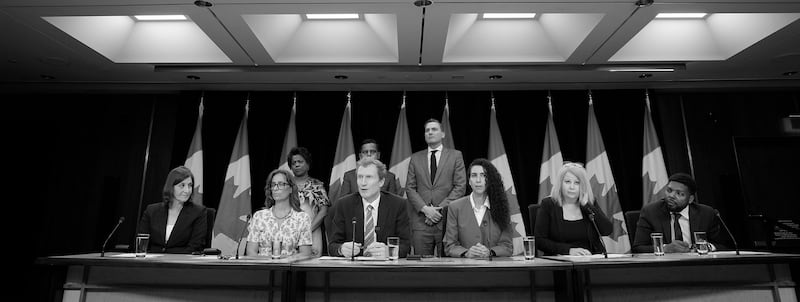
Legislatively speaking, the major event of the week was the long-awaited tabling of the Liberals’ thrice-revised online harms legislation. The latest iteration has gone through a bit of a rebrand, as the “Safe Social Media Act.”
The content is also amended from previous versions, focusing in more on social media companies and AI chat bots their “duty to act responsibly.”
And for the first time, Bill C-34 – as it’s been labelled – proposes to force platforms to block access to kids under the age of 16, unless they receive an exemption for putting adequate safeguards in place.
The big point of contention between reporters, government officials, and the minister, was around the timing of when all of these changes could come into effect. You’ll want to tune in to CTV’s Question Period this weekend for more on that, as host Vassy Kapelos will be pressing Miller on that very issue.
As could have been anticipated given the build-up and pressure put on the government by child health and safety advocates, they embraced the bill, while the tech giants said they were still assessing the legislation.
And it looks like they’ll have time to do so, as MPs now only have one sweek left before the end of the sitting. This bill isn’t on the Liberals’ fast-track list, so it’ll be chilling on the order paper until the fall. More on that below.
Not to be missed

‘Recession is not the word I would use’
Amid weeks of debate in the House of Commons on Canada slipping into a technical recession, Bank of Canada governor Tiff Macklem says that based on the data he’s seen to date, this country’s economy is weak, but “it is not clearly in recession.” “There’s been a lot of volatility, month to month, quarter to quarter, but when you look through the bumps, I mean the economy hasn’t really grown in the last year, but it hasn’t shrunk either,” Macklem said Wednesday following his interest rate announcement. Despite Macklem’s declaration, Conservative Leader Pierre Poilievre continued to criticize the government in question period Wednesday for what he’s been calling a “Liberal recession,” and seizing on the Bank of Canada governor’s use of the word “weak” instead. “That translates into lost jobs, lost homes, and bigger lineups at food banks,” Poilievre said. Energy and Natural Resources Minister Tim Hodgson then accused Poilievre of “cherry picking” his points by leaving out Macklem’s assessment that Canada is not in a recession from his line of questioning.
Canada not expecting traditional G7 joint communique
Despite agreeing to a “common set of principles” for a safer and more secure digital space for minors, leaders of G7 countries are unlikely to come to a consensus on government regulations against online harms, according to senior government officials. That news was made in a background briefing ahead of Carney’s trip to Ireland and France, which includes the meeting of seven of the world’s advanced democratic economies. CTV News senior political correspondent Mike Le Couteur is travelling with the prime minister and details here why achieving consensus around the table in France on a number of pressing issues could be just as elusive as the last time the meeting was held in that country.
Gov. Gen. Louise Arbour makes her debut
And, Canada has a new governor general. On Monday Gov. Gen. Louise Arbour was sworn in on Monday in a ceremony inside the Senate that featured traditional elements as well as personal touches. In her first speech in the new role, Arbour spoke about how her career and time in countries that are very different from Canada has exposed her to a range of perspectives and informed her belief that “it is through our differences that we will build our common future.” Here’s a full transcript of her remarks. And speaking of differences, ahead of Arbour’s installation, CTV News caught up with honoured guest former prime minister Jean Chretien, who had some choice words about Alberta Premier Danielle Smith’s fall referendum.
Quote of the week
“I think we know that social media can be made safe by design, that these responsibilities are important on platforms, and there are platforms for kids under 15 that can be used responsibly. There’s an important role here that falls on two sets of shoulders, one of which has been overburdened heavily in the last while, which is parents. There is a role for parents here. One of the considerations was in looking at this bill is to consider what the federal government or the state can or should do and what parents can or should do. We’re not substituting our judgment for those parents. And there are platforms that can be made safe. We believe that is the case. So, too with chatbots. The second element in this, which is a very important piece of the puzzle in a place like Canada where we are a federation, is the role of the provinces. Provinces have a responsibility and a duty to make kids safe in this environment as well, that falls on their responsibility principally in the classroom. And I know a lot of governments and my colleagues that are my counterparts and provinces have reached out about bans in classrooms and regulating platforms in their way. This is stuff we’ll have to do in partnership, but it is key to making sure that kids have a safer experience in this country in their online experiences and actually get out and play… We just put three quarters of a million dollars into sports. That hasn’t been done in 20 years. Hopefully this creates a space where kids have something to do outside like I did 20 years ago.”
— - Minister of Canadian Identity and Culture Marc Miller, unveiling the new-new-new online harms bill
The week ahead

It looks like MPs are taking the spring sitting right to the bitter end. Despite some fleeting chatter about the House of Commons rising early – about as predictable of Hill gossip as the blooming of tulips are in this city – they’re sticking around until next week.
Amid the typical flurry of accusations of both sides in the Chamber ragging the legislative puck and using dilatory tactics with indiscretion, Government House Leader Steven MacKinnon has indicated there’s still bills to pass before Saint-Jean-Baptiste Day.
So what’s on the agenda as a must-do? Well, the government has moved to restrict how much more time can be spent before the spring economic update legislation gets voted on, they want to sort through some Senate amendments to the bail reform bill, and then tie up some loose ends with other lower-stakes pieces of legislation.
And, as many House leaders have done before him, he’s asking for opposition party members to “work with” the government – read: not obstruct – in the final days before summer.
Covering the latest political news from CTV’s parliamentary bureau in Ottawa, Rachel Aiello offers exclusive analysis on political developments straight from Ottawa.

