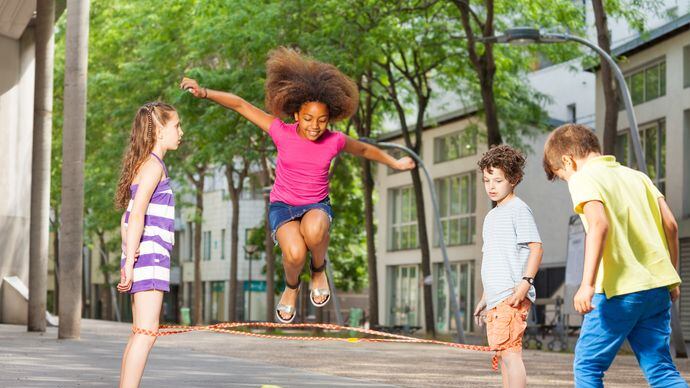
As Canada marks the United Nations International Day of Play this week, a global children’s charity is raising concerns about what it says is a decline in unstructured outdoor play and the impact it could have on children’s development and well-being.
“Kids are playing less globally than previous generations, and that’s driven by a lot of different factors,” said Jessie Thomson, CEO of Right To Play International.
“I think as parents, we all know that digitalization, AI (and) social media is pulling kids away from play, physical play, but also just free play.”
The organization, which uses play-based programming to support children in vulnerable communities around the world, says the issue extends far beyond recreation.
Thomson said a recent consultation involving 10,000 children highlighted some of the barriers young people face.
“One in three children told us that they didn’t have enough time to play. One in five children told us that they didn’t have a safe place to play, and one in four children told us that they didn’t have anyone to play with.”
She said the consequences can be significant.
“When kids don’t play, they don’t learn and grow in the way that they need to. But we also know it has a tremendously important impact on their mental health and on their physical health and on their overall well-being.”
In Calgary, some parents are turning to outdoor play programs in an effort to reconnect children with nature.
Opportunities for unstructured play
Eight-year-old Jonathan Chan spends his days climbing trees, digging holes and exploring the outdoors through a forest-based play program operated by Nature Play Limited.
“I can just be in my own bubble away from the world,” he said.
Owner Devon Karchut, a physiotherapist who works with children, said her son inspired her to create the program.
“We have a forest school program and then a therapy-based program, so giving kids, who in the city might not get lots of chances to play outside in nature, ensuring that that happens for them,” she said.
Karchut believes opportunities for unstructured outdoor play are more important than ever.
“Taking that away has really shifted so many areas of child development that we’re now having to kind of fix, I guess, in a way, or think about how we can bring that back because that unstructured outside time is so vital for kids.”
The issue is also a focus of Right To Play’s annual Heroes Gala in Toronto, which is raising funds for play-based programs in Canada and abroad.
The organization supports more than 60 Indigenous communities across Canada and works internationally with children facing adversity, conflict and displacement.
Former Canadian sprinter and Right To Play ambassador Sam Effah said he has seen firsthand how play can transform young lives.
“I’ve seen how a soccer ball can change an environment from maybe a struggle or frustration to confidence,” he said.
Effah said the benefits of play extend far beyond sports.
“It helps people to participate, (and with) gender equity. In some countries across the world, not everybody has an opportunity. So I think using play as the catalyst to be able to do that is huge, and I’ve seen it firsthand, whether I’m in Calgary or I’ve been back to Guyana.”

