


TORONTO — The first major heat wave of the summer for Ontario and Quebec is settling in this week, with sweltering conditions expected to last several days and humidex values climbing into the 40s.
But in downtown Toronto, most people who spoke with CTV News welcomed what lies ahead.
“It was pretty cold last week so it’s nice to finally have some hot weather,” said one man.
Another passerby said she was “kind of disgusted” by the forecast but added that “winter makes me sad, so I’ll take the heat.”
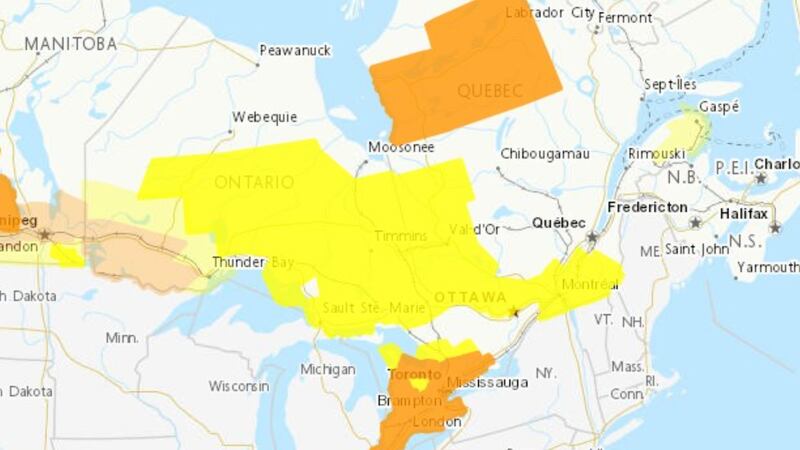
Parts of both provinces are under orange or yellow heat warnings through Friday, and possibly into the weekend. Environment Canada says the humidex could reach 45 C in Windsor, Ont., on Tuesday.
In Toronto, temperatures are set to climb above 30 C for at least the next six days.
“This one has the intensity and the duration to make it quite serious,” says Environment and Climate Change Canada climatologist David Phillips.
For anyone planning to attend outdoor events on Canada Day, it will be a hot one. The air temperature in Toronto is expected to hit 35 C, which Phillips says may come close to the record for that day. He added that Windsor is expected to break its record.
Overnight lows in Toronto aren’t expected to dip below 23 C until Saturday, which will likely make it difficult to sleep for those without air conditioning.

Phillips says the weather isn’t connected to the heat wave that has gripped Europe, but is similar in that it’s the result of a very large high-pressure area that won’t budge.
“It has built in the United States, the eastern seaboard, and it is just pumping like a heat pump, pumping this warm moist air from the Gulf of Mexico up into Canada,” said Phillips.
The scorching temperatures are also being felt across many parts of the United States, from Michigan to the Gulf Coast.
Officials are urging people to watch for the early signs of heat exhaustion, which can include headache, nausea, dizziness, thirst, dark urine and intense fatigue. They are also asking people to check on older adults, those living alone and others at risk.
‘Extreme heat is dangerous’
Dr. Christopher Labos, an epidemiologist and cardiologist, said the danger should not be underestimated.
“I think people need to remember that extreme heat is dangerous, especially to older individuals, especially to people with pre-existing medical problems,” he said.
Labos said the best strategy is to avoid going outside, particularly during the daytime.
“This is not the time to go outside running. This is not the time to do your gardening. This is not the time to do outside work around the house,” he said. “You really should try to stay somewhere that is cool.”
He added: “People die of heat stroke. That’s why we’re seeing the spike in mortality we’re seeing now across Europe.”
Phillips says the first heat wave of the summer is usually the one that’s toughest on people.
“Often the first one, from a health point of view, is the worst one, because, of course, we’re not acclimatized to it.”

