MISSISSAUGA, Ont. -- After surviving a daring escape by sea, Dong Guangping, an indomitable 68-year-old Chinese dissident who has been a thorn in the side of China’s authoritarian government for decades is now rebuilding his life in Canada.
On Friday, Dong walked off an Air Canada flight from Seoul, South Korea, and was welcomed by a group of Canadian supporters who have been trying for 11 years to get him to safety in Canada. His supporters may have seen on video calls, but had never met Dong in person until his arrival.
Dong was handed a bouquet of flowers, then participated in a FaceTime call with a Canadian immigration officer who welcomed him to Canada.
First TV interview
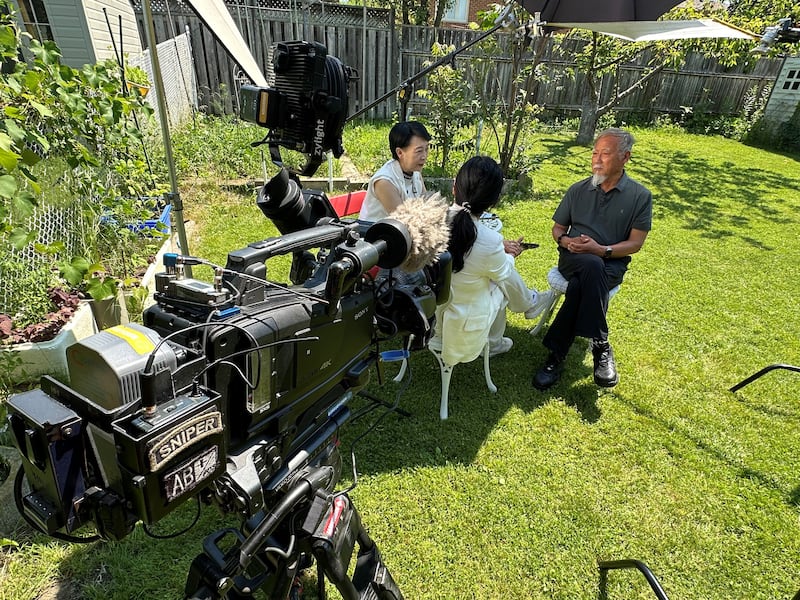
In his first broadcast television interview, Dong provided CTV News with more details about his escape and the network of friends who helped him evade capture.
The former police officer and soldier had been imprisoned for several years after criticizing the Chinese government’s 1989 violent crackdown of protesters at Tiananmen Square. His time in custody alternated between between jails and house arrest with guards stationed outside his door.
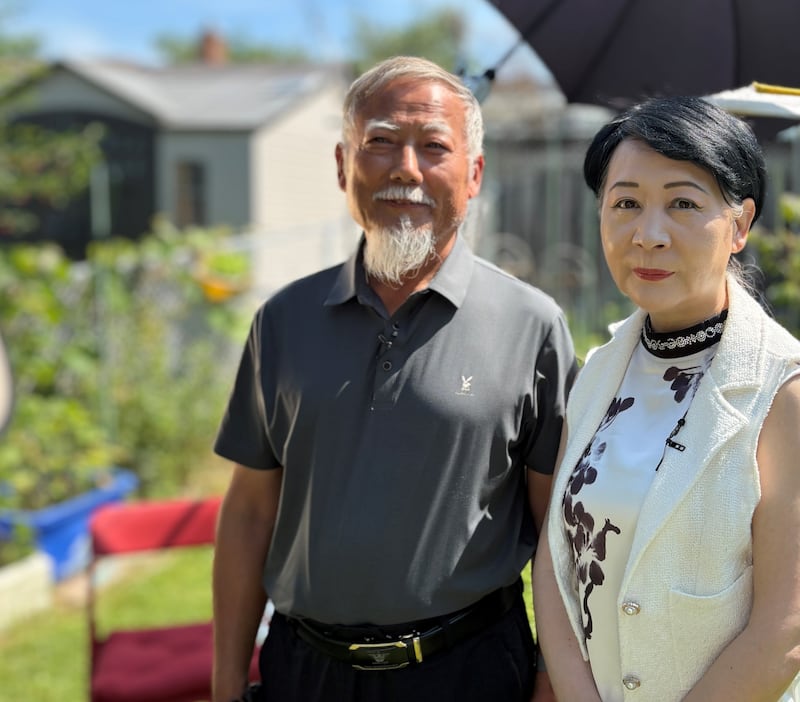
“The Chinese communist regime can try to kill me, but they cannot kill my dream. My dream is that I live where that allows me to think freely and to express myself,” Dong said with translation help from his friend, Sheng Xue, a fellow human rights activist who lives in the Greater Toronto Area.
A plan two years in the making
Dong said that he had been planning his escape for two years and that this was his fourth attempt at fleeing the Communist regime.
“I had already tried to go by water to Taiwan. Some people go north to Russia and others go west to India. I thought about everything. I knew I had to go east toward Korea even if it was dangerous,” Dong said.
Prior to the escape, he was on house arrest in the city of Zhengzhou in Henan Province. With help from supporters, Dong made it to the northeast coast. He says he was able to get a three-metre long rubber, inflatable raft and a “bad quality” outboard motor.
He packed some beef, chicken and crackers and pushed off the shore at 4 a.m. on May 24. He used a cellphone for GPS navigation to cross the Yellow Sea.
After being battered by waves for 40 hours, his chances of survival were fading like his cellphone battery.
“Without the battery, I would die. I would have no map. No direction…then I saw bright lights.”
The rescue
Those lights were from a boat belonging to a group of fishermen who pulled his exhausted body out the water and helped him contact the South Korean coast guard. He was then taken to an immigration centre in Incheon and questioned for “suspected immigration violations.”
He waited for a month, while human rights lawyers and activists lobbied the Korean and Canadian governments for his release. Thirty-two days after he was rescued, Dong was told he would be put on a flight from Seoul to Toronto. Dong was doubtful, until he was handed an Air Canada ticket.
“I didn’t believe until I saw Toronto (on the ticket).” Dong’s skeptism stemmed from two previous attempts where officials lied to him, or blocked his passage.
Previous attempts
In September 2015, when Dong fled China for the first time, he was accompanied by his wife and daughter. The family had documentation indicating they were United Nations refugees and had been approved for a refugee resettlement program in Canada. But Dong was flagged for secondary screening and separated from his wife and child. He was told that he would be put on a plane with his family, only to be deported back to China.
When he landed, Dong said, he was put in solitary confinement for five months, in a dark windowless cell. Dong, who was the son of a senior military official, was never beaten, but says the Chinese government tried to break his spirit.
He was handcuffed 24 hours a day and watched by two guards.
“They were ordered not to speak to me. I have nothing to do. I cannot read. I can only sit there and sleep.”
It was during that time that Dong and Sheng first connected over their shared anger at the Chinese Communist Party (CCP) and its actions, on June 4, 1989.
That day, Sheng was among the tens of thousands of people participating in pro-democracy demonstrations in Tiananmen Square. She saw the tanks roll in and the military open fire on protesters. After the crackdown, Sheng came to Canada to study, became a Canadian and continued to be a strong voice in the overseas Chinese pro-democracy movement. Sheng said when she learned of Dong’s ordeal, she vowed to help bring him to Canada.
In December 2019, Dong tried to flee for a second time after his release from prison. He broke free of a distracted guard and tried to swim to Taiwan. After being in the water for ten hours, he clung on to a plastic board and placed a phone call to Sheng.
“I picked up the phone and Dong said he needed help, but he didn’t know where he was,” recalls Sheng. Dong would eventually be found by Chinese fishermen who brought him to shore and turned him over to the CCP.
In 2020, Dong would escape again, this time making it to Vietnam. Sheng and her network of activists would help to hide him for two years. In August 2022, while waiting for Canadian officials to convince the Vietnamese government to let him leave, Dong was arrested by a swarm of police officers who placed a black hood over his head.
His “kidnapping” was followed by months of silence as Dong’s desperate daughter pleaded with Beijing to release her father.
‘A power above us’
Now four years later, Dong will finally get his wish and be reunited with his family. At 68 years old he says he’ll work as an Uber driver, until he gets a commercial trucking licence.
After listening to Dong recount his perilous journey to South Korea, Sheng busies herself in the kitchen making his favorite food: tomato, shrimp and egg noodle soup.
She says she feels honoured to have helped him in his journey.
“I feel there must be a power above us. Because this is so amazing…he never gave up. This is not a dream (just) for him or for me, but it’s a dream (come true) for people who want to get out of persecution and to embrace freedom.”