OTTAWA — Canadians are evenly split on whether they believe the proposed Alto high-speed rail project should be a government priority, according to the latest data from Nanos Research, commissioned by CTV News.
The multi-billion-dollar infrastructure project would connect Quebec City to Toronto and promises to cut travel times between those cities in half.
The federal government recently concluded its 100-day public consultation process, with a report published late last month on the findings.
Last month, federal Transport Minister Steven MacKinnon announced a proposed stop in Kingston, Ont.
But the projects have faced significant pushback, including from more than a dozen municipalities who oppose it, and from federal Conservative Leader Pierre Poilievre, who’s called it a “waste of money” and said he would cancel the project altogether if he became prime minister.
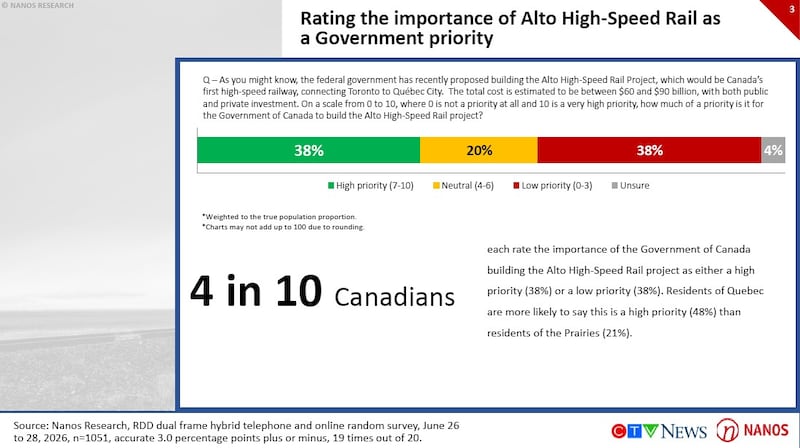
According to Nanos Research, when asked how respondents would rate the project from zero to 10 as a priority for the government, 38 per cent of people said it should be “high priority,” 38 per cent said it should be “low priority,” and 20 per cent were neutral.
Four per cent of people said they were unsure.
Support for the project as a government priority varies by region. According to the numbers, support for the project is strongest in Quebec and opposition is highest in the Prairies.
In Quebec, 48.4 per cent of respondents said Alto should be a government high-priority project, compared to 42.9 per cent in Ontario, 37.9 per cent in Atlantic Canada, 30.9 per cent in British Columbia, and only 21.4 per cent in the Prairies.
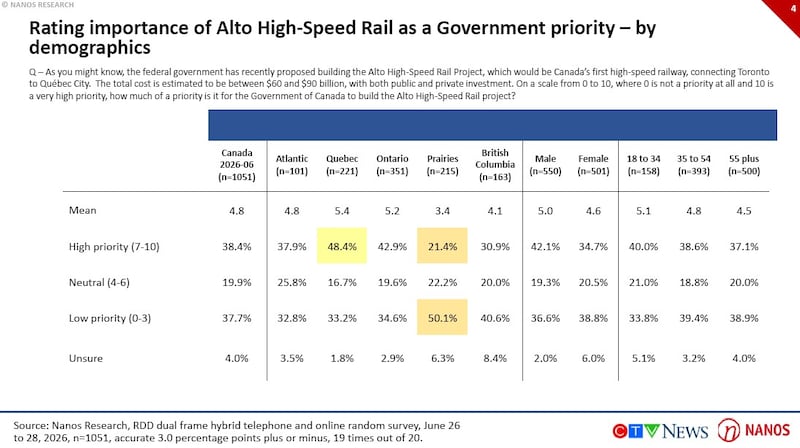
The Prairies, meanwhile, had 50.1 per cent of respondents say the project should be low priority, compared to 40.6 per cent of people in B.C. who said the same, 34.6 per cent of people in Ontario, 33.2 per cent in Quebec, and 32.8 per cent in Atlantic Canada.
People in Atlantic Canada were the most likely to say they’re neutral, at 25.8 per cent, followed by the Prairies, at 22.2 per cent. The region with the smallest percentage of neutral respondents was Quebec, at 16.7 per cent.
With files from CTV News’ Vassy Kapelos and Graham Richardson
Methodology: Nanos conducted an RDD dual frame (land- and cell-lines) hybrid telephone and online random survey of 1,051 Canadians, 18 years of age or older, from June 26 to 28, 2026 as part of an omnibus survey. The sample included both land- and cell lines across Canada. The results were statistically checked and weighted by age and gender using the latest Census information and the sample is geographically stratified to be representative of Canada. Individuals randomly called using random digit dialling with a maximum of five call backs. The margin of error for this survey is ±3.0 percentage points, 19 times out of 20.

