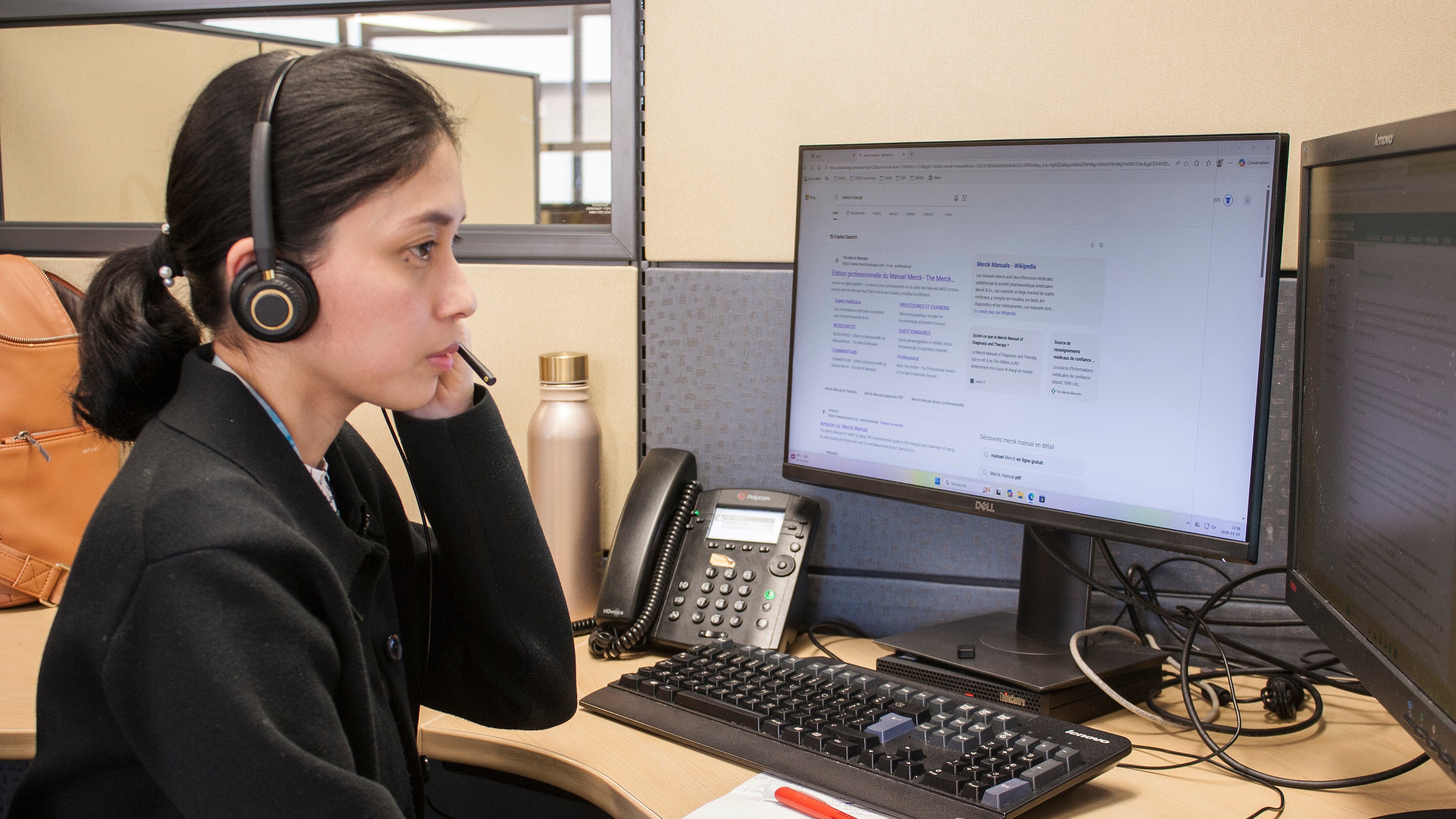
Quebec’s Info-Santé 811 phone consultation line has become the first health service of its kind in Canada to use AI to help improve its service.
The service provides Quebecers with free, confidential health-care advice by phone 24 hours a day, 365 days a year. Calls are answered by the first available nurse from one of 15 call centres across the province.
Now, callers who select the influenza or gastroenteritis option for adults are transferred to a non-clinical agent who uses an AI-powered app called Navig to help patients.
The app uses an AI system that contains many prompts and recommendations that have been validated by clinicians, helping agents with the questions to ask next and what course of action to suggest to patients.
This includes speaking with an Info-Santé nurse, visiting a pharmacy or an emergency department, contacting the poison control centre or SOS Pregnancy, or booking an appointment with a medical specialist.
According to a media spokesperson for Santé Québec, the change has reduced wait times for callers seeking help about influenza or gastroenteritis and eased nurses’ workloads.
As a result, nurses can take more calls and focus on more complex or urgent cases.
“Navig has reorganized the system and helped orient calls better, which has improved the service,” she told CTV News.
Reorganizing calls to enhance service
The AI technology was implemented in April after completing two pilot phases over the last two years.
According to Santé Québec, between February and June of this year, the service received 17,366 calls related to influenza or gastroenteritis for adults.
Of those calls, approximately 5,000 were handled by agents using the AI-powered app, while about 12,000 were answered by nurses.
Before the implementation of the AI technology, all those calls would have been answered by a nurse.
“It doesn’t seem like much, but given the volume of calls we receive, it is a significant impact,” Santé Québec told CTV News.
Callers who selected the influenza or gastroenteritis for adults option previously waited nearly an hour to receive advice, but now, that wait time has been reduced to about 15 minutes, Santé Québec says.
Shorter wait times, fewer calls to nurses
Kathy Malas is the director of quality, innovation and value for the Santé Québec West-Central Montreal Health and Social Services University Network and chief artificial intelligence officer with the team that developed the AI-powered app.
She says they have spent nearly three years developing the app.
“The technology is helping agents orient the patient better. Callers are waiting less, and we’ve reduced the number of calls being routed to a nurse,” Malas told CTV News.
Agents using the app first conduct a screening to rule out any life-threatening emergencies and determine if a patient needs to be transferred to a nurse.
Agents do not give clinical assessments but instead manage straightforward cases that do not require a nurse’s intervention.
“One of the pain points in our health-care system is that a nurse spends 15 to 40 per cent in administrative work,” she said.
“If you remove all this time and you give it back, the nurse will be able to use the scope of their practice to its full potential, and the agent can orient patients to the different options.”
Following the positive results on Quebec’s 811 phone line, Malas has also been involved in deploying the AI technology to the phone booking systems used by Groupe de médecine de famille (GMFs).
Similarly, the AI technology is helping patients reach the appropriate health-care provider more quickly and efficiently, she says.
Long-term vision for 811
While the AI technology has improved the service, call volumes remain high, according to Santé Québec.
The 811 phone line receives about 2 million calls a year. On average, the service handles about 6,000 calls a day, including about 300 related to influenza or gastroenteritis.
Wait times to speak to a nurse are at least an hour, and calls last 30 minutes or longer.
Santé Québec says its long-term goal is to implement the AI technology beyond its current use for influenza and gastroenteritis in adults, and to apply it to all calls across Info-Santé.
They also plan to implement the technology within Info-Social services.
“We have a long-term vision to first have an AI agent that screens rapidly, second, a human supported by AI, and third, the correct orientation,” Malas said.
“That’s the vision of how to integrate AI ethically and responsibly in health care and health practices. The need for something like this is essential today in our health organizations.”

