


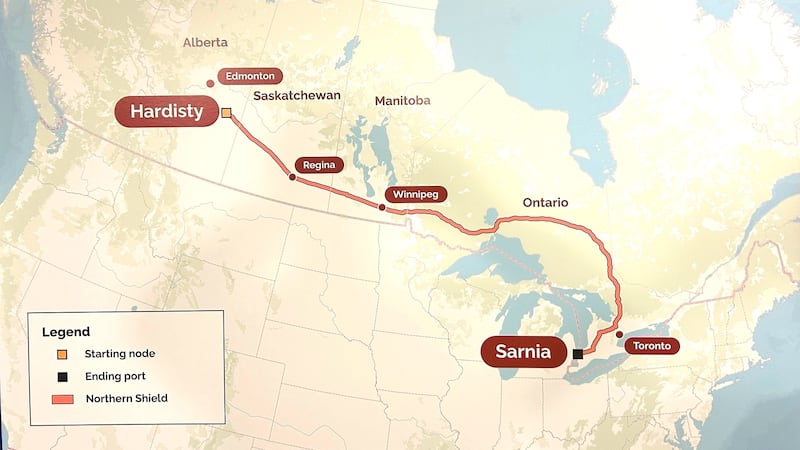
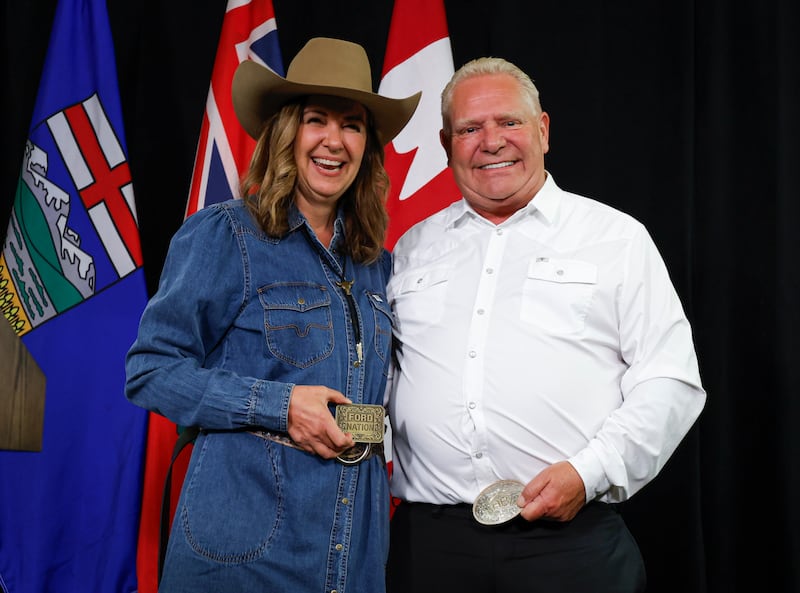
Ontario Premier Doug Ford and Alberta Premier Danielle Smith have unveiled a proposed route for a new west-east crude oil pipeline that would run from Alberta to Ontario.
The Northern Shield Energy Corridor would carry oil about 3,300 kilometres from Hardisty, Alta., to Sarnia, Ont., where it would connect with Ontario’s refining belt.
The project is being pitched as a way to strengthen Canadian energy security, reduce reliance on foreign markets, create jobs and open new markets for Canadian oil.
The proposed pipeline would move about 500,000 barrels of oil per day for domestic use and export, with the potential to expand to 800,000 barrels per day.
The route would remain entirely within Canada and would be built using Canadian steel.
The Ontario government says it is also exploring possible pipeline extensions to new and existing ports, including an option that would allow Manitoba and the Manitoba-Crown Indigenous Corporation to study a possible extension to the Port of Churchill.
“By connecting Alberta’s energy with Canadian refineries and markets, we can create jobs, grow our economy and make better use of the world-class resources we already have,” Smith said in a news release.
“Alberta is committed to working with provincial and federal partners to turn this opportunity into reality. A new west-east pipeline will connect Canadian energy with Canadian consumers while laying the foundation for future growth.”
Ford says the project is aimed at protecting workers and building a more secure Canadian economy.
“Our plan to build the Northern Shield Energy Corridor is a plan to protect workers in Ontario, Alberta and every part of the country,” he said.
“We’re going to keep working to build a more secure, united and resilient Canadian economy, so we can keep Canadian workers on the job, make life more affordable for Canadian families and help get Canadian energy to new markets across the country and around the world.”
Greenpeace Canada criticized the proposal, saying there is no private proponent for the project because there is no business case.
Keith Stewart, senior energy strategist with the environment group, said public money should not be used to subsidize a new fossil fuel pipeline.
“Why not cut out the middleman and just have Canadians send their tax dollars directly to ExxonMobil?” Stewart said. “There is no private proponent for this pipeline because there’s no business case.”
Stewart said electric vehicles, heat pumps, wind and solar power are cheaper, cleaner and faster to deploy than major fossil fuel infrastructure projects.
He also said much of Alberta’s oil already reaches Ontario through existing pipeline routes that pass through the United States.
“Spending what’s probably going to be on the order of $40 billion, $50 billion (in) public money to subsidize oil companies building a new pipeline doesn’t make sense when we should be looking at getting Ontarians, Quebecers, everyone into electric vehicles,” Stewart said.
He said Energy East was studied years ago and ultimately abandoned because it didn’t make economic sense.
“The only way this gets built is if you and I pay for it,” Stewart said.
Heather Exner-Pirot, director of energy, natural resources and environment at the Macdonald-Laurier Institute, said the proposal appears to be driven more by energy security and sovereignty than by a commercial business case, although she says there’s still “good reasons to invest in security and sovereignty.”
Exner-Pirot said Sarnia is currently supplied through Enbridge Line 5, which runs under the Great Lakes and has faced political pressure in Michigan.
“It’s been under a lot of political risk,” she said. “The governor of Michigan and a coalition of activists have been trying to shut it down, literally stop it, for several years.”
She said a west-to-east pipeline may be easier to justify as a public investment if it’s seen as a matter of domestic energy security, but the cost still has to be weighed carefully.
But still, there’s still work to be done to determine whether the project is worth the cost, Exner-Pirot said.
The proposal stems from a memorandum of understanding between Ontario, Alberta and Saskatchewan focused on new energy and trade infrastructure.
Ontario says a feasibility study is underway and is expected to be completed by the end of 2026.
The province also says it has started its duty to consult with Indigenous partners and communities.

