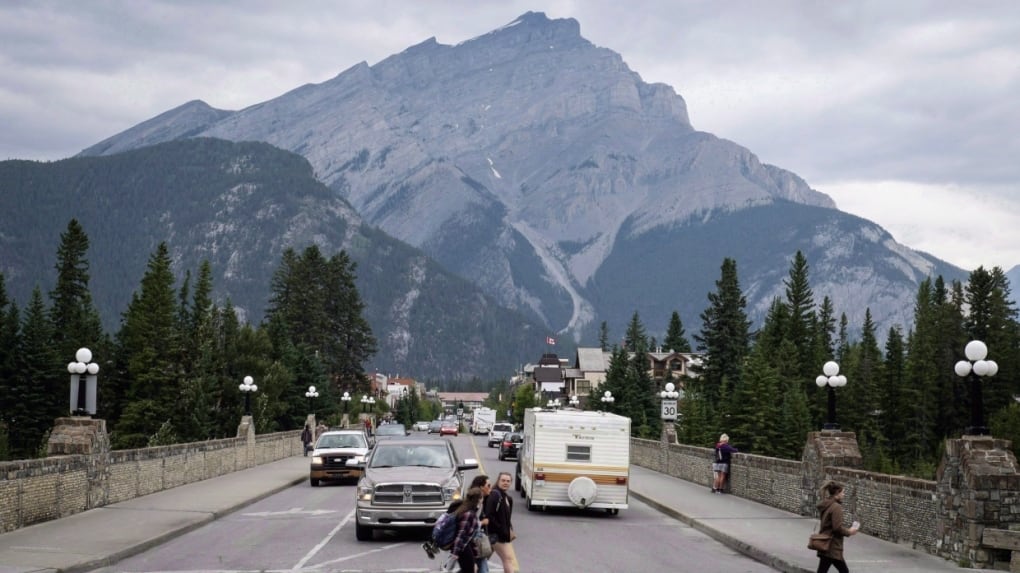
The summer season is ramping up, with millions of visitors from around the world flocking to Alberta’s mountain communities.
The Canada Strong Pass, a federal program that allows free entry to Canada’s national parks and historic sites, is making it even easier for those guests to reach the Rockies, but some locals aren’t happy about it.
“It’s definitely being abused. The town definitely doesn’t need any more volume, especially traffic-wise,” said Kyle Mills, who has lived in Banff for the past 24 years.
“I don’t have a parking spot for my vehicle, so I have to use the resident street parking ones and those are not enforced whatsoever.”
- Sign up for breaking news alerts from CTV News, right at your fingertips
- The information you need to know, sent directly to you: Download the CTV News App
The pass was originally introduced by Prime Minister Mark Carney in 2025 to encourage domestic travel and help Canadians save money, but it also applies to all international visitors too.
In addition to free admission to national parks, the Canada Strong Pass also provides open access to museums and art galleries and discounts on stays at campgrounds and travel with VIA Rail.
The Carney government renewed the program for the 2026 season despite criticism that it put undue strain on the resources and infrastructure of mountain communities such as Banff and Jasper.
“We think that the Canada Strong Pass is a great initiative in terms of bringing Canadians to national parks, particularly new Canadians, however, it does cause additional pressures on the town of Banff,” Corrie DiManno, Banff’s mayor, told CTV News in an interview this week.
DiManno says Banff is expecting a very busy summer, building on a record number of just under seven million visitor vehicles set in 2025.
“1.8 million were in July and August each and that was record-breaking as well. So, we’re expecting to see the same and part of that is the Canada Strong Pass incentivizing day visitors into the town.”

DiManno says the existence of the Canada Strong Pass is more of a “nice surprise” for international visitors.
“I don’t believe that that is a motivating factor for people to come from far away, however it is a motivating factor for our day visitors,” she said.
“We are close to Calgary, one of the fastest growing communities in Canada in one of the fastest growing regions.”
DiManno says this pressure has pushed them toward modifying their messaging to visitors.
“We’re just getting into our summer season. Usually Canada Day is good indication of what’s to come, but our vehicle volume was down 11 per cent (on July 1).”
She believes it was likely due to the holiday being a Wednesday but was also surprised about the increase in transit traffic in the town.
“Our transit stats are up 28 per cent from last June while our visitor vehicle numbers have gone down by about two per cent,” DiManno said.
This trend has helped shape Banff’s policies on transit, where it has worked to encourage more people to hop on a bus to visit the mountains instead of taking their own vehicle to explore.
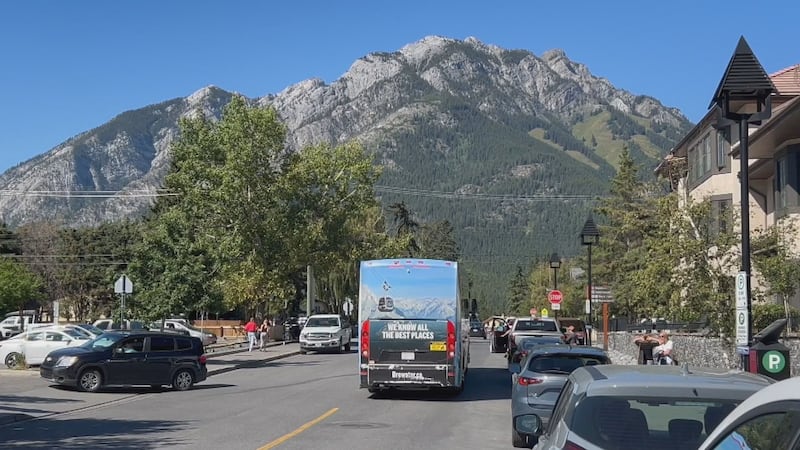
“We really strongly urge people to learn about all the ways they can get here without a car because the reality is, our parking lots are full at 10 a.m. in summertime.”
Paying for parking ‘not a deterrent’
DiManno says Banff only has about 1,400 publicly available stalls. Given that the town is located within a national park, it doesn’t have any ability to expand to build more spots.
“(It’s) something we are grateful for. We don’t believe trying to build our way out of this is the solution.”
While all vehicles can enter Banff National Park for free, parking those vehicles still comes with a cost. DiManno said the town installed a paid parking program in 2021.
The fee per hour of parking in the town is currently $12, an increase from $7 per hour in May.
DiManno says the fee hasn’t slowed down the thirst for parking in the town.
“Paying for parking did not do anything to really help with stall turnover. Last year we saw parking at over 100 per cent occupancy, so that’s a crazy statistic,” she said.
“It really showed us that price was not a deterrent for folks staying parked.”
With nowhere to park, she says it just adds to the problem of traffic in the townsite as people circle around, looking for a place to stop.
Without any free parking spots, DiManno said some visitors are also breaking the rules.
“The last couple summers I would categorize has having illegal parking; people parking in really wacky and kooky places.”
Banff’s bylaw officers have responded to those calls and drivers have been ticketed. In some cases, DiManno said the town has worked with partners to tow vehicles, but the main aim of its traffic enforcement strategy is education.
“We know that people are really desperate to find a spot, which is why we suggest coming here by transit to begin with or, once you’re here, trying to park in the outskirts of town like the train station.”
All parking fees collected are used to fund several programs in the town of Banff such as free transit services for locals, e-bike rebates for residents, new Banff Transit buses and even infrastructure upgrades.
Pass is good for Canada: businesses and tourists
Some business owners say they don’t see any issues with the pass, adding it’s a real boost to their bottom line.
“It’s good overall for the economy of the country,” said Stephane Prevost, chef and owner of Banff’s Block Kitchen + Bar.
“Visitor levels have increased all across the country, stimulating the economy in a positive way.”
He acknowledges that the pass has led to some concern about overcrowding, but there are plenty of other peaceful and tranquil spots in Banff for visitors to enjoy.
Andrew Wilson, from Bridgewater, N.S., took advantage of the Canada Strong Pass, which allowed him and his family to enter Banff National Park without paying at the gate.
“We would have come regardless, but just having the opportunity to do it is great for everybody.”
He is for the program, saying it is great to have international visitors experience all that the country has to offer.
“It’s a great way to celebrate Canada.”
Another visitor, Steven Zammrt from Sydney, Australia, couldn’t pass up the opportunity to come to Lake Louise on his first trip to Canada.
“It’s absolutely stunning,” he said.
Zammrt didn’t know about the pass but thought it was “quite surprising” to be able to enter all Canada’s national parks for free.
“The tourists around here are all pretty friendly and it’s a great place to come and look at.”
Even without the pass, he says he would still visit.
“We’ve done some travelling around New Zealand and this place just blows it out of the water.”
Senator not convinced by Canada Strong Pass
Alberta Senator Karen Sorensen, former mayor of Banff and resident herself, told CTV News that while the pass will encourage tourism, it might not be “the best mechanism” to accomplish that.
“The current program encourages visitation to some already popular destinations like Banff National Park. This has exasperated issues with overcrowding and traffic congestion for tourists and residents alike,” Sorensen said in a statement to CTV News.
She believes it would be better for the government to install a policy to allow Canadians to experience more of their home country, including all its hidden gems.
Mills agrees with the idea of the Canada Strong Pass being only available to Canadians.
“It gets people from within our country to come and see the beautiful national park and everything,” he said.
“I think if there was a small fee for international travellers, if they’re coming all this way, it’s not necessarily a bad way to make some extra money.”
The 2026 Canada Strong pass is in effect until Sept. 7.
With files from Tyler Barrow

