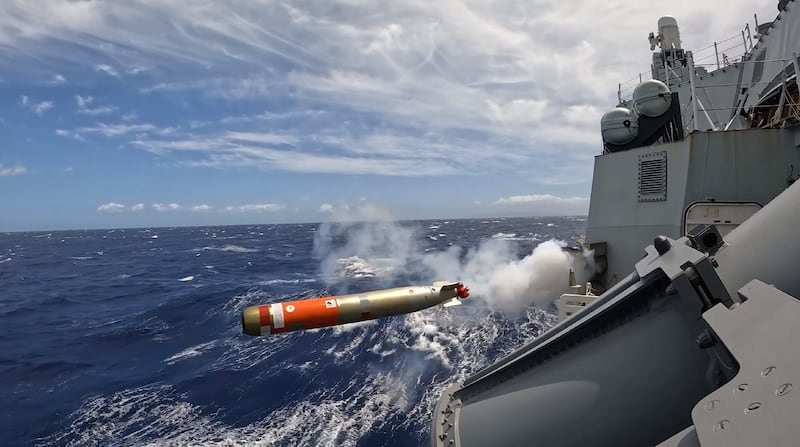
A Canadian warship successfully test-fired a pair of torpedoes this week, giving the Royal Canadian Navy its first chance to evaluate a major upgrade to its anti-submarine warfare capabilities.
HMCS Ottawa, one of two Canadian frigates deployed to Hawaii for the Rim of the Pacific (RIMPAC) exercise, fired and recovered the Mark 46 torpedoes amid the world’s largest naval gathering, involving an estimated 25,000 personnel from 31 partner nations.
While such a test might sound routine, for the Canadian navy it’s anything but.
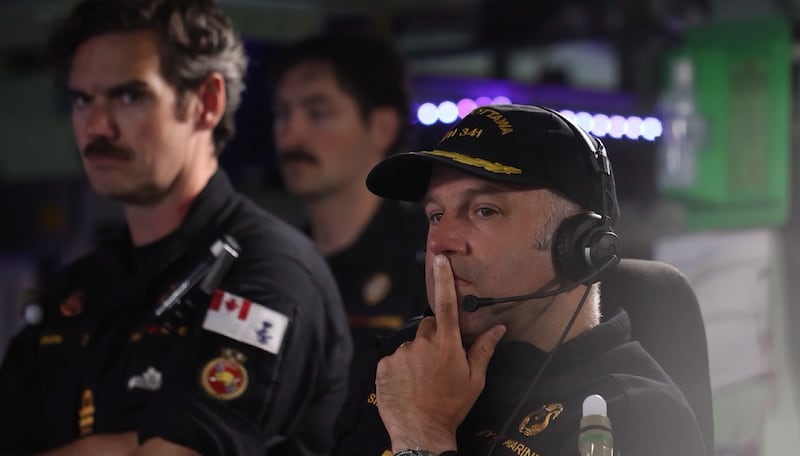
“I’ve been in the navy for 20 years and it’s the first time that I fired a torpedo,” said Cmdr. Justin Simmons, the ship’s commanding officer, in a phone interview from HMCS Ottawa. “It was really something long in the planning.
The July 7 demonstration had a dual purpose: providing sailors with the rare opportunity to conduct the simulated combat scenario, while also testing the ship’s newly installed underwater warfare system under operational conditions.
The system, dubbed the Underwater Warfare Suite Upgrade (UWSU), comprises a suite of next-generation sensors designed to detect and deter modern submarines and torpedoes.
The upgraded system, which replaces the frigate’s legacy anti-submarine equipment with improved detection of quieter threats at greater distances, is expected to be implemented across the Halifax-class fleet by 2034.
The technology includes active intercept sensors and a towed low-frequency sonar array that the Department of National Defence says increases the detectability of targets in both open-ocean and near-shore environments.
Simmons compares the improvements to the introduction of the iPhone.
“It’s a real gamechanger for us,” he said. “This new system is so new, so advanced that we’re continuously learning from it.”
HMCS Ottawa is one of only two Royal Canadian Navy ships currently fitted with the upgraded system and the first West Coast frigate to receive its latest configuration, making it the navy’s primary operational test platform.
Sister ship HMCS Regina is also expected to demonstrate a newly introduced capability by conducting a live firing of the Evolved Sea Sparrow Block II missile at RIMPAC next week.
The upgraded air-defence interceptor uses its own active radar seeker to guide itself to airborne threats, a significant improvement over the previous version, which relied primarily on the launching ship’s radar.
Canada’s presence at RIMPAC also includes submarine HMCS Corner Brook, the replenishment ship MV Asterix, a CP-140 Aurora long-range patrol plane, two CH-148 Cyclone maritime helicopters and more than 800 Canadian Armed Forces members.
This year marks the 30th edition of the biennial RIMPAC war games, which began in 1971. Canada has participated in every iteration of the exercise as a founding member alongside the United States and Australia.