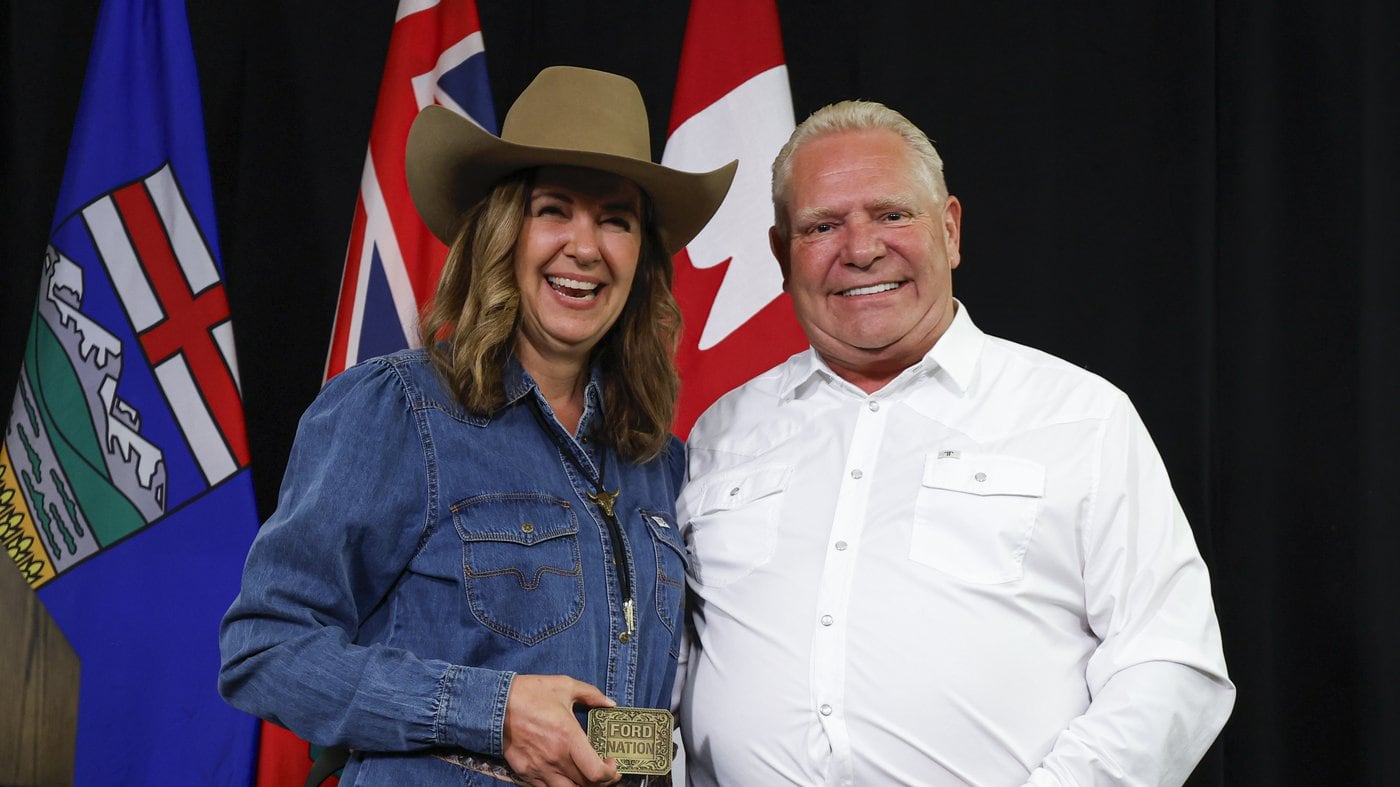
CALGARY — The Calgary Stampede is more than a rodeo. It’s a runway for western fashion that politicians strut down each year.
Politicians of all stripes attend the annual exhibition and rodeo, considered a celebration of everything western.
The cowboy hats, belt buckles, denim and boots that leaders pull on show that politics and wardrobe go hand in hand, say fashion experts.
“Stampede is really about performance. It’s not just Sunday best. It’s something else,” said Paul Hardy, a Canadian designer.
“Every self-respecting Albertan has a small section in their closet of western wear, and people turn out (in it). It just is part of the culture here.
“It is a social phenomenon that surprises me to this day.”
The Stampede’s website says western wear is encouraged.
And politicians follow the dress code.
Prime Minister Mark Carney, federal Opposition Leader Pierre Poilievre, Ontario Premier Doug Ford and, of course, Alberta Premier Danielle Smith have all been spotted in their western wear at the event this year.
Their duds show politics is about more than policies, said Anne Bissonnette, dress historian and professor at the University of Alberta.
“Politicians and others understand that through what they wear, they are building into the story they’re weaving for their audiences. So it’s about character development,” she said.
Poilievre, for example, was in the spotlight last weekend for a white embroidered shirt he wore with a matching white cowboy hat during a speech he gave criticizing Liberal government policies.
“We will re-instil a warrior culture, not a woke culture,” the Conservative leader said near the end of his speech.
The shirt, which appeared super shiny, was mocked online and sparked several memes.
Hardy compared Poilievre’s outfit to something a Ken doll would have on.
“The large controversy was the messaging of his speech seemed to be a bit contradictory to what his personal esthetic was for that forum,” Hardy said.
But it showed Poilievre was really immersing himself in cowboy culture, she added.
“You have to ask him what his thought process was in picking that. Maybe his kids liked it or something. He definitely made a bolder fashion choice, and it got people talking,” Hardy said.
Others have been fashion faulted too.
About a decade ago, former Alberta premier Rachel Notley was mocked for wearing her cowboy hat backwards at the Stampede.
Bissonnette said politicians wear cultural clothing to show respect and understanding. They may also want to seem approachable and relatable.
But it can go wrong. In 2018, former prime minister Justin Trudeau was criticized for overdoing it on the attire that he and his family wore during a trip to India.
“(Politicians) want to be seen as part of the culture, but it is not their culture,” Bissonnette said.
“They have to figure out what they’re trying to say. What is their message? How could it be understood or misunderstood? They have to study the crowd. They have know why they’re there,” Bissonnette said.
“It is such a visual mode of communication, and people who understand this will take advantage of this.”
Smith, who has worn everything from floral dresses to denim on denim, is a prime example of someone who understands the Stampede and therefore Albertans, said Bissonette.
Meanwhile, Carney and Ford haven’t strayed too far from their daily dress — just adding a cowboy hat or a belt buckle while at the Stampede.
Bissonette said some could interpret them as not leaning into western culture.
Carney, known as a button-down banker, loosened up at his first Stampede as prime minister last year, with jeans and a hat. He didn’t wear boots or a belt buckle but had on brown shoes and a thin belt.
This year, he upped his game somewhat with a belt buckle but still no boots. Instead, he wore blue and white runners.
“Even if they wanted not to cater and not to fit in, they would stand out by not paying tribute in some ways to that type of event,” Bissonnette said.
Politicians appear to enjoy dressing up for the Stampede, added Hardy, and fashion is more significant in their jobs than people think.
“They really want to engage with the public,” he said.
“We’re a visual society and, whether (people are) willing to admit it or not, we’re innately attracted to certain types of esthetics.”
This report by The Canadian Press was first published July 12, 2026.
— By Fakiha Baig in Edmonton
The Canadian Press

