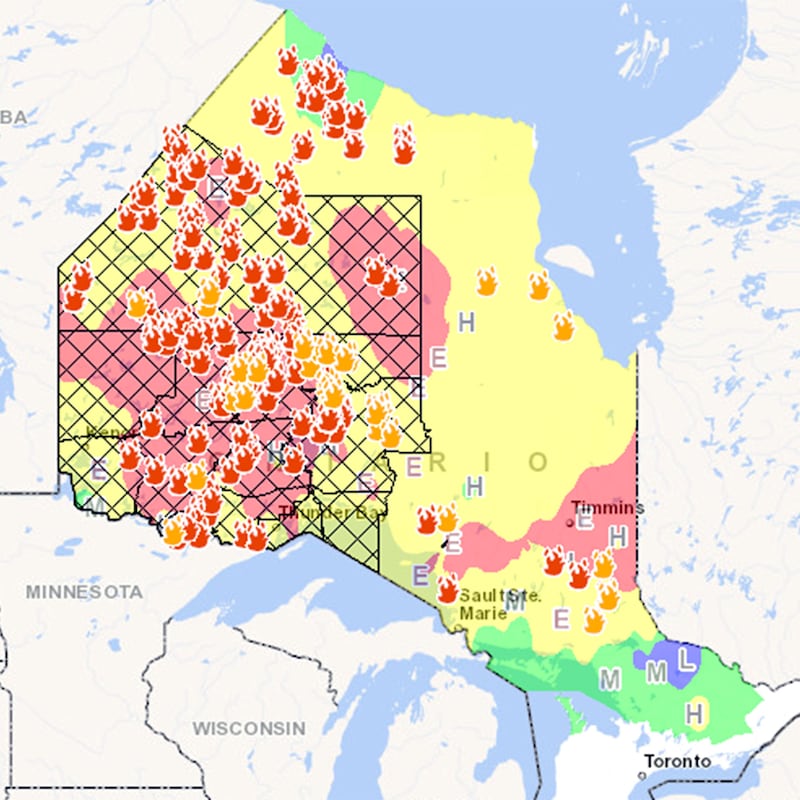
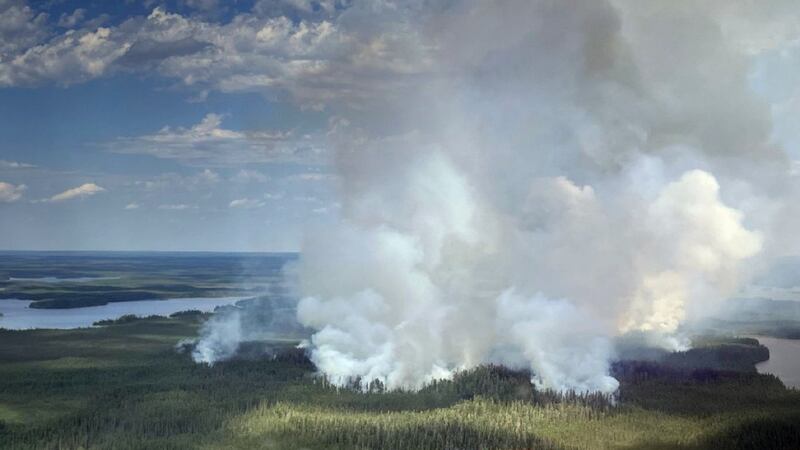
Nearly 200 wildfires are burning in northern Ontario, forcing residents to flee their homes, destroying buildings and sending smoke across much of the province.
A total of 185 active wildland fires — 148 in the northwest region and 37 in the northeast region — are burning, according to the province’s latest updates posted Tuesday evening.
In the northwest, where the majority of the fires are reported, 69 are not under control, while seven blazes are being held and five are under control. Sixty-seven fires are being observed and four were called out Tuesday.
Meanwhile, in the northeast, of the active fires, five are not under control, three are being held, one is under control and 28 are being observed.
First Nation ‘devastated’ by fire
Anishinabek Nation Grand Council Chief Linda Debassige says Namaygoosisagagun First Nation, or Collins First Nation, has been “devastated” by an unexpected and fast-moving wildfire.
In a statement Wednesday, Debassige says the fire caused extensive damage, destroying homes and community buildings.
The First Nation is located roughly 210 kilometres north of Thunder Bay, Ont., and is not accessible by road, meaning people fled on boats.
“We’re aware that community members were forced to carry out an emergency evacuation without the support of emergency services, and based on information currently available, all community members known to have been in the community at the time have been accounted for; however, this will be confirmed pending a full assessment,” Debassige says.
Some residents ordered out
The fires are continuing to threaten communities, Ontario Provincial Police Northwest Region said in an update at 10:15 p.m. Tuesday. Several areas are under evacuation orders, including Armstrong, Ont., where a rail worker captured harrowing video as a fire closed in on a CN train.
“We’re encased in flames now,” a crewmember could be heard saying.
People living in Collins First Nation, Gakijiwanong Anishinaabe Nation (Lac La Croix First Nation), Gull Bay First Nation, Lac des Mille Lacs First Nation and Whitesand First Nation were also told to evacuate.
Information on Ontario.ca lists several fires of note after “significant growth,” including at Namaygoosisagagun First Nation, McDowell First Nation, Quetico Provincial Park/Atikokan, Gakijiwanong Anishinaabe Nation and Lac Des Mille Lacs/Upsala — as well as at Mishkeegogamang First Nation, Wabakimi Provincial Park and Cat Lake, where “multiple” fires are burning.
The Ontario.ca fires page lists new fires, their size and status. An interactive map shows active fires, current fire danger and restricted zones.
Air quality impacts
Smoke from the fires is drifting to other parts of the province, including Toronto, where an orange air quality warning is currently in effect, amid a heat warning. Environment Canada warns of not only “very poor air quality” but also reduced visibility, saying conditions may improve by Friday morning.
“During heavy smoke conditions, everyone’s health is at risk regardless of their age or health status,” the weather agency says. “Limit time outdoors. Reschedule or cancel outdoor sports, activities and events.”
Ontario’s Air Quality Health Index lists forecast maximums, from low to high risk (1 to 10+), with several areas forecast at “10+ very high risk.”
Highway closures, restricted fire zone
Sections of two roads remain fully closed as of Wednesday morning, including Highway 599 between Highway 516 and Mishkeegogamang First Nation, while Highway 527 is shut down between Gull Bay First Nation and Armstrong.
An alert on the Ministry of Transportation’s 511 website, which lists the road closures, warns of restricted fire zones for parts of northern Ontario.
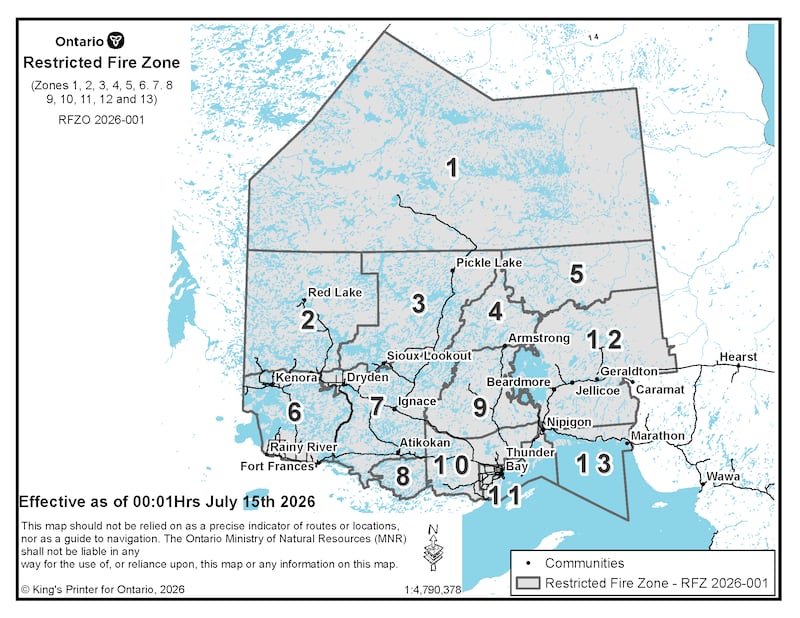
“Due to the high to extreme fire hazard, increased wildland fire activity, the current fire load and to reduce the number of human-caused wildland fires, the Ministry of Natural Resources has declared a Restricted Fire Zone for the Northwest Fire Region, and parts of the Northeast Fire Region,” it says.
The restricted fire zone is in place “until further notice,” the ministry says, meaning no open air burning, including campfires, is allowed within the boundaries.
People are asked to use extreme caution when using portable gas or propane stoves for cooking or warmth, and all burning permits are suspended.
The ministry says crews are prioritizing “protection of life, property and infrastructure,” amid “elevated” burning conditions and high winds.
It says they’re honing their efforts in areas where suppression is most likely to be successful, with a focus on protecting firefighting personnel and the public, critical infrastructure and capturing, where possible, new fires.
“The types of wildland fires we are seeing on the landscape, either large in size or close to communities or other important structures or resources, require the full deployment of our available resources,” it says.
Year to date, 453 wildland fires have been reported inside Ontario’s fire region, compared to 349 in 2025. The 10-year average is 312 fires.