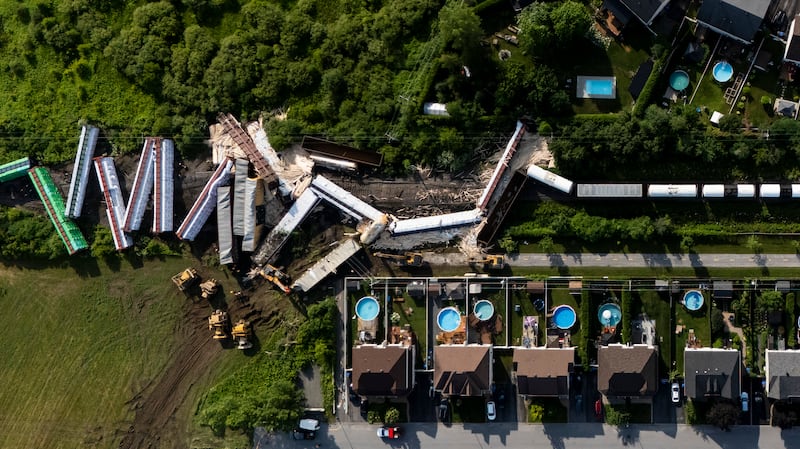
The Transportation Safety Board of Canada (TSB) has flagged poor track conditions near the site of a train derailment in Repentigny, Que. Investigators walked nearly 10 kilometres of CN Railway tracks and issued a safety advisory to Transport Canada.
The TSB noted that several rail anchors were missing or had been displaced and several wooden ties were skewed on stretches on either side of the crash site. It was 29 C on July 5, the day several cars of a 172-car freight train jumped the tracks next to homes frightening many in the suburban area.
“During the summertime there is some expansion in the steel of the rail because of the heat,” says Luc Regis, investigator in charge with the TSB. “That expansion needs to be controlled and that is the part that the rail anchors play. They anchor the rail to the wooden tie.”
If those anchors are missing or ineffective the rail could move and lead to a misalignment of the track. The TSB says it is too soon in to conclude rail conditions and heat contributed to the derailment, but those factors are part of the investigation.
“We cannot say for sure it is a contributing factor to that derailment,” says Regis. “But it is sufficiently worrisome that we thought it was warranted to produce the safety advisory as fast as possible and send it to Transport Canada and to CN.”
The TSB says the train was travelling at 77 km/h, slower than the maximum permitted in the area, when an emergency brake was applied. The crew saw several cars had derailed.
Images filmed by local residents show derailed cars scattered near residences. No one was hurt and no dangerous material was released.
Many living in the area say they had noticed the tracks were in poor condition. Sylvie Content lives metres from where the rail cars jumped the track. She says there had been work near the site two weeks before the accident.

“I am afraid now, I was afraid before the accident,” says Content. “I would like to see more maintenance, more security. Ideally, I would want trains to stop passing here but it is not possible, so I would like them to permanently travel at reduced speed in this region.
Transport Canada says it now requires Canadian National (CN) to maintain a reduced speed of 16 km/h through the affected area.
“The speed restriction will remain in place until Transport Canada has completed its post-repair inspections, CN has completed its internal review of the cause and implications of the occurrence, and Transport Canada is satisfied all applicable safety requirements have been met,” it said in a statement to CTV News.
Transport Canada says it is also assessing the integrity of the track on the rail line to verify its condition.
“On July 10, 2026, Transport Canada conducted an inspection of the track in the affected area and continues to follow up with CN to ensure that all applicable safety standards are being met,” the statement continued.
Officials are also in contact with CN to verify compliance with all applicable safety requirements.

