This story was updated with new information on July 20 at 4:25 p.m.
For two years, Jaspinder Kaur believed she was building a future in Canada.
The international student from Punjab, India, enrolled in a business management diploma program offered through Portage College and the Canadian Institute of Osteopathic Therapy (CIOT) in Calgary after being told she would be eligible for a post-graduation work permit (PGWP) once she finished her studies.
Instead, weeks after celebrating her graduation, she received a refusal letter from Immigration, Refugees and Citizenship Canada (IRCC).
“I was so shocked,” Kaur said.
“I talked to my lawyer in a panic, thinking, like, what can I do next?”
Kaur is among a growing number of international graduates who say they have unexpectedly been denied post-graduation work permits after completing programs they believed qualified under federal immigration rules.
The permits allow eligible international graduates to gain Canadian work experience after finishing their studies and are often considered an important pathway toward permanent residency.
Graduates interviewed by CTV News say they enrolled in their programs, completed their studies and submitted complete PGWP applications before June 24.
On that date, IRCC updated its online guidance on its website to clarify that graduates of “non-credit” programs, except for certain flight-school programs, are generally not eligible for a PGWP.
The students argue applications that were already submitted should not be assessed using the updated guidance.
IRCC says there have been no changes to the program’s eligibility criteria and that the June update simply clarified longstanding requirements.
Meanwhile, Kaur said she has already filed a request asking IRCC to reconsider her application and has now applied for a judicial review in Federal Court.
“My father spent his whole lifetime saving on me,” she said.
“After completing my two years of study, I thought I would be able to work and gain some Canadian experience.”
Graduates say they feel blindsided
Several graduates who spoke with CTV News said they enrolled before recent changes to IRCC’s online guidance and were repeatedly assured they would qualify for post-graduation work permits.
Sukhpreet Singh, who graduated from the same program, was approved for a work permit but says many of his classmates were refused despite having nearly identical circumstances.
“Some people are getting it and some are not, but it’s like one in 20 applying that are approved,” he said.
“We just demand reconsideration. Open up the students’ files and give them a proper decision.”
He said many students, including himself, have invested about $32,000 in tuition over two years, not including housing and other living expenses.
“Canada has been one of the famous destinations for international students to come here, study here,” Singh said.
“International students have paid three times more than the students who study here.”
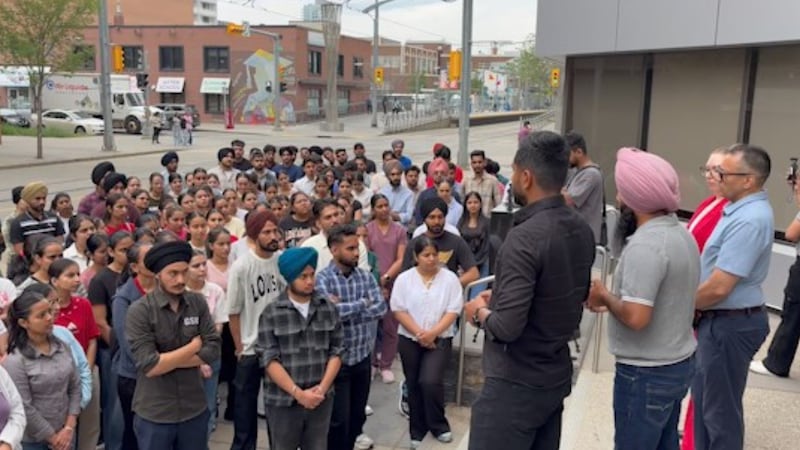
Mukul Rana said students who received refusals are now struggling financially and mentally after losing the ability to work.
He says many of his fellow students enrolled before the May 15, 2024, PGWP policy deadline to qualify.
“This is a betrayal of thousands of international students; it is not just administrative, it is a human crisis,” Rana said.
“Now, many of us have been refused PGWPs based on a policy that changed after we committed our futures to Canada. After we fulfilled our part, thousands of students are facing PGWP refusals, loss of legal status, loss of employment, financial devastation and uncertainty about their futures.”
Portage College says decisions rest with IRCC
Portage College says it recognizes that “some graduates have been affected by recent PGWP decisions” and understands “the stress and uncertainty these outcomes may create.”
In a statement to CTV News, the college said PGWP applications “are assessed and decided solely by IRCC,” and that it has “no involvement in the review, assessment or determination of individual immigration applications.”
The college encouraged graduates with questions about their immigration status to seek advice from “a licensed immigration lawyer or a Regulated Canadian Immigration Consultant.”
It said it also provided contact information for “an independent immigration consultant” on its PGWP information webpage and encouraged graduates to visit its PGWP updates and support webpage “for the latest information and available resources.”
Earlier this year, Portage College sent a letter to students stating they should remain eligible for a post-graduation work permit provided they maintained good academic standing and met program requirements.
The college said that letter was intended to explain what students needed to do to remain eligible to apply for a post-graduation work permit through IRCC.
“(The) key word is eligible. Eligible to apply through IRCC,” the college said in an email to CTV News.
“If the student is not of good standing, they would not be eligible able to apply for a PGWP.”
Students’ coalition says roughly 1,500 graduates could be affected
The Portage Students Union has formed a coalition representing graduates across Canada and says approximately 1,500 former students may have been affected.
In a letter sent to the federal government, the organization says those graduates generally enrolled before June 24, completed their studies before or around that date, submitted complete PGWP applications before June 24 and complied with all study permit conditions.
It is asking the federal government to conduct an urgent review of refusals, clarify whether the updated guidance was intended to apply to pending applications, consider transitional measures and reopen refused applications where fairness concerns are identified.
The letter notes that when Ottawa introduced significant PGWP reforms in 2024, transitional measures were provided for some students who had already committed to their educational programs.
Lawyer says students have several legal options
Calgary immigration lawyer Laura-Anne Goulding of Shory Law says her office has been contacted by dozens of affected students.
“So many,” she said.
“Our office alone is dealing with more than 200 total right now.”
Goulding said many of the applications currently being refused were submitted between 18 and 21 months ago.
“Some of them may want to do reconsideration requests,” Goulding said.
“Some of them may want to go through Federal Court and judicially review their refusal.”
While she acknowledged IRCC has the authority to change immigration policies, she said the concern is that many students were caught off guard.
“I think the issue here is a lot of students were just unaware of this because that was not something that was brought to their attention,” Goulding said.
“I have not seen something like this before.”
IRCC says eligibility rules have not changed
In a statement to CTV News, IRCC rejected suggestions that it introduced new eligibility criteria for post-graduation work permits.
“There have been no changes to the eligibility criteria for the Post-Graduation Work Permit (PGWP) Program,” the department said.
IRCC said it updated its website in June “to clarify the existing eligibility requirements related to non-credit programs of study.”
The department said applicants must complete “a program of study that leads to a degree, diploma or certificate from a designated learning institution.”
“This longstanding requirement does not include general interest programs, ESL/FSL programs and other types of non-credit programs,” IRCC said.
The department added that it regularly updates online guidance to improve clarity and works with provincial and territorial partners to ensure educational institutions receive consistent information about PGWP eligibility.
When asked how many applications have been refused under the non-credit program interpretation since the webpage update, IRCC said it does not collect data specific to non-credit study programs.

