For a brief moment, two tornadoes were active at the same time in the Rocky Mountain House area in western Alberta on Saturday, investigators have confirmed.
The first tornado southwest of Rocky Mountain House was dissipating just as the second was developing east of the community at about 6:36 p.m. MT, according to the Northern Tornadoes Project (NTP) out of Western University.
NTP’s analysis consists of witness testimony and video, as well as radar imaging of two simultaneous areas of rotation.
“It’s pretty rare to have what we call twin tornadoes,” said Matthew Woodward, leader of the damage survey for the Alberta NTP team.
“It’s a result of a process known as supercell cycling… One tornado is put down and eventually a supercell will lose steam and cycle. And during that cycle, another tornado can form.”
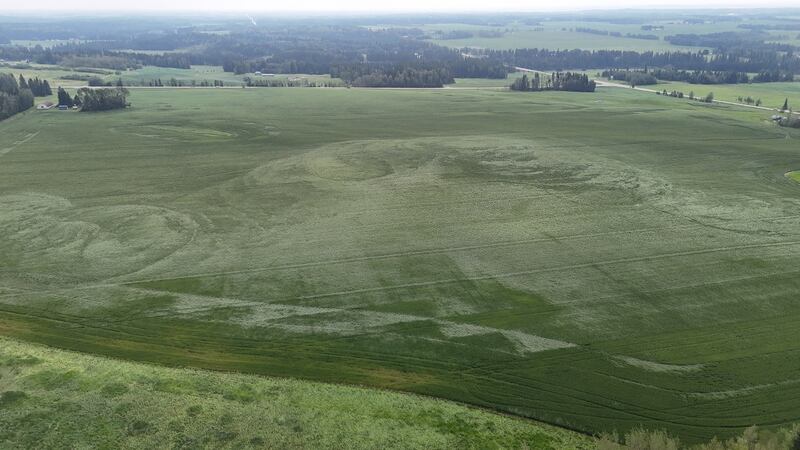
Both were rated EF2 on the Enhanced Fujita (EF) scale, which measures tornado intensity according to factors like wind speed and damage.
The first tornado, while tracking about 7.5 kilometres to the south end of Rocky Mountain House, swept a Clearwater County building off its foundation and caused significant tree damage at roughly one-kilometre wide.
“Which is incredibly wide for a tornado. Usually they’re a 10:1 length-to-width radio,” Woodward told CTV News Edmonton on Wednesday.
The second tornado travelled 10.6 kilometres from east of Rocky Mountain House toward Codner. While it was smaller, 600 metres wide, it still caused significant damage, damaging a roof and trees.
Both had an estimated wind speed of 190 km/h.
No one was injured.
Woodward said the county has counted 51 damaged buildings between the two events.
Rocky Mountain House, which has a population of 8,000, is located 200 kilometres southwest of Edmonton.
Tornado in Robb makes 27 for year
Woodward’s team has also confirmed an EF2 tornado touched down near Robb, east of Jasper National Park, one day earlier, although the team has not yet had time to survey the damage.
Justin Evernden, who works in the oil-and-gas industry in the area, said he watched the funnel touch down from several kilometres away.
“You could see it kicking up the dirt and threes and everything…. Basically, I jumped in my truck and tried to get out of there,” he recalled in an interview on Wednesday.
“It was way too close for comfort.”
That brings the total number of tornadoes NTP has confirmed in Alberta this year to 27, the most since 2019, when it recorded 23. Typically, the province counts about 15 to 20.
Although Woodward couldn’t speculate the cause of the record number, he said an increase in wet weather creates more opportunity for thunderstorms to develop.
“It’s fuel for the thunderstorms, which generate the tornadoes.”
With a month-and-a-half left of tornado season, he urged everyone to heed extreme weather alerts.
“Getting in an enclosed interior room… Put as many walls between you and the tornado as possible,” he advised.
NTP researches tornadoes to help inform tornado preparedness policies and building codes.
With files from CTV News Edmonton’s Amanda Anderson

