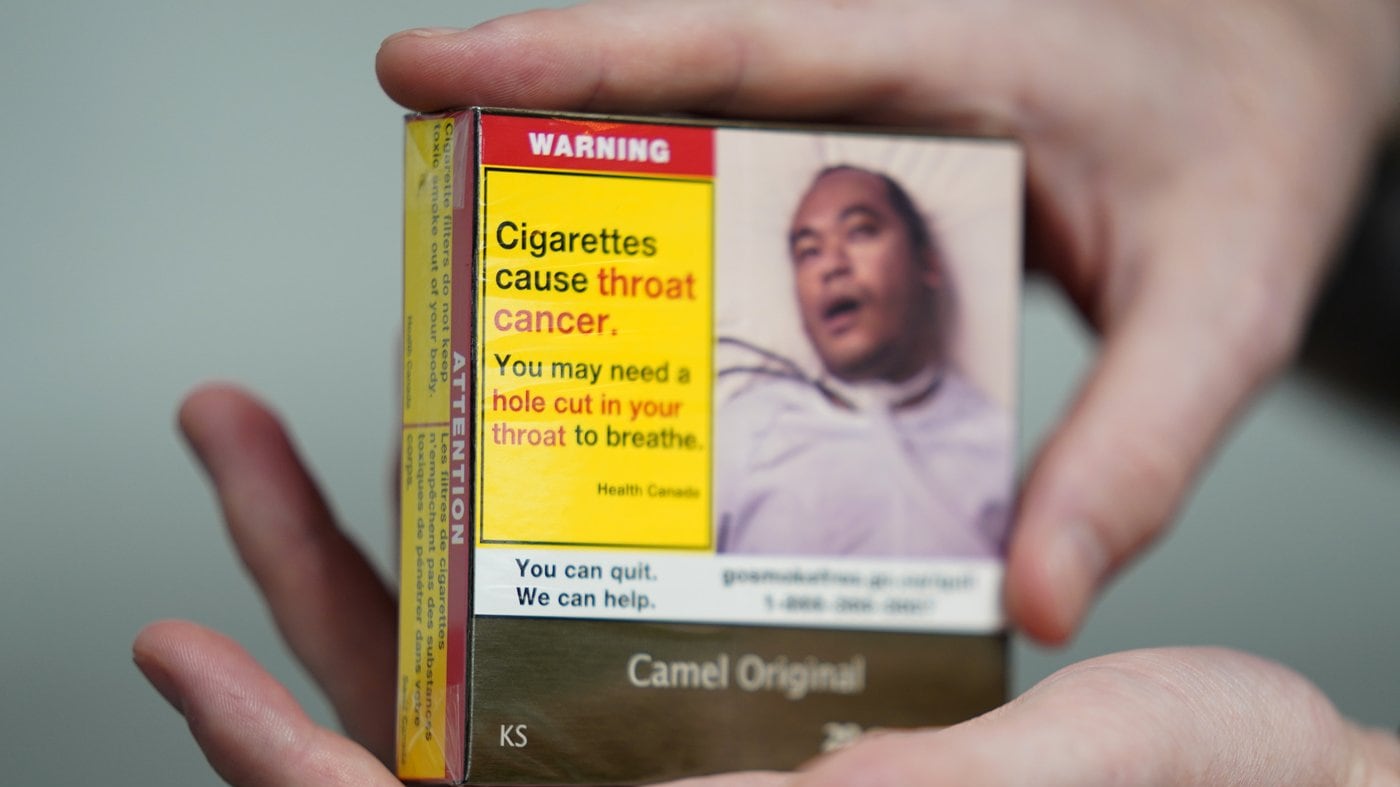
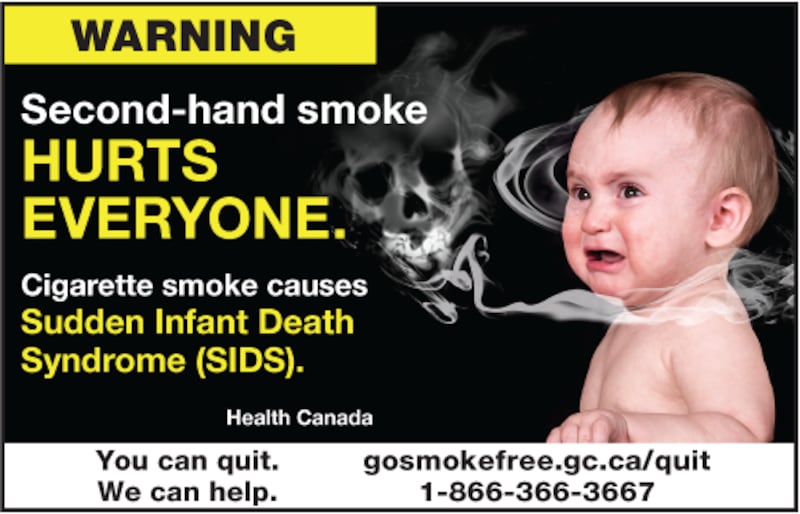
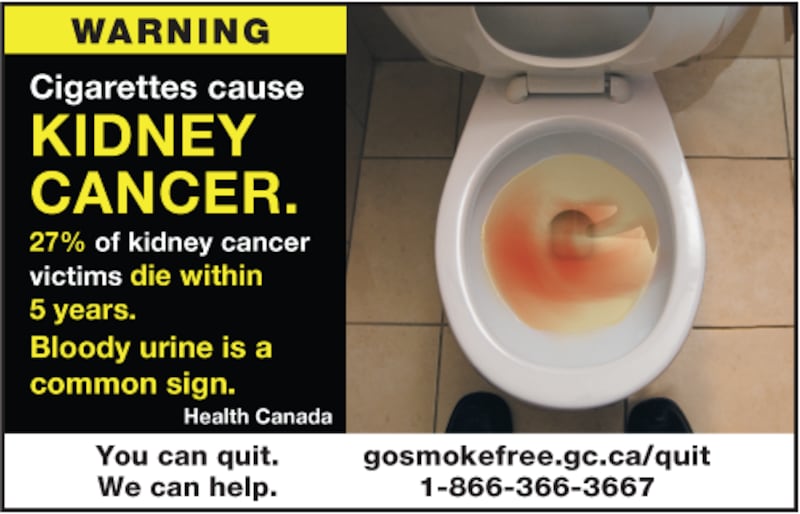
TORONTO — A baby swarmed by smoke. A toilet of bloody urine. A cancerous colon.
These are among the new series of 13 graphic images that are required to be printed on cigarette packages across Canada by Aug. 1.
This is the fourth set of warnings mandated by Health Canada since 2000, aiming to reduce tobacco use to less than 5 per cent by 2035.
According to the federal health agency’s latest projections, Canada appears on track to reach that goal. Tobacco use was down to an estimated 13 per cent in 2024, compared to 29 per cent in 2001. Approximately 300,000 Canadians who smoked in 2023 quit in 2024.
Still, tobacco use is the leading preventable cause of illness and premature death in Canada, killing approximately 48,000 people each year, according to Health Canada.
Some experts say more drastic public policy measures could be taken in tandem with the long-standing practice of health warnings to reduce smoking, pointing to the upcoming ban on younger generations buying tobacco products in the United Kingdom.
David Hammond, a professor at the University of Waterloo’s School of Public Health Sciences, said the “scary and frightening” images and statistics on cigarette boxes are still having an impact.
“But I will say that tweaking these warnings, changing the pictures, changing the wording, is likely going to have far less impact than these other measures.”
In the United Kingdom, anyone born on or after Jan. 1, 2009 will be banned from buying tobacco products as of 2027, a move aimed at preventing future generations from becoming addicted to nicotine.
Health Minister Marjorie Michel’s spokesperson said in a statement that the government is monitoring “measures taken by like-minded countries to reduce youth smoking, including the United Kingdom’s recent initiative.”
“However, the Government of Canada has no plans to introduce a similar prohibition at this time.”
The new images printed on cigarette packages across Canada depict a range of health issues — from the dangers of second-hand smoke for children, to diseases such as throat, lung, tongue and mouth cancers that are linked to smoking, according to Health Canada.
Karine LeBlanc, a senior communications adviser at Health Canada, said the latest series of messages will be on packages of cigarettes, little cigars and cigarette tobacco for two years and on all other tobacco products for three years. The set of warnings will then rotate back to the messages featured since January 2024.
Messages about the benefits of quitting will also be added to the extended upper flap inside cigarette packages to “make the information up front and larger instead of on the backslide of the package, which is easier to ignore,” LeBlanc said.
Two of the images are being reused from past years after focus groups identified them as particularly effective, said Rob Cunningham, senior policy analyst with the Canadian Cancer Society.
“They’re very striking,” he said.

One is of Barb Tarbox, a 42-year-old woman from Alberta who died of lung cancer in 2003. The image shows her skeletal body near the end of her life with a cigarette still in hand, paired with the words “highly addictive.”
The other is of bloody urine in an unflushed toilet bowl, stating, “27 per cent of kidney cancer victims die within five years.”
Cunningham said it’s difficult to quantify the direct impact of the warnings on smoking rates in Canada, since there have been a number of simultaneous measures taken in recent decades.
“There’s so many other things happening at the same time. Our tax increases, smoke-free places, public education campaigns. But we know that direction is clear. And if they were not effective, then the tobacco companies would not have been historically so opposed to having them,” Cunningham said.
Six new messages are also being printed on individual cigarettes, such as “Tobacco smoke is toxic” and “Cigarettes harm children.” Canada was the first country to require these additional warnings in 2024.
While graphic images on cigarette boxes have become the norm in Canada over the last 25 years, that wasn’t always the case.
Canada began requiring pictures on packages warning consumers of the health risks in 2001, rotating the images in 2012 and 2024. The country also adopted the standardized, logo-free appearance recommended by the World Health Organization in 2019.
The WHO released guidelines for “plain packaging” in 2016, which recommended prohibiting tobacco company logos and branding on products and implemented a standardized box and font. The intent was to “kill the glamour” of cigarettes, WHO’s director-general said at the time.
“People can become desensitized to the messages over time, reducing their impact,” LeBlanc said. “Rotating different messages helps people notice, remember, and engage with the information.”
Health warnings have played a major role in widely communicating the deadly risks of smoking over the past five or six decades, Hammond said, recalling an increase of calls coming in to the helpline to quit smoking when the picture warnings were introduced.
“There’s no doubt that these have played a big role in helping smokers to quit, but even more importantly, discouraging young people from wanting to start in the first place,” Hammond said.
Data from Health Canada shows smoking dropping to an “all-time low” of less than two per cent in 2024.
“That is phenomenal,” Hammond said, but he questions why Canada would take a back seat now when there is more that “can and should be done.”
Hammond said introducing an “endgame policy” like that of the U.K. would almost guarantee Canada reaches its 2035 target.
A Canadian government graph of smoking prevalence in the country since 2010 shows a steady decrease slowing in recent years.
Cunningham said other tobacco control measures could also be effective, such as raising the legal age to buy cigarettes to 21 in all provinces, as has been done in Prince Edward Island. Nunavut lifted its minimum age to 19.
In 2019, the United States raised its federal minimum age to 21 for buying tobacco products, including e-cigarettes.
Restricting where tobacco can be sold so that it’s no longer easily available at convenience stores and gas stations would also reduce access, Cunningham said.
“It’s a comprehensive strategy of taxation, regulation, enhanced programming that is going to be essential to maximize the progress that we can make.”
Hannah Alberga, The Canadian Press

