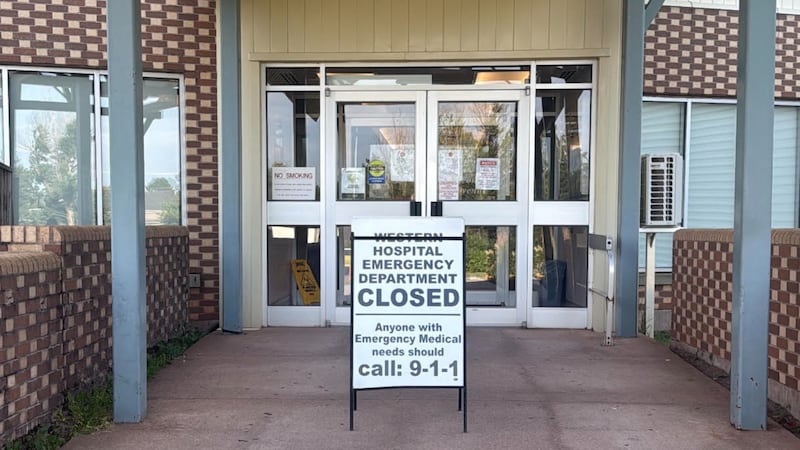
ALBERTON, P.E.I. – For the third time this month, the emergency room serving P.E.I.’s westernmost communities is closed, meaning patients in urgent situations must seek care elsewhere.
Health P.E.I. issued an alert Sunday notifying Islanders that Western Hospital’s emergency department in Alberton would be unavailable Monday because of a temporary staffing shortage. The closure follows earlier disruptions on July 17 and 23.
“We need this. It’s a small town,” said Donna Brace, who lives in the community of about 1,300 people. “We need more doctors.”
Western Hospital serves patients from communities across the region. The closest alternative is often the emergency department at Prince County Hospital in Summerside, almost an hour drive from Alberton.
As of mid-afternoon Monday, posted wait times there ranged from two to six hours, depending on the level of urgency.
“You spend more time waiting than getting looked at,” said Richard Lantz, a dialysis patient who travelled about 45 minutes to Western Hospital from his home in Lennox Island.
His medical driver, Jean Tuplin, said distance can make a critical difference in a life-threatening situation, making reliable access to nearby care even more important.
“Our population is getting older and I think we need it more than we ever did before,” she said.
Dr. Spencer Brown, P.E.I.’s provincial department head for emergency medicine, said closing an emergency department is sometimes the only option.
In the case of Western Hospital, Brown said a single physician may sometimes run the emergency department, working the full 12 hours from 8 a.m. to 8 p.m. That shift can stretch even longer, depending on how many patients arrive and the complexity of their conditions.
Keeping the doors open relies on a small and highly dedicated group of physicians, he says, some of whom have recently retired or are nearing retirement, while others may be dealing with personal or family situations that temporarily keep them from work.
“The fact that it’s such a long, difficult shift, it makes it harder to get physicians to work,” he said. “Newer physicians, or any physician really in general, doesn’t prefer to work in that model anymore.”
Brown said there aren’t enough trained physicians to meet the need, while some experienced doctors are choosing options that are less difficult and less taxing on their mental health.
“You have to make a lot of important decisions,” Brown said, explaining that working in rural hospitals comes with unique challenges.
“It’s very difficult when they don’t have the basic things like a CT scan or an ultrasound, and you have to make logistic arrangements to transfer (patients) to a more urban centre.”
Health officials try to fill staffing gaps, but Brown said that can be difficult on short notice.
What worries him most are unexpected closures and the risk that someone facing a serious medical emergency may arrive expecting the department to be open.
“That can be a very dangerous situation,” he said. “That’s the thing that keeps me up at night, and the thing that makes us try and scramble to get people to cover these shifts, myself included sometimes.”
The emergency department is scheduled to reopen for regular hours Tuesday at 8 a.m.
In the meantime, Health P.E.I. says anyone experiencing a medical emergency should call 911. Those seeking health advice can call 811 to speak with an experienced registered nurse about the best course of action.

