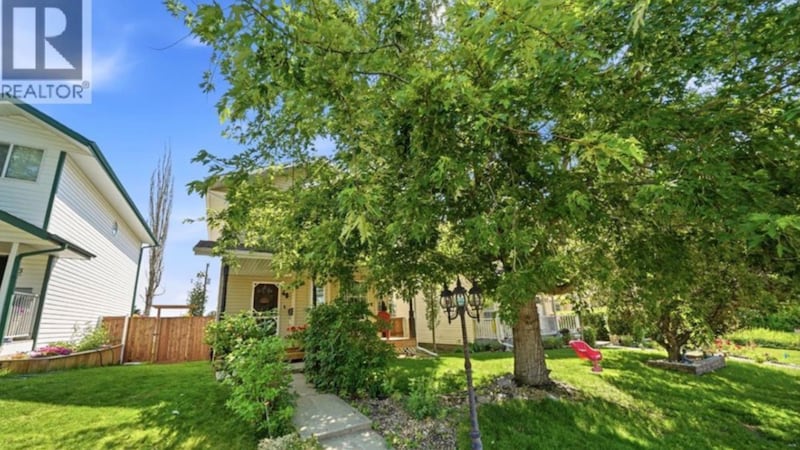
LACOMBE, Alta. -- An Alberta homeowner had a 26-year-old maple tree cut down without her permission after a scammer, posing as her, hired an arborist to remove it while her family was away.
Alina Schweer first learned something was wrong when a neighbour texted her about what was happening at her Lacombe home.
“I started yelling through the camera, like the doorbell camera, be like, ‘Hey, can you please stop?’” she said.
By then, much of the roughly nine-metre-tall tree had already been cut down.
Jesse Harder, owner of Clear Mountain Solutions, travelled about 90 minutes to Lacombe for the job, believing Schweer had hired him. Someone posing as the homeowner had contacted him and used a photograph from the home’s real estate listing to arrange the tree removal.
“We take responsibility for it. But it’s also unfortunate,” Harder said.
What is an overpayment scam?
The Canadian Anti-Fraud Centre identifies what happened as an overpayment scam, which can target a range of businesses. Fraudsters typically send a fake cheque for more than the agreed amount, then ask the victim to send the difference back or to a third party before the fraud is discovered.
In Harder’s case, he had requested a 50 per cent deposit before beginning the tree removal. The cheque he received was for more than the required deposit.
“They asked if I could transfer them or give (the extra) money to the roofers when they’re on location. And I said, ‘No, I’m not handling money,’” Harder said.
Harder later learned there were no roofers and the cheque was fraudulent.
Lacombe police are investigating and say they are working to identify the person or people responsible.
“The scammers are definitely getting more creative in trying to come up with ways that they can try to take your money from you,” Const. Travis Marcott of the Lacombe Police Service said.
The Canadian Anti-Fraud Centre told CTV News it has received two reports since May involving tree-removal businesses targeted in similar schemes.
In one case, scammers attempted to use a fraudulent electronic cheque and obtain online banking information before the business became suspicious. In another, two tree-removal businesses were sent to the same property on consecutive days after scammers used a photo from its real estate listing.
Schweer said her family had a similar encounter just days before her tree was cut down.
On Aug. 3, another arborist arrived at the property while Schweer was home and asked whether she had sent a text requesting that her tree be removed.
“I honestly thought they had the wrong address,” Schweer said. “We thought nothing of it at all.”
Days later, Harder arrived while the family was away.
“And to me that’s really concerning, that they (the scammers) knew we wouldn’t be home,” Schweer said. “Like, how would they know that?”
It is not known whether the scammers knew the family would be away or how they would have obtained that information.
For some in the tree-removal industry, fraudulent requests are familiar.
Hard to spot
Mandy Tseung of Calgary’s 4 Tree Service Ltd. said her company receives as many as 20 scam requests a year and now takes additional steps to verify customers.
“Usually, when we ask them to meet us in person, they are not able to do that. They will have many excuses,” Tseung said.
She said another red flag is when a prospective customer cannot provide a recent photograph of the tree and instead sends an image available online or through Google Street View.
Harder said nothing about the initial request immediately struck him as unusual as legitimate customers often arrange jobs by text, make unusual requests and sometimes have another person pay the bill.
He said the experience will change how he handles future jobs.
“I’m going to be a lot more vigilant, sort of like, ‘Are you actually the homeowner?’ And probably stop doing quotes by pictures.”
Lacombe police are urging residents and businesses to remain cautious when conducting business by phone or online. Police recommend people do the following:
- Verify property ownership or authorization when work is arranged remotely.
- Provide written estimates and consider requiring partial deposits before starting work.
- Be cautious of unusual payment arrangements, including overpayments and requests to forward money to third parties.
- Never forward an overpayment to a third party.
- Confirm the original payment has fully cleared with your financial institution before returning any funds directly to the person or business that made the payment.
“People are out there just to harm people, and it’s not good. They’ll find any way to do it,” Harder said. “Hopefully it doesn’t happen to anyone else.”
Even though the scammers didn’t receive any money, both Schweer and Harder were left dealing with the fallout.
Harder was never paid for the tree removal and said he plans to return on his own time to help repair the damage.
Schweer said the remaining roots will have to be dug out before the front yard can be levelled, resodded and landscaped.
“$5,000 to $15,000, in that ballpark, is my best guess,” she said of the cost.
The damage has also forced her family to put plans to sell the home on hold.
“We have to pull our listing, and we can’t list until next year because now we have to do all this work of our front yard,” Schweer said.
Despite everything that’s happened, Schweer said she doesn’t blame Harder or his company.
“At the end of the day they got scammed too,” she said. “I just think they were very trusting. And that’s the unfortunate part of society.”

