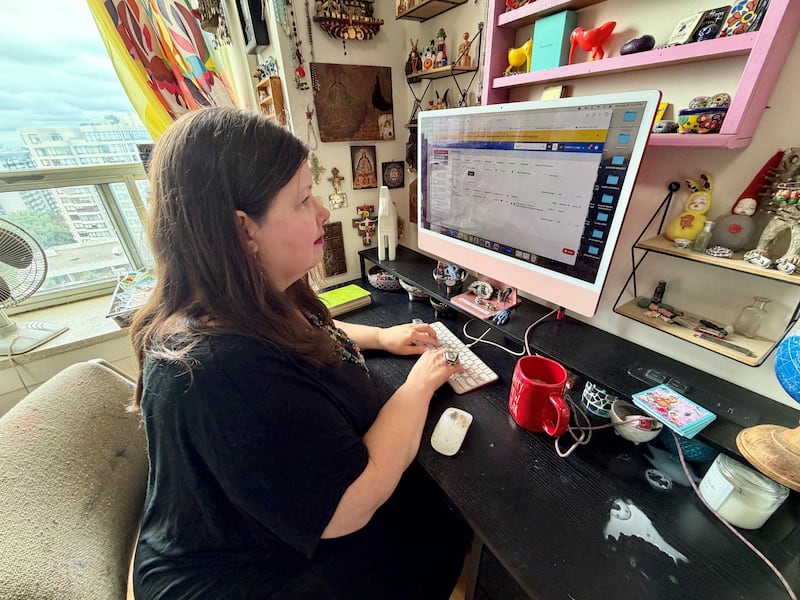
TORONTO — Lorette Luzajic hardly makes a fortune from her art, but sales to American buyers have long let the Toronto-based artist eke out a modest living. Her mixed-media pieces and paintings have sold in 40 countries, and Americans remain her biggest customers.
“It seems Americans are really interested in visual art,” Luzajic says.
In some years, she says nearly half of her income has come from U.S. sales. She’d assumed fine art would be spared from U.S. President Donald Trump’s trade war — until this past weekend, when she learned otherwise.
“I had a good cry when I realized that this is probably happening,” she says.
The reality of the new tariffs sank in the next morning. Luzajic had sold a 12-by-12-inch artwork over the weekend to an American customer for C$450. When she went to fill out the shipping paperwork, she discovered the shipping and tariff costs would total $263 — more than half the sale price.

She cried again.
“I immediately burst into tears because it was real,” Luzajic says.
Rather than surprise the buyer with the extra cost, she decided to absorb the tariff herself. Still, handing over more than half the sale price was hard to accept.
“Moving forward, I’m not sure how to handle it,” she says.
Luzajic is one of many artists across Canada now facing a potential collapse of U.S. sales. Some were already hit last year when Washington scrapped duty-free treatment for low-value shipments under the “de minimis” exemption, which had covered goods worth less than US$800. After a legal challenge, a U.S. trade court ruled earlier this month that the Trump administration could halt the tariff exemption for small packages.
The new tariffs now apply to a wide range of Canadian artwork, including paintings, drawings, collages, sculptures and original prints, as well as pieces made with materials such as bone and antler — a category that could hit Indigenous artists especially hard.
‘The financial hit will be rough’
Vancouver photographer June Hunter, known for her images of crows and ravens, says about half of her customers are American.
She hadn’t been closely tracking Trump’s tariff threats because she assumed her work would continue to be covered under the Canada-United States-Mexico Agreement (CUSMA). Now, most of what she sells into the U.S. is subject to the new 50 per cent tariff — including photos printed on items like notebooks, mouse pads and coasters.
“Weirdly, it seems that calendars... of any kind are not listed,” Hunter says.
So she’s continuing to sell her crow calendars but has suspended sales of nearly everything else to American customers, some of whom she’s known for 15 years.
“They’ve become friends. We communicate about things other than sales,” she says. “We’ll still keep in touch, but the financial hit will be rough.”
She’d already stopped selling jewelry to the U.S. last year after it was hit with tariffs, and suspended sales of silk scarves for the same reason.
“American customers are 50 per cent, and I don’t know what’s going to happen with Canadian customers because, of course, Canadian customers have had their finances affected by all of this as well,” Hunter says.

Artists ‘cannot be an afterthought’
CARFAC, the national association representing Canada’s professional visual artists, is working to draw attention to the toll the tariffs are taking. The group says that unlike corporations, individual artists don’t have the financial cushion to absorb new costs, and it’s urging Ottawa not to overlook them.
In a press release, Jenna Faye Powell, Interim National Executive Director of CARFAC, is quoted as saying: “Artists cannot be an afterthought in Canada’s response.”
Luzajic, for her part, is hoping to grow her sales closer to home and is encouraging more Canadians to buy local art.
“Just think consciously about supporting Canadian artists when you have the chance to do it,” she says.
With files from CTV News’ Kristen Yu

