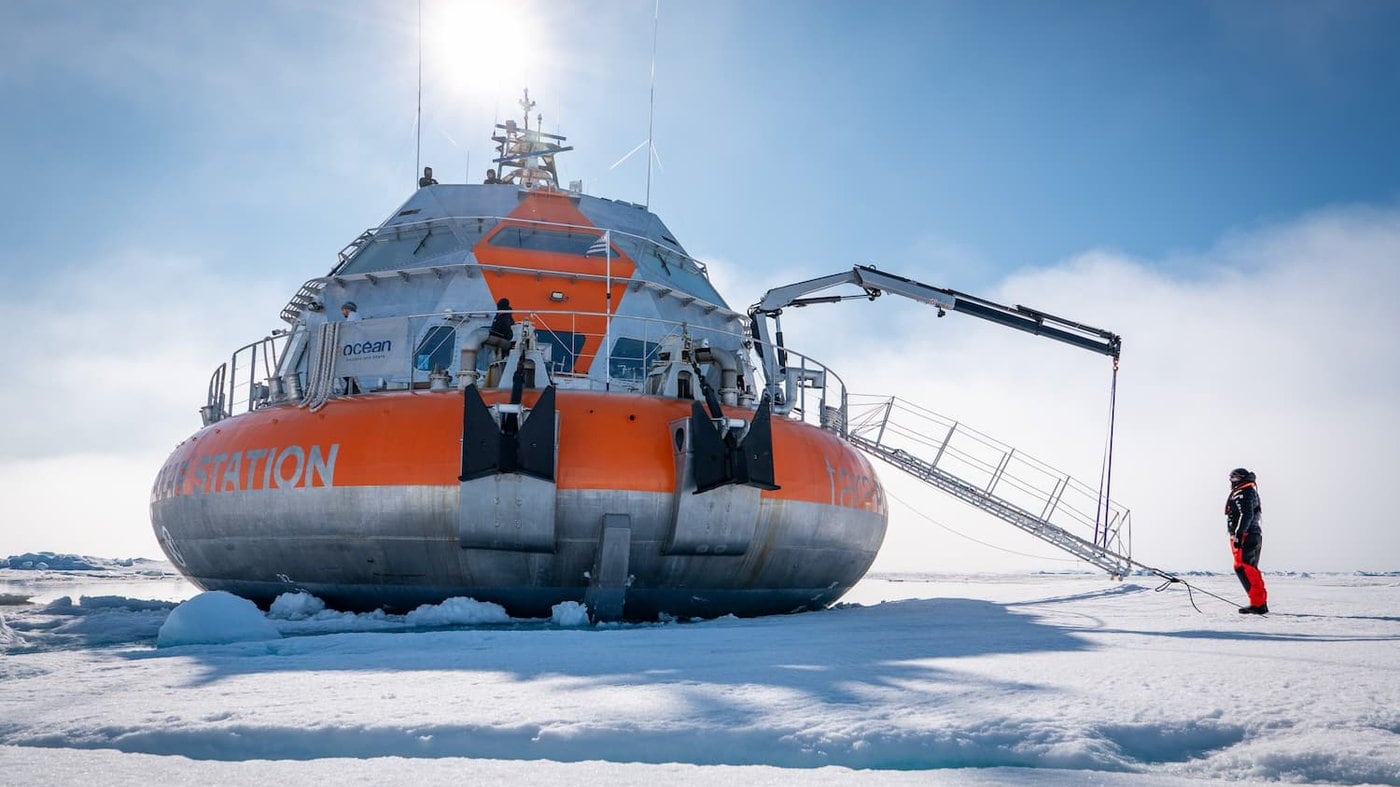
KIRKENES — A Newfoundland-based scientist is leading an international team of researchers on a mission to deliberately embed their saucer-shaped vessel into the Arctic sea ice during months of total darkness.
“We have more than 220 (research) protocols that we’re going to do… although we’re just six scientists on board, so it’s a very good analogy with the International Space Station,” said Maxime Geoffroy, the project’s chief research scientist and a member of Memorial University’s Fisheries and Marine Institute.
“The idea is to cover as much as possible of the different realms in the Arctic ecosystem. So we look at the atmosphere, we look at the sea ice, we look at the water in the ocean. And there’s also pollution and microbiology.”
The six scientists and six crew members will take the first eight-month shift aboard the Tara polar research station, an aluminum-clad saucer-shaped vessel specially designed to be frozen directly into the Arctic pack ice. It will then drift through the region as sea ice currents push it along.
Speaking recently from the platform’s final port of call in northern Norway, Geoffroy said the plan is to embed the vessel in the transpolar drift, which he says is a kind of conveyor belt of ice moving throughout the Arctic.
It’s similar to a project Norwegian researcher Fridtjof Nansen tried in 1893, embedding his wooden vessel in the ice hoping it would carry the crew to the geographical North Pole. The ship never reached the goal, but collected reams of scientific data on its journey.
Geoffroy, the only Canadian aboard, says Nansen’s expedition took more than three years, but the new version will last 15 to 18 months. His team will be aboard for the first eight months, a time when much of the Arctic experiences 24 hours of darkness. A new crew will swap in when the light returns, with subsequent crews rotating every three months until the platform is free from the ice.
There are more than 80 lead researchers from 13 countries waiting for the data. The vessel carries cameras, multiple sonar systems for measuring everything from currents to fish distribution, equipment to sample sea ice and bottles that can be closed at different ocean depths to capture organisms living in those zones.
It’s also outfitted with a small remote-operated vehicle for exploring under the sea ice, and a meteorological balloon it can deploy into the atmosphere.
“So we have a range… of one kilometre above (the) sea ice to two kilometres below,” said Geoffroy.
The project is overseen by France’s Tara Ocean Foundation, a public-interest organization dedicated to ocean study. The group is an official observer at the United Nations and has an annual budget of about 6.6 million euros.
Geoffroy’s personal research interests centre on fish and zooplankton ecology in the region. He wants to understand how many fish are in the Arctic, what they’re eating and how much fat is on their prey.
Down the line, the research could help determine if the Arctic could sustain a commercial fishery. He says the region has been under a 16-year fishing moratorium signed by many fishing nations.
More broadly, the project will look at biodiversity and how animals change and adapt to such an extreme environment. For instance, one program will be looking at antifreeze proteins in cells of different organisms, which Geoffroy says could be a hint that life started in sea ice.
Geoffroy says he’s done a two-person kayak trip through the Northwest Passage, but this will be the most isolated he’s ever been. Scientists and crew members all have Arctic experience and were selected because of their complimentary skills.
They underwent medical and psychological screenings to ensure they could cope with the isolation, perpetual darkness, workload and extreme environment. They also participated in seminars on how to resolve tension and conflicts.
Geoffroy says there are big freezers on board storing almost all the expedition’s food. The freezers will be filled up with scientific samples as the crew eats through their supplies and room opens up. He said the French vessel has a French cook on board, so the cuisine is expected to be top-notch.
The lead researcher has a long-term partner, and says it won’t be easy to be away for so long, but she understands it’s a once-in-a-lifetime opportunity.
“I definitely have some packages, gifts from family and from friends and pictures,” Geoffroy said. “So this, I think, would be what I will be craving more than any particular food, with pictures and gifts from them, and surprises that I have to open along the eight months.”
This report by The Canadian Press was first published Aug. 26, 2026.
— By Devin Stevens in Halifax.
The Canadian Press

