With each development in U.S. President Donald Trump’s trade war with Canada, many Ontario cities have received news of tariffs on Canadian goods with panic and devastation for their local industries.
A Hamilton official last year warned that tariffs in the steel town could spell “the end of the industry” and thousands of jobs lost.
In Oshawa, autoworkers already mourning the steady decline of the industry feared for their ability to put food on the table.
But even as Ontario Premier Doug Ford has threatened to cut off the flow of critical minerals to the United States in response to the latest round of Trump’s tariffs, the province’s mining capital appears unshaken, minimizing trade fears as it doubles down on getting its product to other markets.
Paul Lefebvre, the mayor of Greater Sudbury, said the city is largely sheltered from the trade war compared to other municipalities because nickel and copper — its two key exports — are not subject to tariffs. The city is only feeling indirect effects from some suppliers, he said, so he’s not overly worried about the United States.
“They need our nickel to continue,” Lefebvre said in an interview. “They would just be hurting themselves.”He added, “We’re confident that the U.S. will not want to impose tariffs on us.”
Critical minerals have become increasingly important to American national security and manufacturing. The Pentagon has sought more secure supplies of minerals used in military aircraft, missiles, munitions and electronics as the U.S. tries to curtail its reliance on China, which dominates the mining and processing of multiple strategically important minerals.
The U.S. only has one operational nickel mine, in Michigan, and the nickel extracted there is processed in Sudbury, the mayor said with a laugh.
Ontario produced the largest share of the 125,364 tonnes of nickel in concentrate dug out from Canadian mines in 2024, according to official figures.
Natural Resources Canada also reported that 98,199 tonnes of unwrought nickel valued at $2.4 billion were exported in 2024. By volume, 43 per cent of these exports went to the United States, followed by 15 per cent to the Netherlands.
The versatile metal known for its strength and ability to withstand extreme temperatures has long been Sudbury’s claim to fame. The Big Nickel, a nine-metre tall replica of a Canadian five-cent coin, is one of the best known tourist attractions in the area.
After the United States imposed 50 per cent tariffs on a range of Canadian goods last month, Ford said all forms of retaliation, including cutting off electricity supply to U.S. states and shutting down the flow of critical minerals, were on the table should Trump continue to target Canadian industries.
Though Lefebvre said “it’s always concerning” to hear threats about cutting off critical mineral exports to the U.S., he approves of Ford’s strategy. The mayor said he supports the premier leveraging critical minerals to rid the country of tariffs, but believes the local economy must be taken into consideration.
“The uncertainty that (Trump) has created in North America has really shied away a lot of investments,” he said, such as a Sudbury delegation’s trip to Japan and South Korea that was soured by Trump imposing tariffs on the two Asian countries.
The mayor added that Sudbury has not been in any talks with American officials, and he declined an invitation to a conference in the U.S. because of the trade war.
“We don’t have any relationship with them,” Lefebvre said.
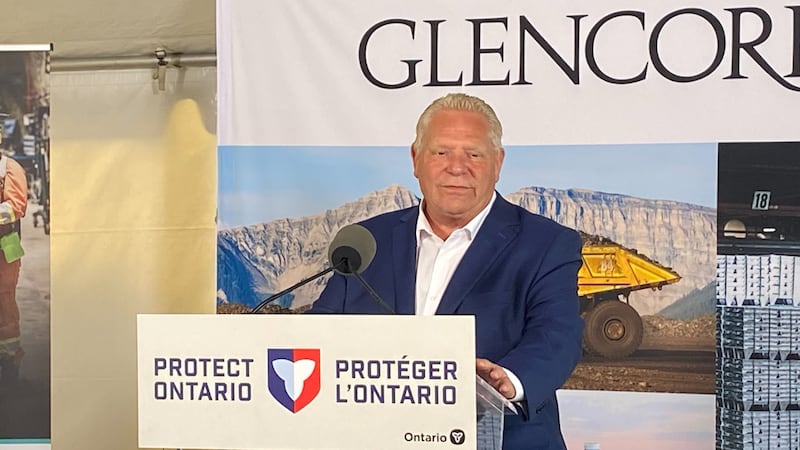
Ford did not reference his earlier threat directed at the U.S. when he was in Sudbury last week but rather called the industry a “heartbeat of the north and an engine of our economy.”
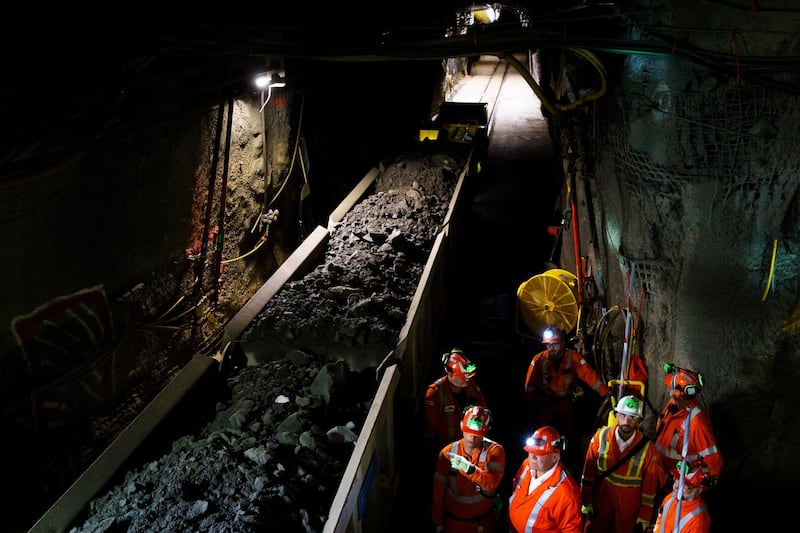
The premier was touring an expansion at Glencore Canada’s Craig Mine, where the existing mine shaft was deepened to gain access to nickel and copper ore. Ford donned an orange hard hat and a high-visibility suit before descending deep into the hot, cavernous mine.
He said the project reinforces the province’s position as “a global supplier of high-class nickel the world needs.”
“And guess who else needs it?” Ford said. “President Trump needs it desperately.”
Despite the rhetoric, Marie Litalien, president of the Greater Sudbury Chamber of Commerce, said “it’s business as usual” for the municipality, which is used to weathering economic ups and downs.
Questions about tariff ramifications are hanging over some small- and medium-sized businesses, she said, but the community is focused on attracting investment and strengthening their international relationships.
The politics of Ford’s threat to cut the U.S. off from critical minerals is “not really of any consequence to us,” she said, adding the government should keep putting funding toward Canadian infrastructure.
Because Sudbury is a global mining centre, “I have no doubt that we’re prepared to deal with any short-term and long-term effects in this,” she said.
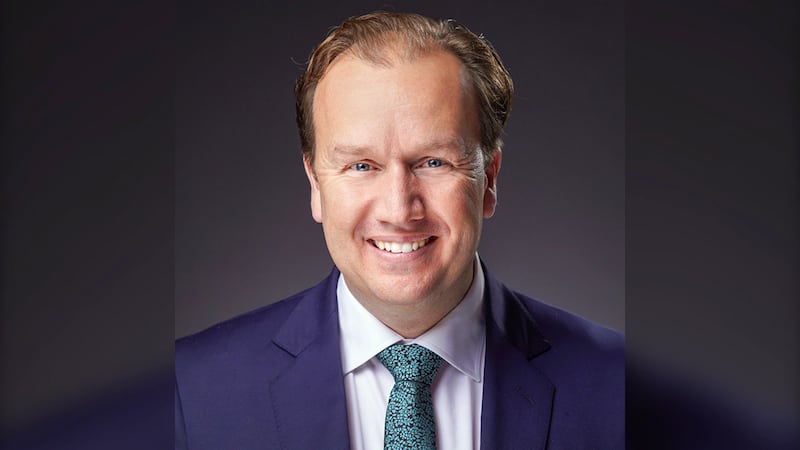
Sadequl Islam, an economics professor at Sudbury’s Laurentian University, said there are lessons for flailing Ontario municipalities.
Relying heavily on one industry — such as Sault Ste. Marie’s dependence on steel — is risky, Islam said, and other communities could learn from Sudbury’s diversification. For example, it’s had success boosting its financial services sector on top of its position as a mining powerhouse.
Size also matters in Sudbury’s case, he said, as it is the largest municipality in the province by land area, and it could benefit from the mayor’s push for a special economic zone designation.
Lefebvre, who is seeking re-election this fall, said his push for the designation is a unique ask, but argued Sudbury contributes more to the province’s economy than many other municipalities and deserves infrastructure support.
“We are an economic zone that is very special in our country,” he said. “Nobody else has this around the world.”
David Robinson, a retired professor of resource and environmental economics at Laurentian, also said Sudbury stands to suffer much less than the rest of the country.
Robinson also doubts the U.S. would ever impose tariffs on nickel, pointing out that the metal is necessary for vehicles made by billionaire Elon Musk’s Tesla, and Musk is an on-again-off-again ally of the president. And if tariffs on nickel were to be imposed, much of the effects would be offset by adjustments in international markets, Robinson said, and the U.S. would simply be raising prices for their own manufacturers.

“We can do without American wine and whiskey,” he said, but the U.S. can’t do without the goods that go into production processes, from nickel and uranium to potash and timber.
He, too, believes Ford’s threat to cut off critical minerals was a smart play.
“What happens if you choked all those goods off?” Robinson said. “Suddenly, you’ve got a baseball bat instead of a pencil to fight with.”
This report by The Canadian Press was first published Sept. 2, 2026.
— With files from The Associated Press
Elissa Mendes, The Canadian Press

