A small business owner in eastern Ontario says the 50 per cent tariffs that U.S. President Donald Trump is placing on Canadian goods have him seriously considering setting up operations south of the border, in addition to its existing Canadian facility.
DFC Woodworks is based out of Kemptville, Ont., just south of Ottawa, and has been in business since 1955. The company sells Muskoka chairs, also known as Adirondack chairs, through its website. The company was founded by Gérard Bruneau and is now owned and operated by his son François.
The company says that if it opened a second facility in the U.S to bolster American sales, it would help expand Canadian operations. DFC Woodworks says it is a Canadian company and insists the Canadian manufacturing will remain in eastern Ontario.
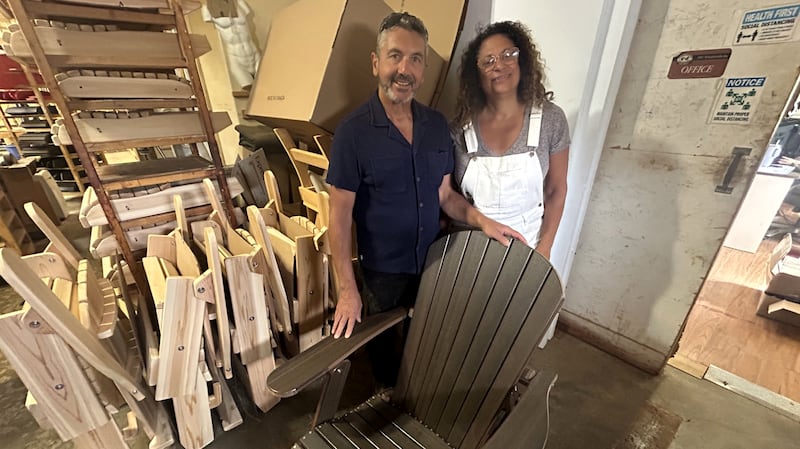
Speaking on Newstalk 580 CFRA’s The Morning Rush with Bill Carroll on Thursday, François Bruneau said about 70 per cent of his client base is in the U.S., and the latest tariffs are putting a serious strain on his ability to remain competitive.
“This is quite the blow for us. Very difficult,” he said. “Just to give you an idea, our last shipment was a small shipment. Over the next eight weeks, I’m looking at $75,000 in duties that I have to come up with, and I don’t know about you, but that’s a killer for a small company like ours.”
Bruneau said because his business ships directly to the consumer, he’s had to absorb the additional costs on orders that came in before the tariffs were in place and, if nothing changes, he’ll have to raise prices.
“We’re not going to go and charge our clients 50 per cent more than they paid; they’re just going to cancel their orders, so at this point we have to swallow that charge,” he said.
“In the long term, if our prime minister says be ready for the long term with difficulty, we won’t have a choice but to raise our prices. Then we’re not competitive, and the duties would increase exponentially to a point where we wouldn’t be able to sell anything to the U.S. at all.”
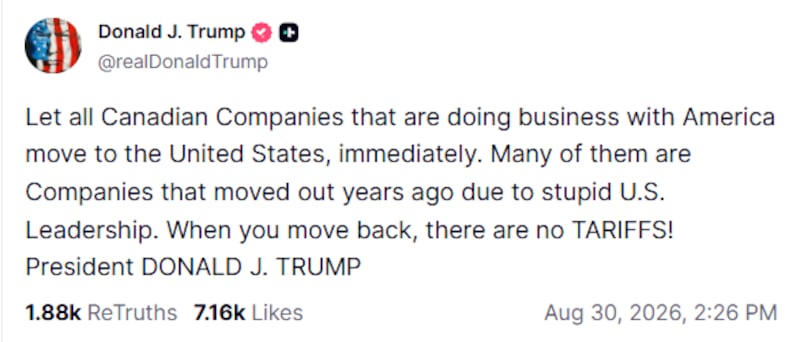
Bruneau says the situation has him considering setting up operations in the United States for his American customers. Getting Canadian companies to move operations to the United States is is a goal of Trump’s. On Sunday, the U.S. president urged Canadian companies to move south to avoid tariffs on their products.
“Let all Canadian Companies that are doing business with America move to the United States, immediately. Many of them are Companies that moved out years ago due to stupid U.S. Leadership. When you move back, there are no TARIFFS!” he wrote in a post on his Truth Social platform.
Bruneau says some states are offering significant incentives.
“We looked into places like High Point, North Carolina, where they welcome us with open arms, and they want us down there, and they’re proposing all kinds of incentives to move down there,” Bruneau said.
“For a small company like us, we don’t want to move. We’ve been in business since 1955 — 71 years in business — and we’re proud Canadians. We want to stay in Canada, but given these kinds of tariffs, we won’t have a choice. If we want to survive, we’ll have to move to the U.S. and we don’t want to.”
The Canadian Federation of Independent Business (CFIB) says DFC Woodworks is not alone.
“We’re hearing from our members that export that the US tariffs are already causing a number of challenges, cutting off some access to some of their customers, forcing them to look for other suppliers,” Ryan Mallough, vice-president of legislative affairs and communications of the CFIB, said.
“Of course, there’s a lot of concern amongst our importers about the Canadian counter tariffs and their impact on businesses that come into effect next week.”
Canadian manufacturing would stay in Kemptville
Speaking to CTV News Ottawa, Bruneau clarified that Canadian customers would still be getting products made in Canada.
“Our Canadian manufacturing will remain in Kemptville and we will work hard to keep our Canadian sales high and let our Canadian customers know who we are; however, our U.S. manufacturing may have to move to the U.S in order to continue our U.S. sales due to the 50 per cent tariffs that are crushing small businesses,” he said.
“We hope this isn’t the case and we can remain in Canada because we are Canadians and love Canada.”
But Bruneau said the Canadian market cannot make up for the size of the U.S., meaning it’s unlikely he could survive solely on Canadian sales.
“We’ve been trying to pivot to more Canadian content, and that being said, Canada is a very small market in comparison to the U.S., where it’s 10 times the size. So, we can’t make up 70 per cent of our sales on the Canadian market. That’s a big, tall ask,” he told CFRA.
The company says it is also in discussions with distributors in Europe and Japan to increase its exports from the Kemptville facility.
Trump has spent the last several days taking specific aim at Canada after trade talks between the two nations fell apart in late August. Prime Minister Mark Carney has vowed to impose dollar-for-dollar counter-tariffs on American imports starting on Sept. 8.
Bruneau said moving operations to the U.S. would not be easy on him or his employees.
“I’ve got some employees that have been with me for dozens of years, and it affects their lives too, you know? So, it’s very difficult.”
He added that he could manage if the tariff costs were lower, but as they stand, it’s unsustainable for his business.
“If they finally negotiate something in the 10 or 15 per cent range, we could survive that. Fifty per cent is not survivable,” he said.
Dina Elatawi, vice-president of DFC Woodworks, says she hopes the two countries reach a solution soon.
“I’m sorry President Trump but it’s Lake Ontario,” Elwati said. “We don’t want to leave our families are here we are begging these two countries to get back to the table.”
In a statement to CTV News, a spokesperson for Innovation, Science and Economic Development Canada, said the federal government recognizes the “challenges and uncertainty” U.S. tariffs are creating for Canadian manufacturers.
“We also recognize that the impacts of these tariffs fall largely on small and medium-sized businesses,” Riyadh Nazerally said.
Nazerally says the government announced supports for businesses affected by the new tariffs, including $2 billion in tariff relief through the Canada Strong Diversification Fund, a $500 million “liquidity stream” through the Business Development Bank of Canada and $1.5 billion in investments through the Regional Tariff Response Initiative.
“The government remains focused on helping businesses address immediate liquidity challenges, maintain operations, and protect jobs. At the same time, the government is working closely across organizations to ensure there is no gap between programs and no wrong door for businesses seeking assistance,” Nazerally said.
“The priority is to ensure that Canadian manufacturers have the tools, supports, and conditions they need to innovate, grow, and create good jobs here in Canada.”
With files from CTV News Ottawa’s Katelyn Wilson

