James Moore is a former federal cabinet minister under prime minister Stephen Harper, and is a contributing columnist for CTVNews.ca.
The tariff war is on. The Trump administration hit us unjustifiably with tariffs, and, as Conservative Leader Pierre Poilievre said on the weekend, “All Canadians stand united in denouncing the president’s unacceptable tweets, trolling and tariffs...”
Trump’s tariffs, and our response, are going to hurt a lot of Canadians and Americans. The fight is mutually detrimental and will leave lasting scars of distrust between many Canadians and many Americans, which will take years to heal – if they ever do.
This is, ultimately, tragic. The North American economic alliance has been the greatest trading partnership and wealth-building alignment in human history. That U.S. President Donald Trump chose to pick a fight with Canada is a colossal step backwards for economic prosperity, a shattering of decades of accumulated trust and a threat to our security cooperation going forward.
So, where are we with President Trump and the trade and tariff files today? Well, the belligerence of America’s chosen president is growing hourly, and it is hard to look away from his online character self-immolation.
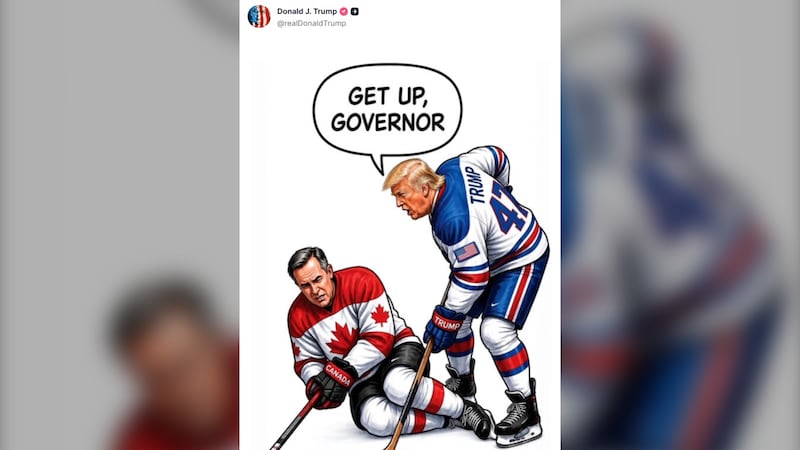
Whether he’s comparing himself to the Green Lantern as some superhero of manufacturing might (even though America’s manufacturing numbers have slid in the wrong direction since he became president and implemented his terrible policies), or whether he’s ranking himself as the greatest American president ever, or whether it’s a cartoon Trump hockey player crosschecking Prime Minister Mark Carney and calling him “governor,” it gets more obnoxious and embarrassing by the hour. It is sad. It is pathetic.
Distraction tactic
Why is he doing what he’s doing on policy? A charitable interpretation would be that he really believes in the virtues of tariffs, and this is what that looks like in action. A more cynical — and accurate — argument would be that things are going so badly with his poorly planned and poorly executed misadventure in Iran that he needs to fortify his tough-guy on ‘others’ meme by going after a traditional friend and ally because the opportunity is there.
A further argument to wed both arguments together is the need to distract the struggling American middle class from their rising cost of living and ongoing inflation challenges with this policy fiasco. There are other theories, but I’ll stop there.
One thing has become clear, however, and that is that these tariffs are both bad policy and bad politics and will ultimately fail economically and electorally for those who advocate and implement them with any vigour.
When I browse social media, read the headlines, and absorb the daily updates on this current drama, I keep returning to a quote that is an anchor in my life.
The quote is: “God grant me the serenity to accept the things I cannot change, courage to change the things I can, and the wisdom to know the difference.”
The quote has its origins in the 1930s and is attributed to Missouri-based Protestant theologian Reinhold Niebuhr. But it rose to more contemporary cultural prominence as a prayer for those attending recovery programs. Yes, God, give us all strength to separate what we can control from what we cannot, and give us clarity about how we correctly decide where to assign our challenges.
It is a fantastic way to look at life, and it is a critical mindset when it comes to being in government. This certainly holds true for Canada in 2026, as we stare down the long minefield in front of us: the remaining two-and-a-half-years of the Trump presidency and all the tangled dramas that are plain to see.
With every day that passes, it is clear to any person of the most elementary capacity for assessment that Donald Trump is neither strategic, wise, fit for office, reliable nor fundamentally clear in his approach to tariff and trade policy. What’s more, the endless stream of AI slop that has been embarrassingly displayed before the world by the president of the United States is a sign of a man who is fundamentally unwell, for whom childish and cheap self-aggrandisement is the only daily preoccupation.
No off-ramp
So where are the off-ramps from this lose-lose path we are on? In the short term, I don’t see one. For President Trump, his positioning is so belligerent and absolute that escalation will be his position for some time. We are in a punch-and-counterpunch cycle that I suspect will last at least until the U.S. midterm elections on Nov. 3.
He has declared his worldview on tariffs for decades, and he will try to sell his actions until the end. Prime Minister Carney has responsibly left the door open, but realistically, he can’t go back to the table and entertain any agreement without evidence of basic recognition – verbally and in writing – of our absolute national sovereignty and elementary standards of respect.
Donald Trump is not capable of such decency or diplomacy. Tactically, for Prime Minister Carney, it is also unwise to come to any new bargaining table before the conclusion of both the Quebec provincial election and the Alberta plebiscite on separation, as it would provide room for exploitation from Washington and among bad-faith actors at home looking for leverage.
Further, the U.S. midterms could well provide Prime Minister Carney with new allies in the new Congress in 2027 to stare down the failing Trump tariff policies. These three events will also provide Carney with key markers of clarity of public opinion on how he will shape his coming federal budget – his first as a prime minister with a majority government.
He will have clarity domestically on the political front and clarity on what the balance of power will be in Washington to think about a way forward through to Jan. 2029, when America will inaugurate a new president and turn the page — one hopes — on Trumpism.
In this sense, time is on Canada’s side. Economically, time may be on America’s side given the size and weight of its economy. But politically, time is on Canada’s side with the stability of Canada’s Parliament, sovereignty movements stalled (hopefully) in both Quebec and Alberta for the foreseeable future, and a public consensus that wants Canada to stand firm, reject tariffs and Trumpism, and prepare for a new Canada-U.S. relationship in a post-Trump world.
While all this is happening, the project of economic growth needs to take off. The full suite of global trade diversification, internal trade liberalisation, resource extraction and infrastructure projects must power forward as we were promised — but have too seldom seen — and make Canada more attractive when it comes to personal, corporate and investment tax policies. It is time to get on with getting on with things.

