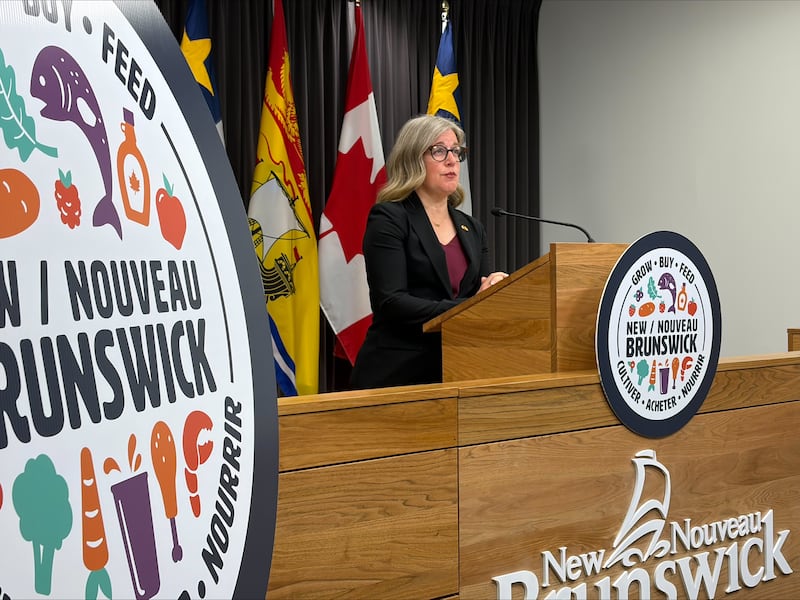
As the trade war between Canada and the United States persists, New Brunswick Premier Susan Holt says the province is taking action to support local business, jobs and products.
The province announced a series of measures Thursday aimed at steering public spending toward domestic products, helping businesses diversify into new markets and providing financial support to companies feeling the impact of the latest tariffs.
“The time to act is now,” Holt told reporters Thursday.
“This isn’t a one-day response. This is about making sure New Brunswick is ready to stand up for itself, and New Brunswickers are ready to standup for New Brunswick.”
U.S. President Donald Trump signed new executive orders on Tuesday ramping up retaliation after Canada imposed its latest set of duties on the United States.
The five orders, which will take effect later this month, will completely bar the import of certain Canadian goods, including motorcycles, some dairy products and alcoholic beverages.
It comes after Ottawa’s tariffs — a response to the 50 per cent duties Washington hit Canada with last month — took effect.
“The total New Brunswick export value affected by the newly imposed Section 338 tariffs and bans is roughly $115.1 million. This represents 0.7 per cent of the province’s total exports in 2025, or 0.8 per cent of U.S.-bound exports,” reads a news release from the New Brunswick government.
New measures
Holt plans to harness the province’s purchasing power to support local products and businesses.
“We can’t control what Trump does. But we can control what we do here at home,” said Holt in the release. “New Brunswick makes great products. We make great beer. We have businesses here that employ hundreds of New Brunswickers in good-paying jobs, and they deserve our support.”
The province’s new measures include:
- All public sector entities will be directed to review their supply chains to integrate New Brunswick and Canadian products where there is an alternative.
- Effective Oct. 1, the provincial government will prohibit the procurement of U.S. goods or services for significant contracts (estimated value over $5 million).
- The provincial government will continue to pursue additional measures, including undertaking a legislative review to explore giving the minister of natural resources the authority to restrict the issue of fishing and hunting licences and mining claims based on certain criteria.
- NB Liquor will review its interprovincial purchasing and sales practices to identify opportunities to prioritize Canadian products.
- The provincial government will release a market diversification strategy this fall and expand provincial trade missions to ensure the world can take advantage of New Brunswick’s products.
- Eight projects will be brought to the Canada Investment Summit next week to build a stronger New Brunswick economy.
- A renewed buy-local campaign will be launched.
“Customers of New Brunswick companies that are in the U.S. are starting to get more and more cold feet with their purchases of New Brunswick products,” said Holt.
“New Brunswick and the Holt government is going to lean in and back these businesses in New Brunswick and back their employees to make sure that we can reduce that pressure as much as possible.”
New markets
To help businesses navigate the impact of U.S. tariffs, New Brunswick is expanding programs for companies looking to enter new markets, providing access to supports such as:
- working capital loans
- marketing and market-development funding
- workforce training programs and employee retention assistance
- export diversification support
The province is directing New Brunswick companies seeking tariff-related support to contact Opportunities NB’s business navigators by calling 1-833-799-7966.
Holt says the province is expanding into new markets such as Belgium, the Netherlands and Japan, and has two upcoming trade missions to South Korea and Cambodia.
In addition, the province says the Department of Agriculture, Aquaculture and Fisheries will increase trade promotion efforts in Europe and Asia.
“Now more than ever, we need to stand up for New Brunswick businesses and workers,” said Holt. “Every time we have a choice to support a New Brunswick or Canadian product, we should take a hard look at that choice. Our businesses employ our neighbours, support our communities and strengthen our economy.”
‘Proud of what we make here’
The latest measures build on the province’s response to tariffs implemented in February 2025.
“The value of U.S. contracts has been reduced from $34.4 million in the 2024-25 fiscal year to $16.4 million for the 2025-26 fiscal year. This is a reduction from 1.4 per cent to 0.7 per cent of the total value of the roughly $2 billion in government contracts awarded each year,” reads the release.
“New Brunswick companies received 82 per cent of the value of all government contracts in the first quarter of this fiscal year, exceeding the target of 80 per cent.”
The province plans to continue to work with its federal, provincial and territorial partners and says it will assess additional measures that can protect New Brunswick businesses and workers.
“New Brunswickers are proud of what we make here,” said Holt in the release. “We’re going to put our own products first, support our own businesses and make sure New Brunswick continues to be a place where people can build a good life.”
With files from The Canadian Press
For more New Brunswick news, visit our dedicated provincial page.

