OTTAWA – Reflecting on the solemn anniversary ahead of a day of cabinet meetings, Prime Minister Mark Carney said 25 years ago, an ordinary day became one of history’s darkest.
“Nearly 3,000 people, amongst them 24 Canadians lost their lives, killed in the worst terrorist attack in American history. Thousands more injured, countless more forever affected by what happened,” he said.
Citing the immediate response of first responders to ground zero, but also the Canadian government without hesitation welcoming 224 planes at 17 airports, including in Gander, N.L. where strangers were welcomed in and were asked for nothing in return, the prime minister said the tragedy also showed what this country is made of.
“This dark moment also brought forth some of our best nature,” Carney said. “The lesson I think of these events… is that the response to darkness is to reach out, is to support, to stand in solidarity – as Canadians did – with our neighbours, in this case our American neighbours.”
Here’s a look back at a few of the pivotal moments over the last 25 years, how the cross-border friendship has evolved, and whether prominent players from these inflection points think this country would respond differently if a 9/11-type event were to happen again.

Canadian sacrifices, red lines in war on terror
In the immediate aftermath of 9/11, Canada deployed troops to help fight the U.S.-led war on terror in Afghanistan.
“I can still remember the day of 9/11. I was presenting information to create new capabilities in the event of a terrorist attack,” said Maj.-Gen. (Ret’d) David Fraser, a senior Canadian military official at the time, who during the war, led NATO forces in Afghanistan.
The war stretched between 2001 and 2014, making it both the longest war this country participated in its largest military contingent ever deployed – more than 40,000 served – since the Second World War.
And while then-U.S. president George W. Bush balked when Canada refused to help invade Iraq in 2003, a decision taken by then-prime minister Jean Chretien, Americans still recognize and honour the sacrifices Canadians made in the decades since.

“We are so grateful for their selfless service … so that we may continue to enjoy our freedoms, and so the Afghan people can retain the hope of having theirs,” said James A. Winnefeld Jr., then-vice chairman of the U.S. Joint Chiefs of Staff, at a 2014 event at the Canadian Embassy in Washington, D.C. featuring Canada’s Afghanistan Memorial Vigil.
“Together we have fought in a noble cause. Together we’ve sacrificed.”
In total, 165 Canadians were killed in Afghanistan, including 158 soldiers and seven civilians.
“Americans understand if we’re prepared to spill blood with them, it means an awful lot, not just to the military, but to the citizens of the United States of America,” Fraser said.
“And that means something. We’re good partners. You know, we have our differences at times, and that’s what democracies are about. But fundamentally, we still like each other.”
Speaking in Gander, N.L. on Friday, U.S. Ambassador to Canada Pete Hoekstra said the anniversary is an opportunity to remember the “shared sacrifices” and instances where Canadians and Americans have stood side by side in the years since, including in Afghanistan.
“To the nation of Canada, thank you. Thank you for being a partner. Thank you for the shared sacrifices that you have made with us,” Hoekstra said.
Friendly, but not frictionless Obama years
After Democrat Barack Obama became U.S. president in 2009, he chose Canada for his first foreign trip, which set the relationship off on strong footing, coming off what former Ontario premier Kathleen Wynne described as an existing “close working relationship” with the previous administration.

Obama and prime ministers Stephen Harper and Justin Trudeau collaborated on a series of border, security and conservation initiatives. Though his time in office was not without friction. That included when in 2015 he rejected the Keystone XL pipeline.
Yet, on his way out, in a speech to Canadian Parliament a year later, he emphasized how in his view, “the world needs more Canada.”
“In the Obama years, it was about building on a foundation … but it was all in the normal course of business,” Wynne said, speaking of the efforts she undertook to strengthen trade and business ties during her time in office. “There was no panic in it, there was no pressure in those years to do something because we were under threat.
Former Canadian ambassador to the U.S. David MacNaughton presented his credentials to Obama and expressed similar sentiments, noting that under the Democratic president, trade issues existed, but they weren’t insurmountable.
But as Wynne said, “that changed in 2016, and obviously it has it has changed again for the worse now.”

The ongoing acrimonious Trump era
Wynne citing 2016 was of course in reference to the election of Donald Trump, whose time in the Oval Office has brought intense acrimony and strained economic relations.
From triggering of North American Free Trade Agreement (NAFTA) renegotiation in 2017, to touting its successor, the Canada-United States-Mexico-Agreement (CUSMA) reached in 2018, as “the largest, fairest, and most balanced trade agreement ever,” the first round of trade talks with the Americans brought no shortage of drama but ultimately ended in a deal.
In his second term though, Trump has upped the ante, both with his targeting of made-in-Canada goods, and his on-again, off-again musings about making this country the 51st state. Having now imposed a series of sectoral and broad-based tariffs on Canada and declared his intent not to renew CUSMA, the U.S. administration is actively taunting Prime Minister Mark Carney’s government in American media and online.

Yet amid all of this, Canadian fire crews have repeatedly travelled to the U.S. to assist in wildfire fights, particularly amid the raging 2020 and 2025 blazes in California.
Citing Trump’s recent renaming of Lake Ontario, his barrage of disparaging social media posts, senior U.S. officials’ insults directed at this country, and the absence of substantive resistance from Americans, MacNaughton said while individual relationships may continue to endure, diplomatic relations face a prolonged recovery.
“It’s going to take quite a while for us to put the relationship back onto a solid footing … It’s more than just ‘oh well, don’t worry about it, there’s only two more years of Trump.’ I think that this is a generational problem,” he said.

Would we respond the same way now?
It’s examples like these, that those CTV News spoke with said make them believe if a similar attack were to ever happen again, Canadians would likely show their support the way they did 25 years ago, despite the current tensions.
“We are people that have strong values, and if this happened again, certainly we would open up our arms and put politics aside because it’s for the better good,” Fraser said. “I think Canada would be probably first to help out.”
Wynne said that while “there’s been a fundamental change” in the relationship, she believes that Canadians wouldn’t be able to stand by and not react.
“Because this is not about the people. It’s not about American people … Maybe I’m being unrealistic, but I really believe that’s who we are. That we would continue to step up,” she said.

“That’s who we are, and that’s not saying that we’re better than anybody else. I just think that we want that relationship to be strong. We want people to be OK, and I just cannot believe that our hearts would not go out to people in the United States, and that we would not take action.”
Though, as MacNaughton noted, that doesn’t mean Canadians consider the friendship to be anything like what it once was.
“Obviously it has deteriorated substantially in the last little while … I do think something fundamental has happened,” he said.
“We’re in for a long, long haul before it gets back to any semblance of what we’ve seen before.”

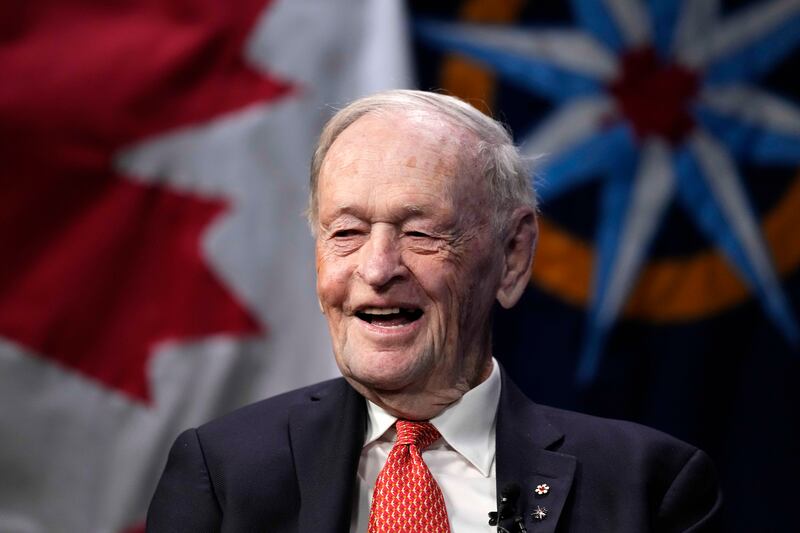
In a moment of great impact at the Gander, N.L. ceremony, Chretien received a standing ovation and a barrage of cheers when he – after reflecting on the horrors of 9/11, the aftermath, and the state of the relationship— shared a “message for our American friends.”
“Yes, Canada is a generous, open country, and Canadians are tolerant and kind. But never mistake our generosity for weakness. Never mistake our tolerance for lack of determination. And never, never mistake our kindness for softness,” he said. “We know who we are, and we are proud of it.”
“We embrace our friends and we help them in their moment of need, but we bow to no one.”