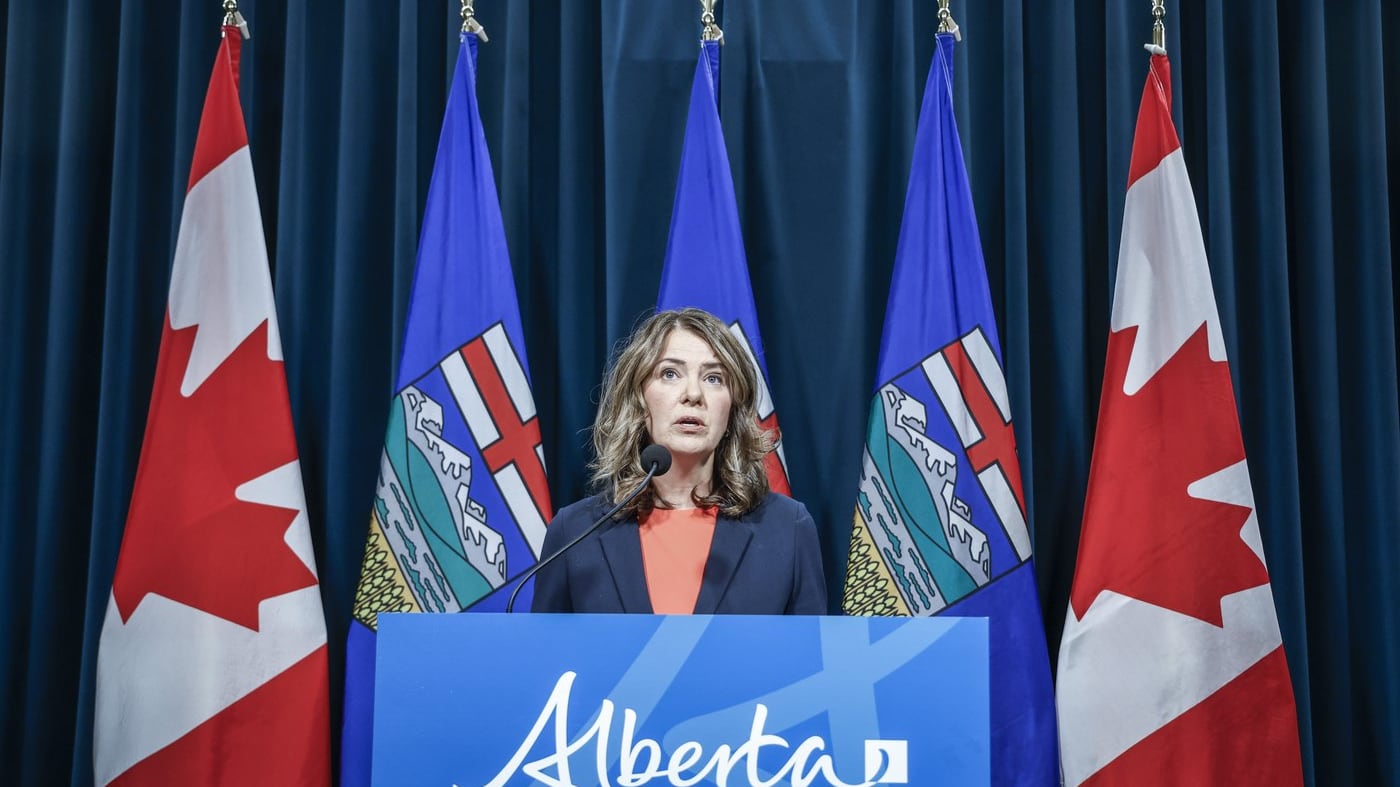
EDMONTON — Alberta Premier Danielle Smith said Saturday that it’s “unlikely” her government will launch a new Crown corporation to build out natural gas pipelines in the province.
Smith, speaking on her provincewide radio call-in program “Your Province Your Premier” on QR Calgary and 880 CHED, said the government has heard from dozens of companies struggling to access natural gas and that the province is looking at solutions, though for now those conversations are sticking to the private sector.
The premier’s comments come after a leaked report to Smith’s cabinet recommended the province move forward with legislation and create two Crown corporations to spur new natural gas transmission lines to meet the demand for oil production and artificial intelligence data centres.
Smith’s government has been working to position Alberta as an ideal location for AI data centres, which are major computing complexes that require loads of power to operate. The cabinet report says Alberta risks data centre builders going elsewhere if a quick solution for natural gas supply isn’t secured.
The Crown corporations would cost between $53.9 million and $162.6 million, according to the report, while building a new major natural gas pipeline could have a price tag in the billions.
Smith — and the report — said the issue comes down to Calgary-based TC Energy, which owns and operates much of Alberta’s natural gas transmission infrastructure. The premier called it a “monopoly.”
The report says the company’s Nova Gas Transmission Ltd. — the biggest natural gas pipeline system in Alberta — is expected to be at full capacity until 2029 with limited plans to expand after 2030.
It says TC Energy doesn’t want to invest in further capacity unless it receives returns on investment at rates similar to its projects in the United States.
Smith said it’s an “active conversation” and that she has met with TC Energy leadership and other private sector companies.
“What we’re looking at is how do we get more competition, more choice, so that we can get more gas to more people so that it can be used,” she said.
“If one player isn’t able to feed our entire market ... then we’re going to look to some of the other private providers to do it.”
Smith said she believes there’s enough private sector interest for further development that “we would very unlikely have to create a Crown corporation to do it.”
Smith also brushed off concerns from Opposition NDP leader Naheed Nenshi, who noted on Friday that the cabinet report warns government intervention could lead to higher energy prices for Albertans.
The report says that current transmission bottlenecks mean natural gas from Alberta sells at lower rates when it reaches the market, but by boosting the province’s transmission capacity it could mean Alberta’s product sells for rates seen elsewhere in North America.
A higher selling price would be good for government royalty revenue, the report says, but it could also mean that Albertans pay more on their power bills.
Smith argued Saturday that boosting the supply of natural gas is what’s needed to avoid having Albertans’ bills go up, not keeping supply constrained as it is now.
“If you have constrained gas and there’s more demand than there is supply, that’s what causes prices to go up,” Smith said.
Nenshi didn’t buy the premier’s argument, saying in a statement Saturday that Albertans’ energy bills were still at risk.
“(The report) says that the government wishes to bully private companies into building infrastructure or spend billions of taxpayer dollars doing it themselves, with the express goal of increasing the price of natural gas,” he said.
Smith didn’t rule out her government moving forward with legislation to spur new natural gas infrastructure, something the cabinet report says could land the province in court with TC Energy.
The legislation recommended in the report would look to override federally approved co-operation agreements the company has in place with another major natural gas provider in Alberta, while also allowing the government to force companies to invest in new projects if deemed in the province’s best interest.
TC Energy did not respond to questions about the report on Friday. It also didn’t immediately respond to a request for comment on Saturday.
This report by The Canadian Press was first published Sept. 12, 2026.
Jack Farrell, The Canadian Press

