Elections Alberta said Thursday it has now seen more than 500,000 requests for mail-in ballots for the Oct. 19 referendum.
The agency is expecting a record voter turnout, and the number of mail-in ballot requests has continued to climb since the application period opened in mid-July, totalling just over 509,000 to date.
The sum far surpasses the nearly 60,000 special ballots requested for Alberta’s 2023 general election, though provincial rules have since been relaxed so that voters no longer need to provide a reason to vote by mail.
The new rules led to some controversy earlier this month as some of the first voters to receive their special ballot packages for the referendum flagged concerns about a form requiring a declaration they couldn’t vote in person, or face substantial fines.
Elections Alberta had said the language was out of date and advised voters to simply cross out that section while filling out the rest of the declaration form.
A spokesperson for the agency, Maia Hanrahan, said Elections Alberta has since contacted every voter who received a package before Sept. 4 to provide more information.
Hanrahan said Elections Alberta has also been working with provincially run jails and federal institutions to ensure inmates are able to vote, which also happens through mail-in ballots.
“If their application is approved, Elections Alberta will send their special ballot package to their facility, and it will be hand-delivered to the inmate by the facility’s election liaison officer,” Hanrahan said.
She said inmates can either declare their address as where they’d be living if not incarcerated, the address of where they were arrested or the address of the courthouse where they were sentenced.
Hanrahan said because Elections Alberta doesn’t release information on who has voted, she couldn’t say how many inmates have requested ballots for the referendum. She said 413 applied to vote in the province’s 2023 general election.
Alberta’s jails, remand centres and federal prisons have a combined capacity of roughly 6,300, though each facility generally runs below capacity.
Statistics Canada put the population at provincial jails and remand centres at 3,340 as of 2023-24.
Chris Hay, the president of the John Howard Society of Alberta, said inmates should be encouraged to vote, and that it should be thought of as a way to help them reintegrate into society upon their release.
“I would take voting as not just a right, but it’s a responsibility,” said Hay, whose organization does research and public education around criminal justice issues.
“The farther you remove (inmates) from the rights and responsibilities of society, the less they’re going to feel a part of that society.”
He said without a strong sense of belonging in society, it’s more likely offenders will revert to criminal activity upon their release, “which means we didn’t contribute to public safety at all.”
Correctional Service Canada said in a statement that its election liaison officers ensure inmates are aware of their right to vote and provided the support to take part in the process.
“Alongside the support provided by election liaisons, informational posters are posted throughout the sites to ensure offenders remain aware of the upcoming referendum vote,” it said in a statement.
Hay also said another issue to consider when it comes to inmate voting, even beyond Alberta’s referendum, is remand centres, which house individuals who have yet to be convicted of a crime.
“There will be thousands of people that won’t get to vote in Canada because they are currently in (remand) at the time of voting,” he said, adding that the average length of stay is 21 days.
One solution for Alberta’s referendum, and other elections, is to establish mobile polling stations within remand centres, but Hay also said the level of staffing and other administrative issues to making it happen would probably be prohibitive.
“I think we could figure it out. Where there’s a will, there’s a way.”
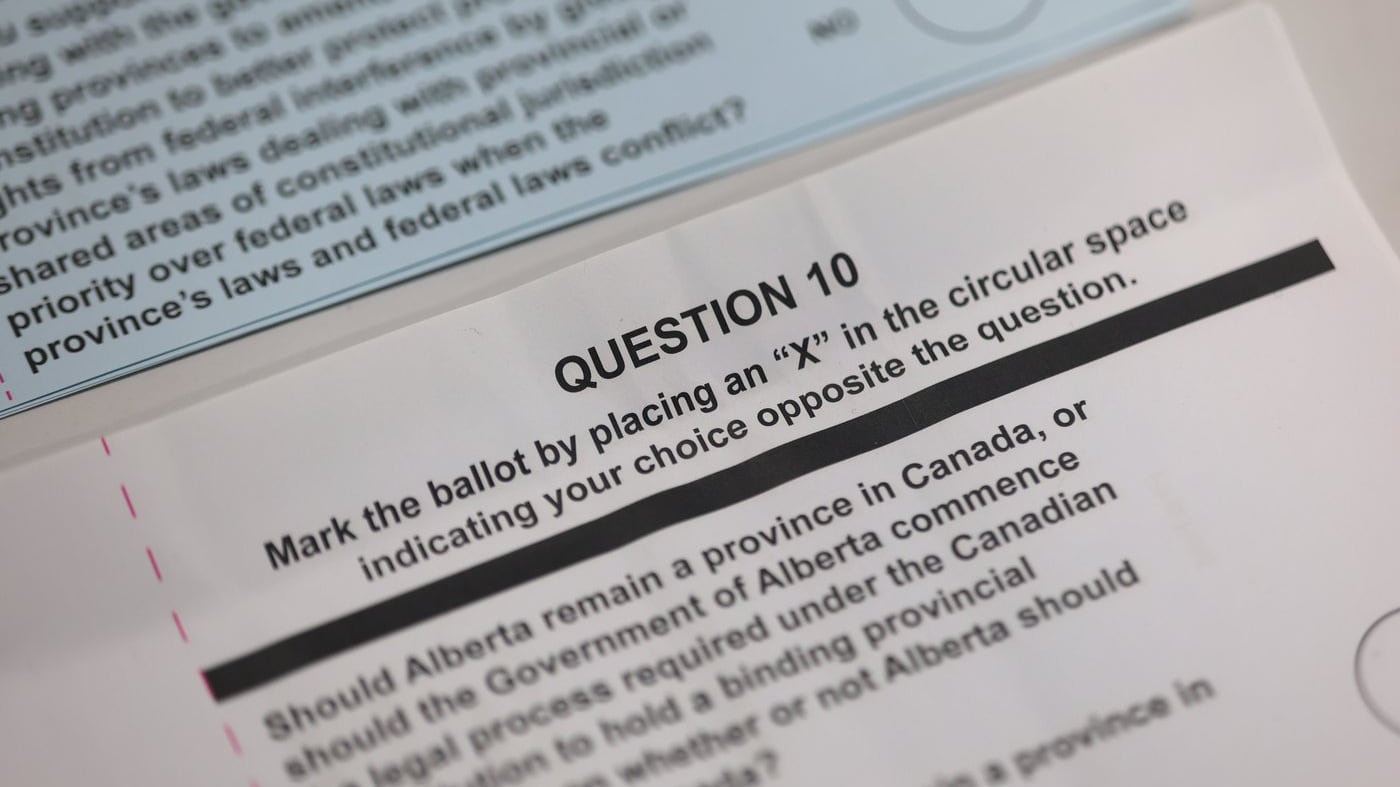
The referendum called by Premier Danielle Smith features 10 questions, including one on whether Albertans want to remain in Canada or hold a second, binding referendum on quitting Confederation.
The number of questions, alongside provincial rules requiring every ballot be hand counted, means the referendum will be the largest voting event in Alberta’s history.
To make it happen, Elections Alberta has said it needs to hire at least 60,000 workers. Hanrahan said Thursday that so far the agency has received about 48,000 applications.
She said workers are still needed in much of the province’s northern communities and ridings, including Fort McMurray, Peace River and Grande Prairie.
This report by The Canadian Press was first published Sept. 17, 2026.
Jack Farrell, The Canadian Press

