


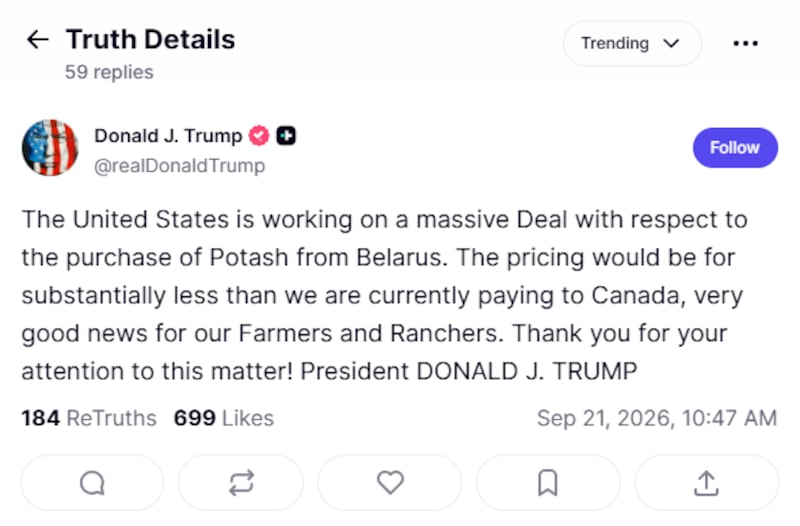
U.S. President Donald Trump says he is working on a “massive deal” to purchase potash from Belarus.
“The pricing would be for substantially less than we are currently paying to Canada, very good news for our Farmers and Ranchers,” he posted to Truth Social on Monday.
Canada is the leading exporter of potash, shipping about 22.9 million tonnes in 2024, accounting for over 39 per cent of global exports according to the Government of Canada.
The leading destination of Canadian exports of potash is the United States. The U.S. imports nearly 85 per cent of its potash from Canada.
Belarus ranks third in potash production behind Russia and Canada.
According to Belarusian media reports Monday, President Alexander Lukashenko said even if there was a desire to enter western markets, there is nothing left to supply.
Reuters reported that potash from Belarus remains under EU sanctions, and the landlocked country has been barred from exporting via the Lithuanian port of Klaipeda since February 2022.
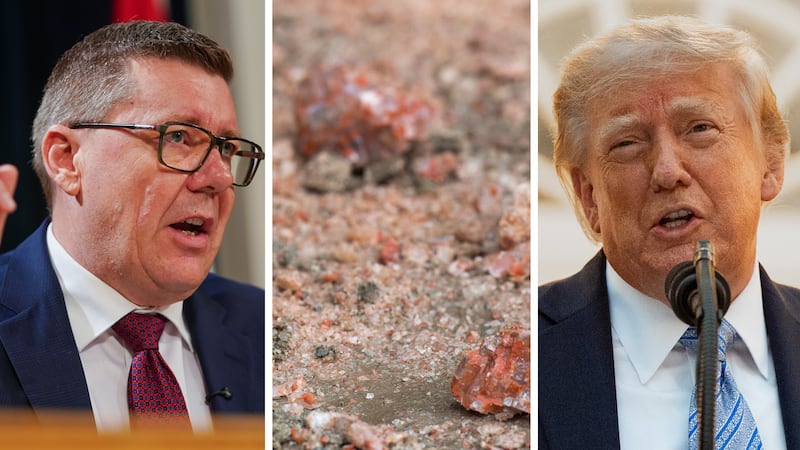
Saskatchewan Premier Scott Moe, whose province provides the U.S. with more than 86 per cent of its potash supply from Canada, said Trump’s tentative deal is “wrong and it doesn’t make sense.”
“More than 40 countries - Canada and its allies - have sanctions against Belarus for supporting war criminal Putin’s invasion of Ukraine. Buying blood potash from Belarus is supporting Russian aggression,” he posted to X Monday afternoon.
“Does anyone believe Belarusian blood potash shipped through Russia is going to be more affordable, more sustainable or more ethical than potash shipped from Saskatchewan - right here in North America?”
Potash leverage in U.S.-Canada trade war
In June, Trump told reporters that there is nothing the U.S. needs from Canada. However, U.S. Ambassador Pete Hoekstra said America needs a “tremendous amount of things” including Canadian potash, since there are “not lots of other places that you can get it.”
Canada’s premiers have been at odds about whether to leverage the critical mineral against the U.S. amid trade war tensions.
While Ontario Premier Doug Ford has previously pushed to retaliate against Trump’s tariffs by cutting U.S. access to electricity, oil and other minerals, Alberta Premier Danielle Smith and Moe said they were concerned about the long-term consequences for those industries.
Canada’s 10 active potash mines are located in Saskatchewan.
Moe has said the province would not support any kind of export taxes or withholding supply for the U.S., as losing its biggest customer would cause job losses, price hikes and a tremendous hit to the local economy.
“The United States of America, most assuredly, would switch to buying potash from other nations around the world. We would lose a long-term customer to some degree,” Moe said during trade talks.
Smith also echoed Moe in July, when she told reporters oil and potash being used as retaliatory measures is “not going to happen.”
Canadian potash has remained exempt from Trump’s tariffs amid the ongoing trade war. However, the U.S. looking to Belarus for potash supply signifies the latest escalation.
The move comes after Prime Minister Mark Carney welcomed the “ambition” to become the European Union’s first associate member, which Trump said he’ll retaliate against if he deems it to be a “hostile act.”
Belarus sanctions
The U.S., Canada and EU have all imposed sanctions on Belarus for its crackdown on human rights and for allowing its territory to be used by Russia for its full-scale invasion of Ukraine in 2022.
However, in December 2025, the U.S. agreed to lift sanctions on Belarusian potash, after Lukashenko freed 123 prisoners with the help of Trump’s envoy.
With files from The Canadian Press

