Outgoing Quebec premier Christine Fréchette spent part of the campaign Friday responding to allegations of possible interference in the provincial election.
According to media reports, a U.S. think tank allegedly proposed destabilizing Canada by proposing covert support for the separatist party, the Parti Québécois (PQ), in the Quebec election — a revelation that the PQ leader says appears suspicious given advance voting begins this weekend.
Québecor media reported Friday that a highly placed civil servant in the Fréchette government met in early September with an official from the federal government, to discuss the Defense Analyses and Research Corporation (DARC).
- See the CTVNewsMontreal.ca Quebec Election 2026 page for complete coverage
- What you need to know ahead of election day in Quebec
- Follow the party platform tracker
The federal government official gave publications from the think tank, based in Arlington, Va., and El Segundo, Calif., to the Quebec official, according to the report.
A blog post on the think tank’s website specifically mentions the Quebec election.
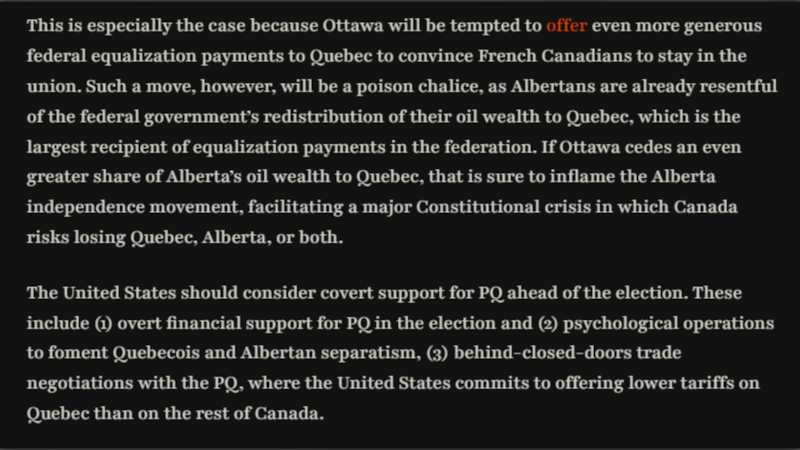
“The United States should consider covert support for PQ ahead of the election,” reads the post, published on Feb. 26, 2026.
“These include (1) overt financial support for PQ in the election and (2) psychological operations to foment Quebecois and Albertan separatism, (3) behind-closed-doors trade negotiations with the PQ, where the United States commits to offering lower tariffs on Quebec than on the rest of Canada.”
“There is nothing to lead us to believe that these allegations, these hypotheses, are true,” Fréchette said during a press conference.
She said she also raised the issue with Prime Minister Mark Carney and that her party approached Canada’s spy agency, the Canadian Security Intelligence Service (CSIS).
“That’s the procedure in this type of situation … We don’t have the tools to analyze this type of situation,” Fréchette said in a press scrum.
“For me, the situation was being handled by CSIS, but now it’s becoming public. [...] It’s becoming a matter of public interest because an article has been published.”
In a statement, CSIS told CTV News that it remains vigilant against foreign interference and espionage threats from foreign actors.
“This is why in June we proactively offered briefings on foreign interference to all political parties in Quebec,” spokesperson Eric Balsam said in an email. The agency did not provide details about being approached by the CAQ party.
Fréchette clarifies when she was informed
The media report also claimed that the Quebec government knew about the possible interference at the beginning of the year, but the CAQ leader refuted that.
“Serious information was made public today regarding the risk of foreign interference in the Quebec election. I am very concerned by what I am hearing,” Fréchette said in a post on her X account.
“One thing is certain: there is a principle that must guide us all—no one other than Quebecers will ever choose who forms their government.”
In a press scrum Friday evening, she clarified that her team informed her last Saturday about the DARC publication, but that her staff had been tipped off before she was.
“[Minister of Domestic Security] Mr. Lafrenière had been made aware of it, but he didn’t inform me,” she said.
She said her team then spoke with CSIS on Tuesday and a meeting was held with the federal spy agency on Wednesday.
She insists, however, that the matter is not closed and that “analyses are underway.” Fréchette says she still hopes to receive “clarification from the federal government.”
PQ leader questions timing
PQ leader Paul St. Pierre Plamondon questioned the timing of the information coming to light.
“There was an obligation to act promptly if there was a genuine risk. It was not done by the CAQ and then if there’s no risk and that’s why they didn’t do anything, why are they sending out this information two days before the voting?” St. Pierre Plamondon said.
Voters in Quebec head to the polls on Oct. 5.
U.S. spoke directly with Quebec about reducing tariffs: report
Fréchette also confirmed another report in Québecor that to get around negotiations with Canada during Trump’s trade war, a U.S. representative tried to meet with Quebec directly to discuss reducing certain tariffs, including those affecting aluminum — an important industry in the province.
She said when her team told her about it, she shut the door immediately, adding that it’s important to have a united front.
Canada’s foreign affairs minister, Anita Anand, reacted to the allegations on Friday, saying in Ottawa that the federal government takes the issue very seriously.
“Protecting our democracy is of the utmost importance to our country,” she said.
She said she had not received any proof of foreign interference and that when any issues arise, she will raise them with her counterparts, including U.S. Secretary of State Marco Rubio.
“Right now I have not seen the evidence,” Anand said.
With files from The Canadian Press and Noovo info

