One of Prime Minister Mark Carney’s top advisers, David Morrison, will appear before Parliament’s Standing Committee on Public Safety and National Security to answer questions about his role in granting a security clearance to an alleged NATO spy.
The date of Morrison’s appearance hasn’t yet been set.
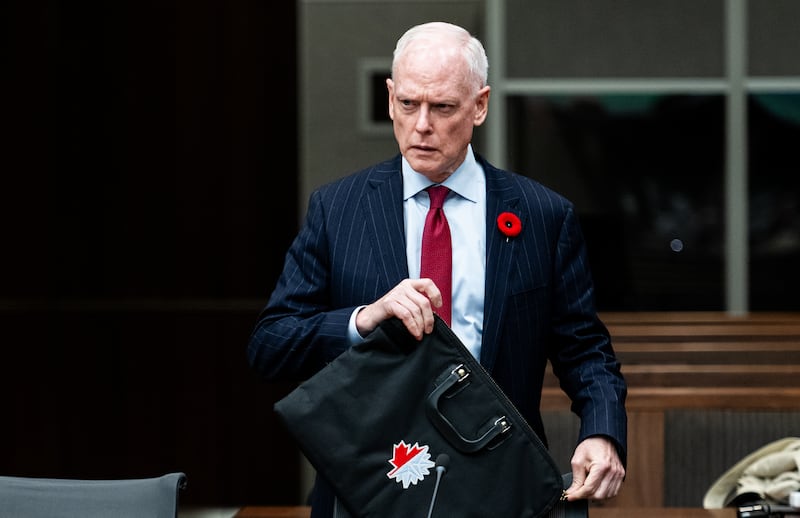
Morrison is currently the senior diplomatic and international affairs adviser to the prime minister. He also assumed the role of national security adviser when he was appointed by Carney on March 4.
According to the Privy Council Office, Morrison was in New Delhi earlier this week, discussing bilateral security and law enforcement co-operation with his Indian counterpart.
Before his promotion, Morrison served as deputy minister of foreign affairs for four years.
On Monday, during his appearance before the standing committee, Public Safety Minister Gary Anandasangaree was asked who was responsible for granting the security clearance of Canadian Biwei Zhang, enabling her to work as a NATO intern in Mons, Belgium.
Zhang is currently in custody in a Belgium jail after being charged with espionage. The federal prosecutor’s office says she’s accused of spying for a “third country” and participating in a criminal organization. Reuters has reported that the third country is China.
The Canadian Security Intelligence Service (CSIS) says that working for NATO requires at least a secret level of clearance or higher.
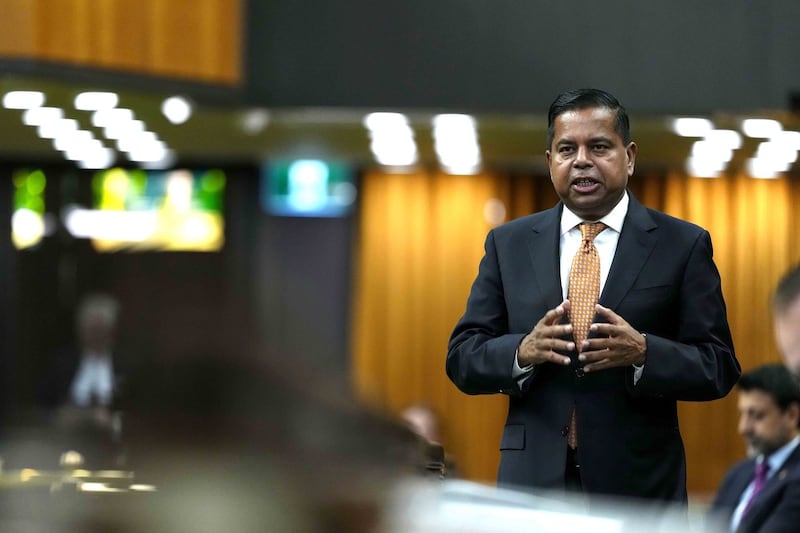
Anandasangaree said that in this particular case, “Global Affairs Canada is the ultimate provider of that security clearance based on advice from CSIS and the RCMP.”
The minister did not name names but did point to “deputy heads” of individual departments “who have accountability to make decisions on whether or not to grant clearance in their department or agency.”
Later in a scrum with reporters, Anandasangaree said that it could be “delegated authority” and that a lower-level manager, such as a director general, could be responsible for signing off on clearances.
‘Pleased to appear’
Zhang was an intern at NATO’s military command centre, the Supreme Headquarters Allied Powers Europe (SHAPE), when she was arrested on July 24.
The program only hires 35 interns annually. Facebook posts reveal that Zhang moved to Mons, Belgium, a year earlier to begin her internship in August 2025.
That time frame coincides with Morrison’s tenure at Global Affairs.
In response to a CTV News inquiry, a spokesperson from the Privy Council Office acknowledged that the senior adviser to the prime minister would appear before the parliamentary committee to answer questions about the alleged NATO spy.
“Mr. Morrison has been invited and would be pleased to appear before the Standing Committee on Public Safety and National Security … We cannot comment further while the investigation is ongoing,” David Chatrand wrote in an email.
Anandasangaree told the standing committee that the information CSIS provides in its vetting process is “relevant to the requested level of clearance,” and would look for “potential indicators linked to national security threats such as foreign influence, espionage or radicalization.”
The vetting policy is set by the Treasury Board Secretariat (TBS), which allows security clearances to be transferred between departments.
“For purposes of efficiency, saving time and consistency, government departments accept other government department’s screening decisions where it is appropriate,” said Adam Hatifeld, the executive director responsible for government security policy at TBS.
Hatfield told the committee that deputy ministers can call for a new clearance check if necessary.

Fraud discovered in past job application
Although deputy heads can decide how to assess CSIS advice, the process is unlikely to be “thick or rigorous” for an intern position with a low security clearance level, according to Wesley Wark of the Centre for International Governance Innovation.
“Should (Deputy Minister) Morrison have known better? Again, it depends on the security clearance advice provided to him and GAC (Global Affairs Canada) by CSIS, and we don’t know what that was,” said Wark, in an email exchange with CTV News.
The national security expert said that information “may or may not come out in evidence before the court in Belgium.”
Wark also points out that the vetting process would not have identified Zhang if she was turned after she arrived in Mons.
Prior to getting the NATO internship, Zhang, who graduated with degrees in systems engineering and economics, was employed full-time at Statistics Canada. She was first hired by the Government of Canada through the Federal Students Work Experience Program (FSWEP) in 2017.
The intern also did stints at the National Research Council, the Canadian Space Agency and the World Trade Organization.
There was at least one red flag in Zhang’s work history revealed in court documents.
An investigation by the Public Service Commission in 2023 found that Zhang committed fraud during the job application process for a junior analyst position at the Canada Border Services Agency by taking the application exam twice using two different names.

Anandasangaree did not say if that information was passed on to Global Affairs, but he did acknowledge “gaps” in Canada’s screening process.
The minister said that CSIS and the RCMP conduct about 200,000 screenings each year for government departments.
After the NATO spy allegations surfaced, Anandasangaree said that each department was asked to review its processes and that he’s considering a list of recommendations to improve the system.
He also told reporters that after Belgium authorities complete their investigation of Zhang, its likely Canadian law enforcement will launch their own probe.

