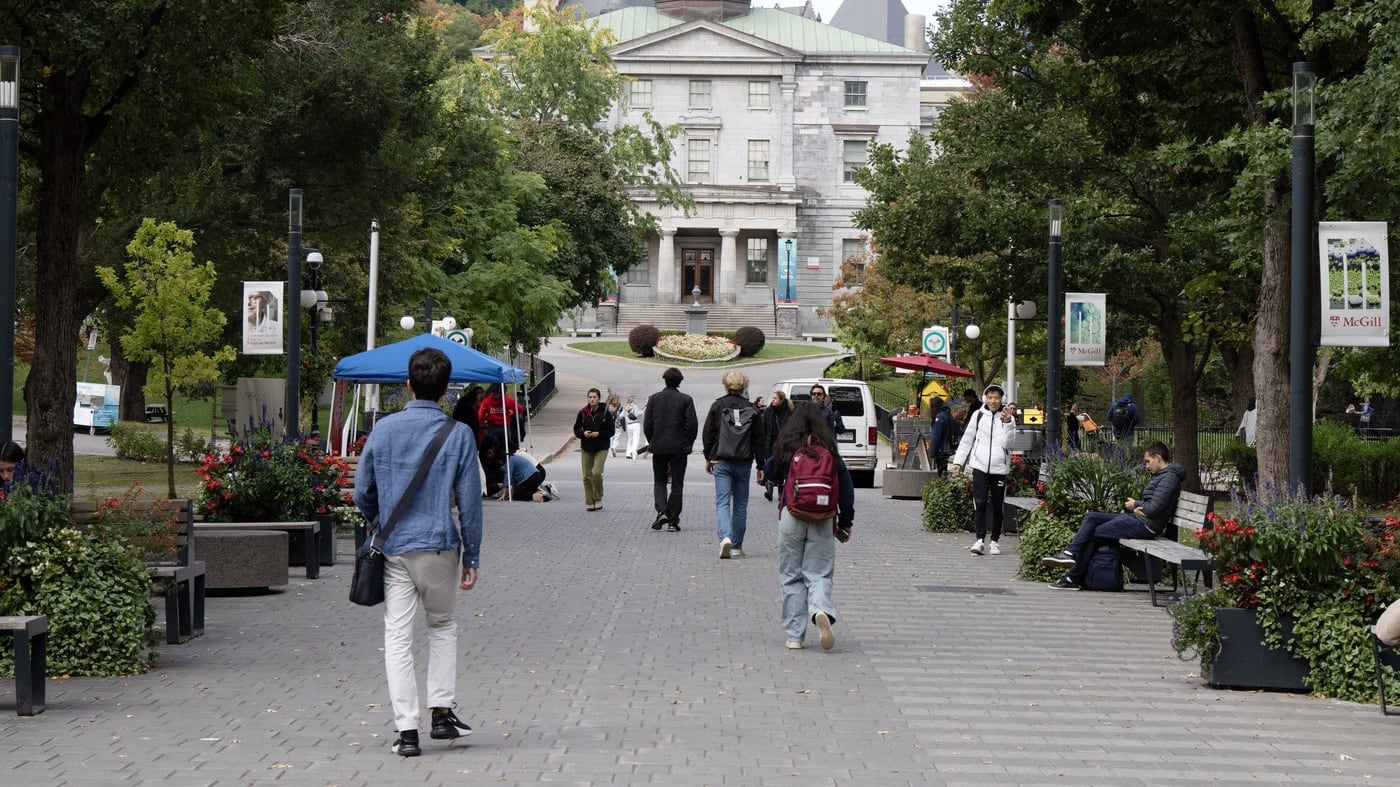
McGill University says it is reviewing its protocols after it was revealed this week that a convicted murderer is attending classes on campus, sparking safety concerns among students.
Jeffrey George Ewert, who is attending law classes and going to faculty events, was convicted of second-degree murder and attempted murder for attacks committed in British Columbia in 1984 when he was in his 20s, according to a report published Friday morning by CBC News. He is now out on parole after spending 40 years behind bars on a life sentence.
According to a 2019 Superior Court decision related to his transfer to another correctional facility reviewed by CTV News, Ewert, who is now in his 60s, met his first victim, a young woman, at a bar and offered her a ride home. He then strangled her until she lost consciousness and then sexually assaulted her. She died from the attack.
His second victim was a 15-year-old girl. He severely beat her and strangled her after she refused his advances. Believing she was dead from the attack, he threw her in a ditch and she was found the next day. She suffered significant brain damage, is now blind, and quadriplegic.
McGill committed to ‘dignity and to second chances’
In a memo sent to students Friday afternoon, McGill provost Angela Campbell acknowledged the man’s criminal past and sought to reassure the university community that it is taking the matter seriously.
“We know many members of our community, particularly in the Faculty of Law, are worried and are asking why they weren’t told more, sooner. Those concerns are legitimate. We hear them and we take them seriously,” Campbell wrote in the memo, obtained by CTV News.
- Sign up now for daily CTV News Montreal newsletters
- The information you need to know, sent directly to you: Download the CTV News App
The CBC News report stated that the man’s parole was extended for six months in June 2026 and, while some assessments ranked his risk of reoffending as “moderate to high,” parole documents said with close supervision at a halfway house and clinical follow-ups the risk would fall to the moderate level.
At the same time, the parole board reportedly expressed concern about his interactions with and attitudes toward women.
In her message to students on Friday afternoon, Campbell said the university takes security seriously and that every student has the right to study in a safe environment.
“At the same time, McGill is committed to dignity and to second chances. Our University believes in rehabilitation and in the power of education to transform lives. A past conviction does not on its own bar anyone from studying here. That commitment must always be balanced against our duty of care to the whole community,” Campbell wrote.
According to the university, Ewert has not been on campus since early October and the matter is being investigated by McGill officials, who have also reached out to Correctional Service Canada for more information.
“We are also reviewing, at a systemic level, how McGill identifies and effectively responds to situations like this one,” Campbell said, adding that privacy laws prevent the university from disclosing further information about individual students.
The CBC News article quoted students who were critical of the university for lacking transparency and putting Faculty of Law students, particularly female students, at risk. Others, however, supported the man and his efforts to improve his life and did not feel unsafe around him.
According to previous reporting on Ewert by The Canadian Press, which cited Parole Board of Canada records, board members found that he “exhibits the need to dominate and control women, emotional management issues, an explosive temperament, and distrust towards others.”
His mother was of Métis descent and his father was British. He was adopted as a baby by a non-Indigenous family in Surrey, B.C. His adoptive father was an alcoholic and his adoptive mother, who had psychiatric problems, abused him sexually, physically, and psychologically between the ages of six and 12, according to the records. He began abusing substances in his early teens.
Since his sentencing, according to another court decision, Ewert has engaged in a healing process and practised traditional Indigenous teachings that helped him deal with his anger, triggers, and substance abuse issues.
CTV News has reached out to his lawyer for comment.
Lawyer defends man’s rehabilitation efforts
Eric Sutton, a Montreal criminal defence lawyer who has no connection to the case, said one of the core principles of the Canadian justice system is that people can be released from incarceration when there is a reasonable prospect that they can benefit from rehabilitation and there is not an “undue” risk to society.
“With that in mind, there’s no point trying to have any kind of rehabilitation strategy if the intent is to tar and feather the person and stop them from doing things that will allow them to function normally in the community, such as pursuing their education, so that they can perhaps work and thrive and be useful members of the community,” Sutton said in an interview.
Sutton disagreed with the suggestion that McGill had a legal obligation to notify the school community about Ewert’s presence on campus.
“We don’t live in a perfectly safe society. We assume certain risks every time we set foot out into the public space,” he said. “I don’t agree that anyone should be singled out unless they have reason to believe that someone is actively a danger.”
Offenders who are out on parole must abide by certain conditions, he added, and that it’s up to the authorities to intervene whenever there is an alleged breach.
The McGill University Law Students’ Association declined to comment on the case on Saturday when contacted by CTV News.
With files from CTV News’ Max Harrold and The Canadian Press

